Substrate Depth for Root Plants Calculator
Size planted aquarium root depth, capped layers, slope volume, root tab zone, and anaerobic risk.
🌿Presets
📏Calculator Inputs
Calculation Breakdown
🧪Substrate Comparison Grid
📊Root Plant Group Depths
| Plant group | Typical rootable depth | Cap range | Root tab pattern |
|---|---|---|---|
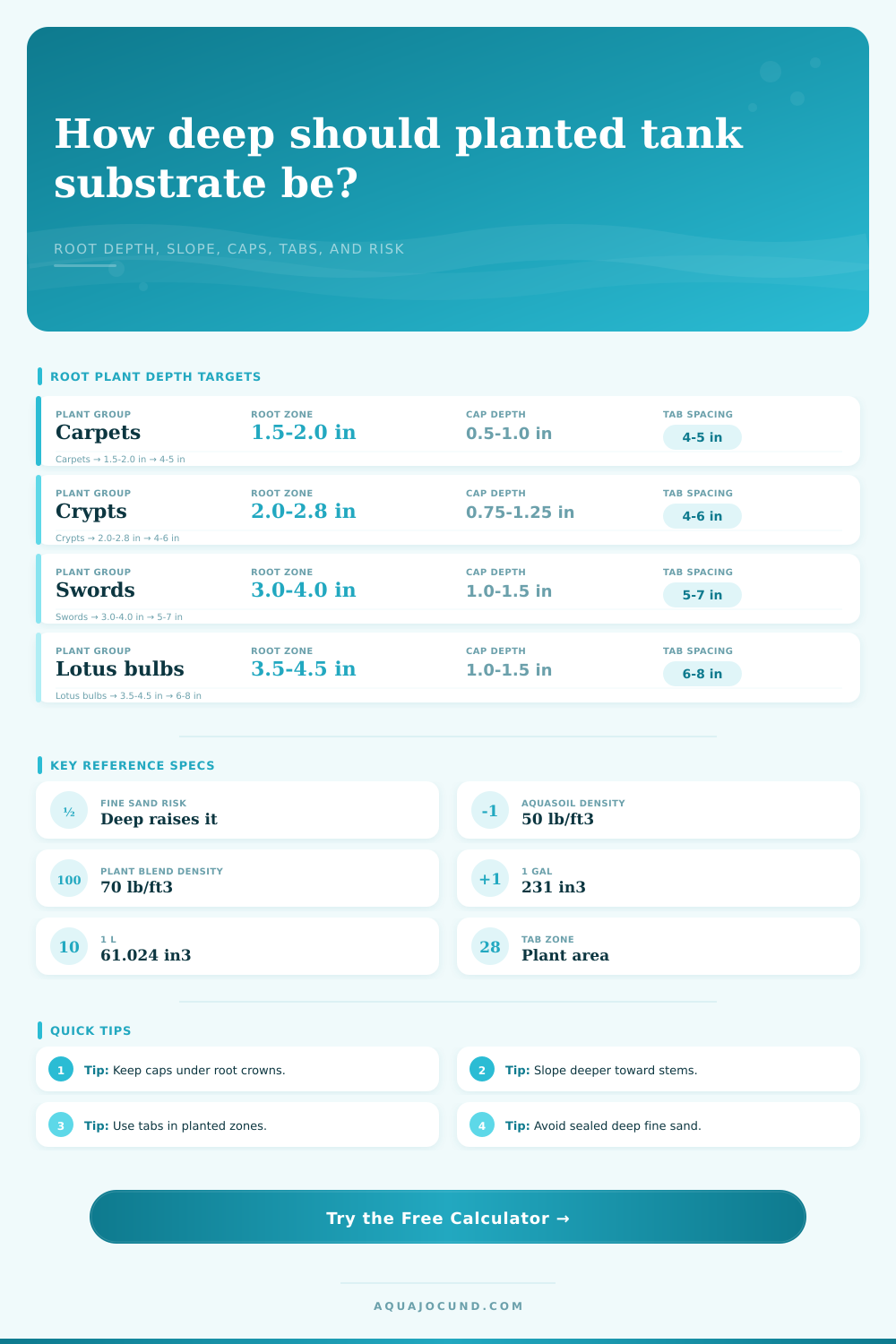
| Carpet plants | 1.5 to 2.0 in / 4 to 5 cm | 0.5 to 1.0 in | Light grid, 4 to 5 in spacing |
| Cryptocoryne and small rosettes | 2.0 to 2.8 in / 5 to 7 cm | 0.75 to 1.25 in | One tab per mature crown zone |
| Rooted stem groups | 2.0 to 3.0 in / 5 to 8 cm | 0.5 to 1.0 in | Grid only where stems are planted |
| Vallisneria and chain swords | 2.5 to 3.5 in / 6 to 9 cm | 0.75 to 1.25 in | Runner paths, 5 to 7 in spacing |
| Amazon swords and heavy rosettes | 3.0 to 4.0 in / 8 to 10 cm | 1.0 to 1.5 in | Dense tabs around crown perimeter |
| Lotus, aponogeton, and bulbs | 3.5 to 4.5 in / 9 to 11 cm | 1.0 to 1.5 in | Wide tabs beside, not under, bulbs |
📐Root Layer Substrate Comparison
| Substrate | Typical density | Aeration behavior | Depth note |
|---|---|---|---|
| Aquasoil | 50 lb/ft³ / 0.80 kg/L | Moderate porosity | Works well at 2 to 4 in planted slopes |
| Plant substrate blend | 70 lb/ft³ / 1.12 kg/L | Moderate porosity | Good all-purpose root layer |
| Fine aquarium gravel | 92 lb/ft³ / 1.47 kg/L | Open pore spaces | Lower anaerobic risk when vacuumed lightly |
| Fine sand | 100 lb/ft³ / 1.60 kg/L | Tighter pore spaces | Keep deep zones planted or interrupted |
| Pool filter sand | 95 lb/ft³ / 1.52 kg/L | Medium pore spaces | Stable cap when not too deep |
| Mineralized soil under cap | 60 lb/ft³ / 0.96 kg/L | Needs a cap | Watch excessive cap plus soil depth |
| Lava rock base blend | 45 lb/ft³ / 0.72 kg/L | High porosity | Useful under very deep background slopes |
| Laterite clay mix | 80 lb/ft³ / 1.28 kg/L | Compact when overused | Use as a blend, not the whole deep bed |
📏Common Planted Tank Estimates
| Tank | Footprint | Root zone target | Typical root layer amount |
|---|---|---|---|
| 10 gallon carpet | 20 x 10 in / 51 x 25 cm | 1.5 in rootable | 1.3 gal / 4.9 L aquasoil zone |
| 20 long crypt bed | 30 x 12 in / 76 x 30 cm | 2.25 in rootable | 3.5 gal / 13 L planted zone |
| 29 gallon sword row | 30 x 12 in / 76 x 30 cm | 3.0 in rootable | 4.7 gal / 18 L background zone |
| 40 breeder jungle | 36 x 18 in / 91 x 46 cm | 3.0 in rootable | 8.4 gal / 32 L heavy planting |
| 55 gallon slope | 48 x 13 in / 122 x 33 cm | 2.5 in rootable | 6.8 gal / 26 L rear band |
| 75 gallon mixed roots | 48 x 18 in / 122 x 46 cm | 3.0 in rootable | 11.2 gal / 42 L broad zone |
🧮Formula and Risk Reference
| Item | Formula | Purpose | Result used |
|---|---|---|---|
| Average finished depth | (front + back) / 2 | Models a front-to-back planted slope | Total substrate volume |
| Rootable depth | average depth - cap depth | Depth roots can actually use | Depth card and gap warning |
| Root tab zone | footprint x planted coverage | Area receiving tabs | Tab count card |
| Anaerobic risk | depth + cap + texture - aeration - disturbance | Flags sealed deep fine beds | Risk card |
💡Practical Tips
The wrong substrate will make your tank appear barren, even if you spend a fortune on fancy lights and CO2 gear. Roots need enough depth to breathe and access nutrients so they don’t end up starving in a crowded room. The right substrate create a lush green carpet, whereas the wrong one results in patches of growth.
After selecting which plants you’d like to grow and entering your tank dimensions, the calculator figure out the rest. That way you don’t have to guess at the number of substrate bag you need.
How to Choose the Right Substrate Depth
Certain plant species prefer to be planted shallowly, while others enjoy being buried deep within the soil. For example, dwarf hairgrass prefers to be rooted in a shallow bed (no more than a couple inches) of active substrate. Pushing this plant any further will cause it to rot. Bulb plants such as lotus and big Amazon swords is best planted in 3-4 inches of loose substrate rich with nutrients. If they aren’t planted deep enough, they’ll pull free from the substrate.
A cap is the inert layer of gravel or sand covering active soil, which provides cap depth. Cap depth ensure the roots can access nutrients but keeps the dirt out of the water. Too little cap depth means your water will be cloudy. Too much cap depth means no roots gets down into the soil. About a 1/4-1/2″ deep is good. It should of be enough to contain the mess without blocking the roots.
Deep beds of fine sand create areas without oxygen that encourage bad bacteria to grow. That produce hydrogen sulfide (rotten egg smell), and it’s not good for fish. To flag this issue, the tool consider both depth and type of substrate. To keep a deep bed of sand oxygenated, you’ll need sufficient current. Or, use a course base layer, and/or break up the depth with hardscape. This little piece of structure avoid a major cleanup down the road.
The sloped ground provide visual interest as well as functional diversity. Without a slope, your plant choices is limited by a flat floor. By making the rear area deeper, you can have areas for different types of plants. Put carpeting in the shallow front and tall stemmed things in the rear where it’s deeper.
When calculating total substrate volume, calculator takes into account that your tank may be sloped. That way you purchase enough substrate to cover the whole footprint.
The calculator will also help you know how much root tab supplements you’ll need. If you’re using inert gravel, you’ll have to provide nutrient supplementation yourself. Root tabs release nutrients gradually. How spaced out do you put them? Too far apart and your plants doesn’t get what they need. Too close together and you’re wasting money.
The substrate gets compacted, especially with plants and regular water flow. If you don’t account for that, you’ll end up with less than expected after a few days. A little compaction can make the difference between what you planned and what ends up being built.
Planning is key to building a planted tank. So is patience. The correct mix and depth will help set you on path for the rest.