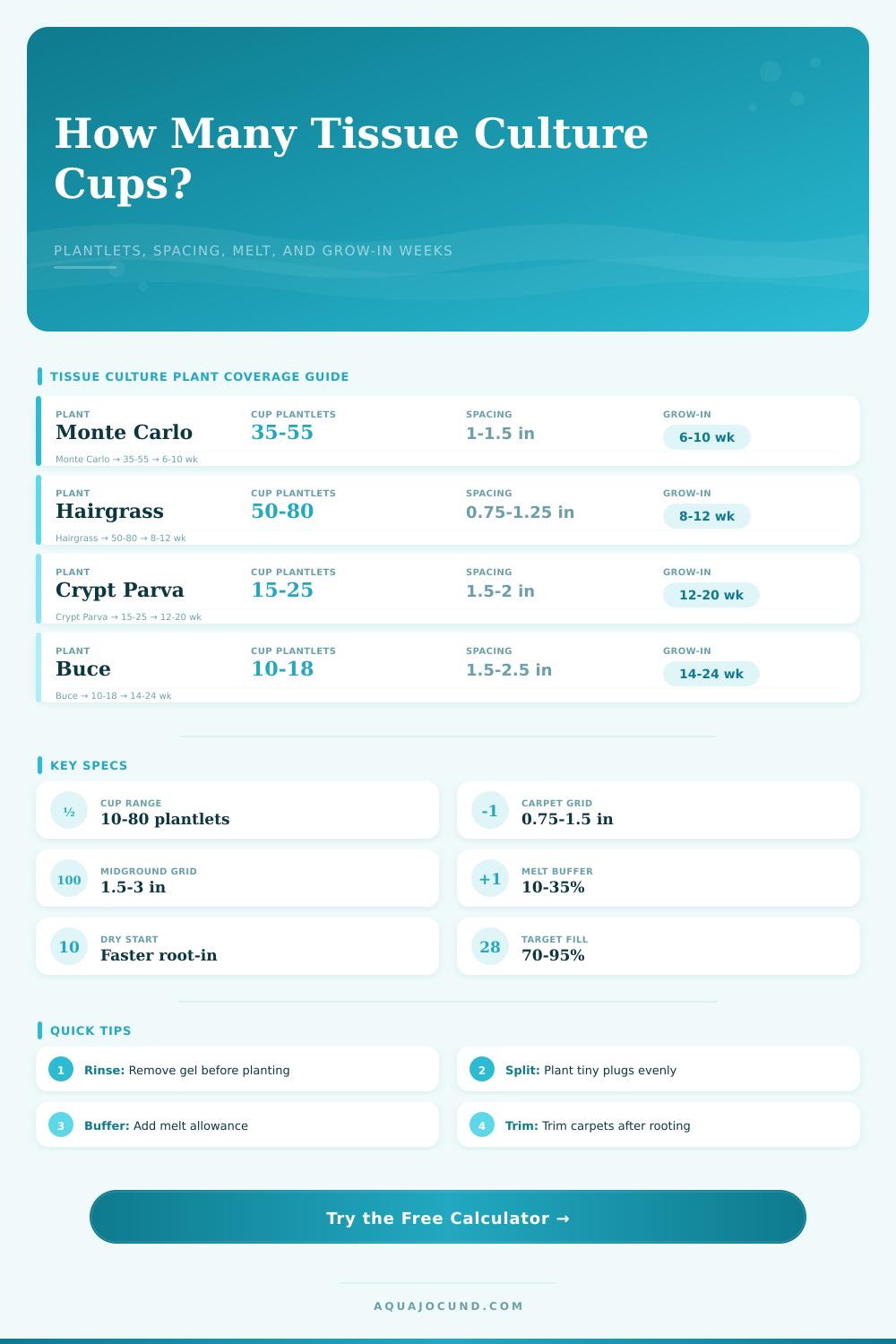
🌱 Tissue Culture Plant Coverage Calculator
Estimate tissue culture cups, usable plantlets, foreground and midground coverage area, planting grid spacing, melt allowance, and grow-in weeks.
| Plant Type | Usable Plantlets Per Cup | Foreground Spacing | Midground Spacing | Base Grow-In |
|---|---|---|---|---|
| Monte Carlo | 35 to 55 | 1 to 1.5 in / 2.5 to 3.8 cm | 1.5 to 2 in / 3.8 to 5 cm | 6 to 10 weeks |
| Dwarf hairgrass | 50 to 80 | 0.75 to 1.25 in / 1.9 to 3.2 cm | 1.25 to 1.75 in / 3.2 to 4.4 cm | 8 to 12 weeks |
| Glossostigma | 35 to 60 | 0.75 to 1.25 in / 1.9 to 3.2 cm | 1.25 to 1.75 in / 3.2 to 4.4 cm | 5 to 9 weeks |
| HC Cuba | 45 to 70 | 0.5 to 1 in / 1.3 to 2.5 cm | 1 to 1.5 in / 2.5 to 3.8 cm | 8 to 14 weeks |
| Pearl weed | 30 to 50 | 1 to 1.5 in / 2.5 to 3.8 cm | 1.5 to 2.5 in / 3.8 to 6.4 cm | 4 to 8 weeks |
| Crypt parva | 15 to 25 | 1.5 to 2 in / 3.8 to 5 cm | 2 to 3 in / 5 to 7.6 cm | 12 to 20 weeks |
| Staurogyne repens | 18 to 35 | 1.25 to 1.75 in / 3.2 to 4.4 cm | 2 to 3 in / 5 to 7.6 cm | 7 to 12 weeks |
| Bucephalandra | 10 to 18 | Not usually carpeted | 1.5 to 2.5 in / 3.8 to 6.4 cm | 14 to 24 weeks |
| Tank | Footprint | 70% Plantable Area | Typical Carpet Cups | Typical Mixed Cups |
|---|---|---|---|---|
| 5 gal | 16 x 8 in / 41 x 20 cm | 90 sq in / 581 sq cm | 2 to 4 cups | 1 to 3 cups |
| 10 gal | 20 x 10 in / 51 x 25 cm | 140 sq in / 903 sq cm | 3 to 6 cups | 2 to 4 cups |
| 20 long | 30 x 12 in / 76 x 30 cm | 252 sq in / 1626 sq cm | 5 to 10 cups | 3 to 6 cups |
| 40 breeder | 36 x 18 in / 91 x 46 cm | 454 sq in / 2929 sq cm | 9 to 18 cups | 5 to 10 cups |
| 75 gal | 48 x 18 in / 122 x 46 cm | 605 sq in / 3903 sq cm | 12 to 24 cups | 7 to 14 cups |
| Setting | Multiplier | Best For | Tradeoff |
|---|---|---|---|
| Open grid | 0.80x plantlets | Low budget, patient grow-in, slow carpeting | More open substrate at the start |
| Standard grid | 1.00x plantlets | Most aquascapes with balanced light and nutrients | Normal grow-in pace |
| Dense start | 1.25x plantlets | Faster fill and fewer bare spots | Needs more cups and careful planting |
| Contest start | 1.50x plantlets | Fastest visual coverage with CO2 and trimming | Higher melt risk if circulation is poor |
| Condition | Growth Factor | Melt Planning | Coverage Note |
|---|---|---|---|
| Low tech | 0.75x speed | Use 20 to 35% melt allowance | Expect slower runners and longer open patches |
| Balanced planted tank | 1.00x speed | Use 15 to 25% melt allowance | Good default for most tissue culture starts |
| CO2 enriched | 1.25x speed | Use 10 to 20% melt allowance | Faster fill if nutrients and trimming are steady |
| Dry start | 1.35x root-in speed | Use 5 to 15% melt allowance before flooding | Strong rooting, but transition melt can still occur |
Aquascaping is supposed to be fun. Your plants arrive, your hardscape arrives, your layout is complete, and now all you have to do is get everything planted and wait. You plant things and then…you wait. You wait and then you notice that most of what you’ve planted has melted down or died off as it adjusts to its new underwater home. Every aquarist go through this rite of passage.
While it’s not exactly fun, seeing bald spots on the substrate feel more like bad luck than anything else. The truth is, a little die-off isn’t normal (it’s expected and even needed), to achieve a lush, full carpet over time.
How to Plant Your Aquarium Successfully
One common error made by most newbies is planting their tissue culture plants as if they were planting them in the garden. Here’s a big clump, there’s another big clump. They hope that plant will fill in the gaps. Nope. Unless you have a lot of space between them, aquatic plants doesn’t grow out; they grow up, and if they have open space, guess what comes in? Algae does. That’s why it’s not just about how many plants you buy, but also where you put them. It’s not a scattering, it’s a grid.
And that tool (above) helps convert your tank size to a realistic planting plan, with the built-in ability to accommodate the inevitable initial melt and still end up with a full look…without having to buy fifty cups of Monte Carlo you don’t need. The melt allowance input is something I think you want to pay particular attention to. It’s not a penalty fee; it’s your plant’s biological buffer.
The reason is that they grow tissue culture plants in agar or gel, that’s great for preserving them, but horrible for their instant ability to adapt under water. They has to expend some of their energy adjusting from survival mode (in gel) to growing roots in soil. Unfortunately, during this adjustment period, old leaves tend to dissolve so they can fuel new root growth. Planting at 100% expectation that you won’t lose any means you’ll be disappointed. If you add 20-30% of that, you are adding enough up-front to cover the purchase of a few additional cups. This prevents you from having to run around like crazy buying more because you notice your foreground is not spreading quite as fast then thinning out.
Substrate also plays into it. Active soils such as aquasoils gives roots instant nutrition. These delicate plants will also be able to anchor much more quickly than they would in an inactive substrate (e.g., gravel or sand). In particular, if you’re going the sand route, you’ll want to lean heavier on the melt allowance and maybe even consider starting a little more densely. Why? Because the estimate for how long it takes the plants to get established factors in the substrate selection in the calculator.
Time is a finite resource, and you can’t top it up. Starting out with a dense carpet of baby leaves and active soil may look bad initially (too many small leaves!). But in just six weeks, it will be a seamless carpet. Starting out sparse but neat on day one means having bare patches and being susceptible to algae infestation by week eight.
Similarly, consider whether or not you’ll attempt a dry start method. You’ll want to keep the substrate wet (but not flooded) for several weeks while the plants is growing above water; this greatly minimizes the shock of being submerged. Depending on what you’re planting, you can safely reduce the amount of melt by quite a bit, as well… Since the roots will be established long before the plant has to deal with the combined forces of light refraction and water pressure. The tables provided here are a starting point for understanding how various species will respond to a dry start situation.
Hairgrass may take up to 12 weeks to reach full coverage in a traditional low tech tank, but it will shorten that time frame if you’ve got a balanced nutrient system and some form of CO2 injection.
The bottom line: Trust the process, don’t fight it. When you’re counting pennies and plantlets, it feels wasteful to plant so densely. But then you spend months replanting dead spots and trimming algae. If you can’t see the biology, just look at the math (there’s no contest here). There are enough starting points so they meet up before the algae does.
This isn’t rocket science…until you realize that the melt is your friend, not your enemy. After that, the entire planning phase becomes less stressful. You buy what you need, you plant with purpose, and you let the weeks do their work. Temporary looks like bare substrate; intentional looks like full carpet. This is the difference between creating a result versus hoping for one.