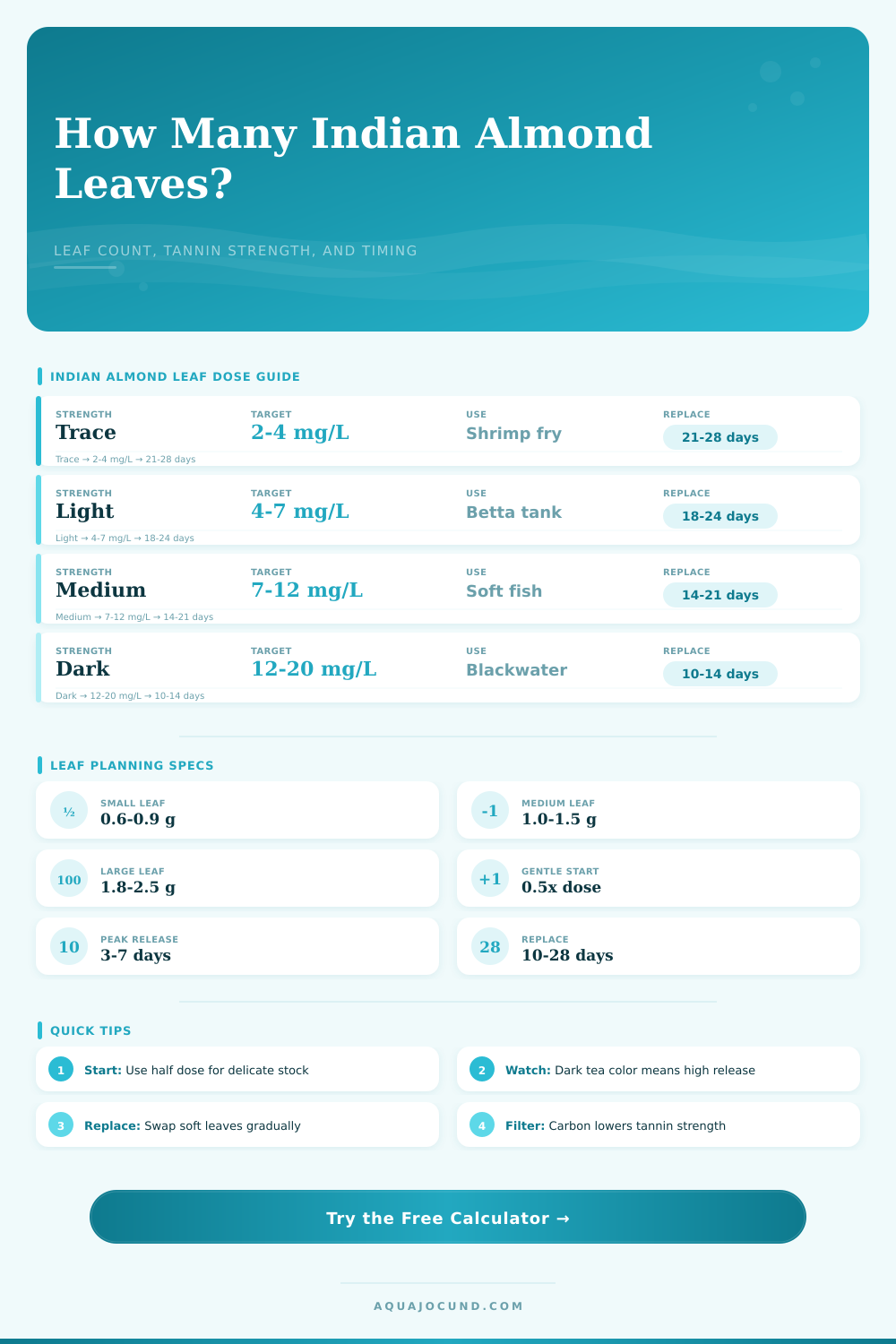
Indian Almond Leaf Quantity Calculator
Estimate how many catappa leaves to use from tank volume, leaf dry weight, tannin target, stock sensitivity, and replacement interval.
Calculation Breakdown
| Leaf size | Typical dry weight | Release estimate | Best use |
|---|---|---|---|
| Small whole leaf | 0.6-0.9 g | 55 mg/g | Nano tanks, shrimp, fry |
| Medium whole leaf | 1.0-1.5 g | 62 mg/g | Betta tanks, 10-20 gal |
| Large whole leaf | 1.8-2.5 g | 68 mg/g | 20-55 gal tanks |
| Extra large leaf | 2.6-3.5 g | 72 mg/g | Large displays |
| Broken or crushed leaf | 0.5-1.0 g portion | 58-75 mg/g | Fast tint control |
| Setting | Multiplier | What it means | Use carefully with |
|---|---|---|---|
| Hardwater stock | 0.55x | Very gentle organic load | Mystery snails, livebearers |
| Shrimp or fry | 0.65x | Slow introduction | New colonies, tiny fry |
| Betta or softwater | 1.00x | Common catappa dose | Low KH tanks |
| Blackwater specialist | 1.30x | Darker tannin profile | Uncycled or unstable tanks |
| Tank | Dimensions | Volume | Light leaf dose |
|---|---|---|---|
| 5 gal nano | 16 x 8 x 10 in / 41 x 20 x 25 cm | 19 L | 0.5-1 small leaf |
| 10 gal standard | 20 x 10 x 12 in / 51 x 25 x 30 cm | 38 L | 1 medium leaf |
| 20 gal long | 30 x 12 x 12 in / 76 x 30 x 30 cm | 76 L | 1-2 large leaves |
| 40 breeder | 36 x 18 x 16 in / 91 x 46 x 41 cm | 151 L | 3-4 large leaves |
| 75 gal | 48 x 18 x 21 in / 122 x 46 x 53 cm | 284 L | 5-7 large leaves |
| Interval | Release profile | Best for | Planning note |
|---|---|---|---|
| 10 days | Strong, steady refresh | Dark blackwater displays | Remove old soft leaves early |
| 14 days | Normal peak and taper | Betta and softwater tanks | Most predictable schedule |
| 21 days | Gentle long taper | Shrimp, fry, low-load tanks | Overlap partial replacements |
| 28 days | Light maintenance tint | Large stable aquariums | Expect weaker color late |
Within 48 hours, you notice that the water has turned color of strong tea after dropping some Indian almond leaves into your tank. It appears drastic. Panic! Often, your response are to remove the leaves and perform a massive water change. The reality isn’t as dramatic. You just overdid it with tannins. Why? Because you guessed rather then calculated. To avoid this outcome, dosing precisely is key. It turns an organic supplement into a beneficial water conditioner instead of visual hazard.
This method copies blackwater rivers found in Southeast Asia. That’s the problem; catappa leaves aren’t uniform like manufactured chemicals. Two leaves of identical length can varies wildly in dry weight, surface area, and tannin density. Two leaves of identical length can vary wildly in dry weight, surface area, and tannin density. That’s why I built the calculator (above), it does all math for you so you know how many leaves to use. Simply pick the tank size, decide your desired level of tannins, and tweak for livestock sensitivities.
How to Use the Right Amount of Leaves
The calculator will give you a recommended number… But not an arbitrary number. Instead of “one leaf per gallon” (which doesn’t take into account volume of the tank nor the size of the leaf), it gives you a recommended dry mass. The second reason is dry weight. Tannins is released based off both the internal structure of the leaf as well as its surface area. For example, two big leaves with lots of pith may not release as many tannins compared to two little leaves that are packed with goodness. To account for this, we have you weigh your leaves (or choose a size category) so that you is working with actual amounts.
The third reason is replacement intervals. Replacement is used as a variable, too. Do you want some tannins? Leave it in for 28 days. It’ll still tint but more slowly. Want a strong, steady tint? Swap out every ten days. That’s the tradeoff. You get more tannin strength with more maintenance effort. Most hobbyists don’t think about that tradeoff until their water start becoming unpredictable in clarity.
There’s also the sensitivity factor, which completely alters the dosage. For example, certain species like shrimp fry and delicate neon tetras is quite sensitive, while hardwater fish like guppies or mollies don’t need high tannin levels. Neon tetra fry and similar shrimp fry are great in soft water with lots of tannins but dont respond well to abrupt changes. In that case, the calculator will decreases the dose so it won’t shock them. On the other hand, if you have some hard water fish such as mollies or guppies, they don’t need much tannin at all. You’re just staining your tank walls by adding too many leaves that aren’t serving any biological purpose at all. Knowing where your fish come from can help you decide how much color you want… From a very slight tea-colored tint up to a very dark amber tint.
Surprisingly enough, filtration also factor into these equations. Activated carbon, which many fish keepers use to maintain crystal-clear water, aggressively removes tannins. You’re literally fighting yourself if you want to create blackwater and are running heavy chemical filtration. To account for this, the calculator will up the recommended dose if you have any type of chemical filtration (i.e., resins, active carbon) in your loop. It makes you face the fact that the media you’re using to remove stuff is actualy working against what you want to add.
At the end of the day: watching and waiting is the name of the game with Indian almond leaves. Nothing changes immediately. You won’t notice anything until the leaves has hydrated and started releasing their color. Don’t assume nothing’s happening if the color doesn’t change right away. Let the water cycle through and wait a couple days. If it’s still really light, add some more. If it turns too dark, take out half of the leaves. The color change won’t happen overnight like making a magic potion, but rather builds over time to grow a sustainable healthy environment that promotes long term health in your livestock.
Go easier on your first try then you think is necessary. You could of always added another leaf. Once your tank looks like a glass of iced tea though…good luck trying to unwind that.