Aragonite Buffer Calculator
Estimate aragonite media mass, KH support, flow exposure, dissolution rate, and replacement interval.
🐟Presets
⚙Tank And Buffer Inputs
🧪Selected Media Snapshot
📊Aragonite Media Comparison
| Media type | Grain size | Bulk density | Relative dissolution | Best placement |
|---|---|---|---|---|
| Oolitic aragonite sand | 0.2-1 mm | 1.35 kg/L | Fastest | Fine media bag, low flow |
| Fine aragonite | 0.5-1.5 mm | 1.40 kg/L | Fast | Filter cup or mesh bag |
| Crushed coral | 1-3 mm | 1.48 kg/L | Medium | Canister basket |
| Reactor aragonite | 3-5 mm | 1.55 kg/L | Controlled | Media reactor |
| Coral rubble | 5-12 mm | 1.25 kg/L | Slow | Sump tray |
| Shell grit blend | 2-6 mm | 1.30 kg/L | Slow-medium | Bag or basket |
| Mixed aragonite bed | 1-8 mm | 1.45 kg/L | Medium | Passive chamber |
| Calcite-aragonite blend | 2-4 mm | 1.60 kg/L | Slowest | High pH systems |
📏Common Tank Reference
| Tank | Dimensions | Volume | Typical media | Common placement |
|---|---|---|---|---|
| 10 gallon | 20 × 10 × 12 in / 51 × 25 × 30 cm | 38 L | 0.2-0.5 lb | Small mesh bag |
| 20 long | 30 × 12 × 12 in / 76 × 30 × 30 cm | 76 L | 0.4-1.0 lb | Hang-on filter |
| 40 breeder | 36 × 18 × 16 in / 91 × 46 × 41 cm | 151 L | 0.8-2.0 lb | Canister basket |
| 55 gallon | 48 × 13 × 21 in / 122 × 33 × 53 cm | 208 L | 1.1-2.8 lb | Canister or sump |
| 75 gallon | 48 × 18 × 21 in / 122 × 46 × 53 cm | 284 L | 1.5-4.0 lb | Reactor or tray |
| 125 gallon | 72 × 18 × 21 in / 183 × 46 × 53 cm | 473 L | 2.5-6.5 lb | Sump chamber |
⚗KH And Dissolution Factors
| Factor | Low | Medium | High | Calculator effect |
|---|---|---|---|---|
| KH gap | 0-1 dKH | 2-4 dKH | 5+ dKH | Raises daily support need |
| pH | 8.2+ | 7.6-8.1 | Below 7.5 | Lower pH dissolves more media |
| Flow exposure | Bag | Basket | Reactor | Changes active surface contact |
| Grain size | Rubble | Crushed | Fine | Smaller grain reacts faster |
| Reserve | 10% | 25% | 60% | Adds media for longer service |
📘Conversion Reference
| Measure | Conversion | Use in calculator | Notes |
|---|---|---|---|
| 1 dKH | 17.848 mg/L as CaCO3 | KH support load | Carbonate alkalinity equivalent |
| 1 gallon | 3.78541 liters | Tank volume | US liquid gallon |
| 1 kg | 2.20462 lb | Media mass | Dry media estimate |
| 1 liter media | 1.25-1.60 kg | Chamber fill | Varies by grain and packing |
The other point about water chemistry is that it constantly change, particularly if your goal is to maintain consistent carbonate hardness while only dosing occasionaly. If your test results indicates your pH has dropped slightly over several days, or your alkalinity seem to be decreasing steadily despite using test strips, this isn’t necessarily cause for alarm; it’s actualy an indication that your buffer system is doing its job. Because aragonite serves as a reservoir of sorts, it dissolves gradualy and refills whatever is being consumed by biological activity.
The trick is adding sufficient amount of buffering capacity without exceeding the threshold where spikes occur rapidly enough to affect sensitive livestock. It’s a fine balance, one which demand more of a gut feeling than basic math.
How to Use the Calculator Correctly
Once you enter in your current water parameters and tank dimensions, this will calculates exactly what amount of media is required to close that gap (see above). If you don’t dose enough, you’ll deal with continued fluctuations. But if you do too much, it might climb to an unhealthful level. Some fish aren’t fond of high pH. So dosing correctly mean calculating correctly.
Once you put your current KH and target KH into those boxes, the system calculates exactly how far off (the alkalinity deficit) you are. It is not just an estimate. It’s telling you how much chemical demand there is in the water volume that exist in your tank.
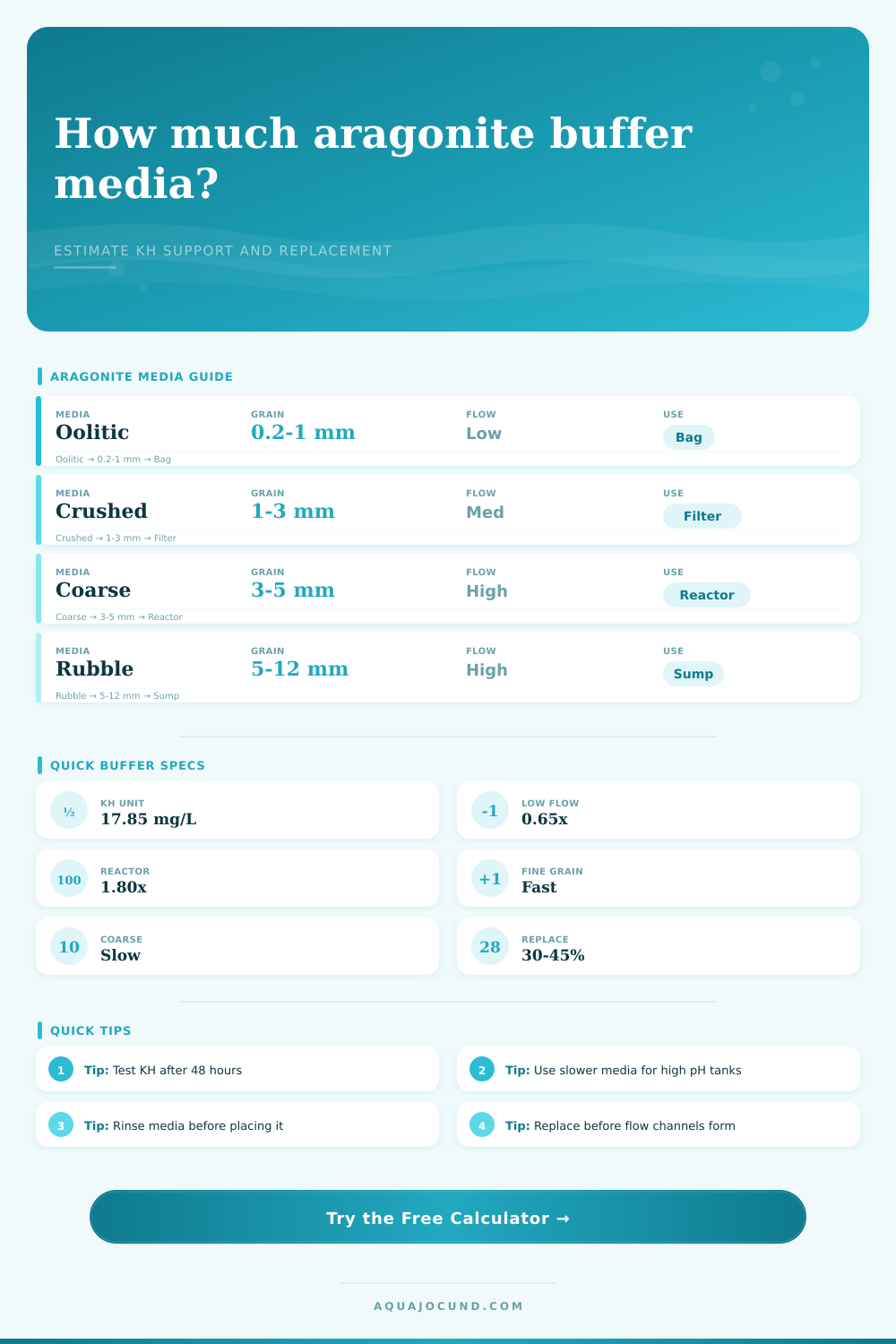
The speed at which that buffer dissolves depend heavily based off grain size. A huge surface area in fine sands mean rapid reaction with the water. That’s great for an immediate fix, but not good for long term stability as the sand dissolve too quickly. On the other extreme is coarse rubble that take far longer to break down and gently releases carbonate over time.
Your choice of media type feeds into the calculator and help adjust its estimate of dissolution rates. It knows that if you pick a fine oolitic sand for your low flow filter bag, it has a high surface contact. However, if you pick a high-flow setup and use coarse reactor aragonite, it knows that greater turbulence will make up for the larger grain size.
Knowing this tradeoff is important to avoid channeling, which is when water take the path of least resistance through your media bed and bypasses everything else. The other important variable most hobbyists forget about is flow exposure. Stagnant water surrounding the media won’t dissolve it well. High velocity water rushing through a reactor strip out minerals more aggressively.
The preset buttons on the interface provide some visual aids for this by showing the relationship between typical media mass and different tank sizes. For example, a small mesh bag of fine media will do just fine for ten gallon shrimp tank, whereas a seventy-five gallon reef system would require far more mass to keep up with all the coral uptake. Though these presets can be good starting places, they aren’t set in stone. How fast you consume your buffer will depend on your specific feeding habit and actual biological load.
The strategy is to replace media before it is fully used up. Dissolving aragonite shrinks and may lose structural integrity. Letting it go halfway will leave only some pieces, so they might wash out or crumble, dropping your KH all at once. Typically, about thirty to forty percent loss is the recommended interval for replacement (as indicated by the calculator), ensuring a consistent level of buffering power during the entire cycle. Otherwise, the media bed will form hollow channels over time, diminuishing its surface area.
There’s no rush. I always test within 48 hours. It takes time for the water chemistry to level out, and aragonite doesn’t dissolve right away. Adding more media too soon could of cause you to overshoot your desired pH. Part of the process is patience.
Within the tool itself are reference tables that show you the different media types relative to each other in terms of dissolution rate and density. These will help you determine if you require something like sand (fast acting) or rubble (slow dissolving), based on your particular tank setup.
A healthy tank start with stable water parameters. Stress comes in many forms, and fluctuations is one of them. They weakens immune systems and invite disease. A calculated approach to buffering take the guesswork out of maintenance. It moves you from reacting to problems to preventing them. It’s not about hitting a number on a test strip; it’s about establishing a steady baseline that supports long-term vitality.
Begin with the calculator, confirm with a test, and make adjustments slowly. That steady hand is what makes the difference between a thriving tank and a struggling one.