Water Storage Container Size Calculator
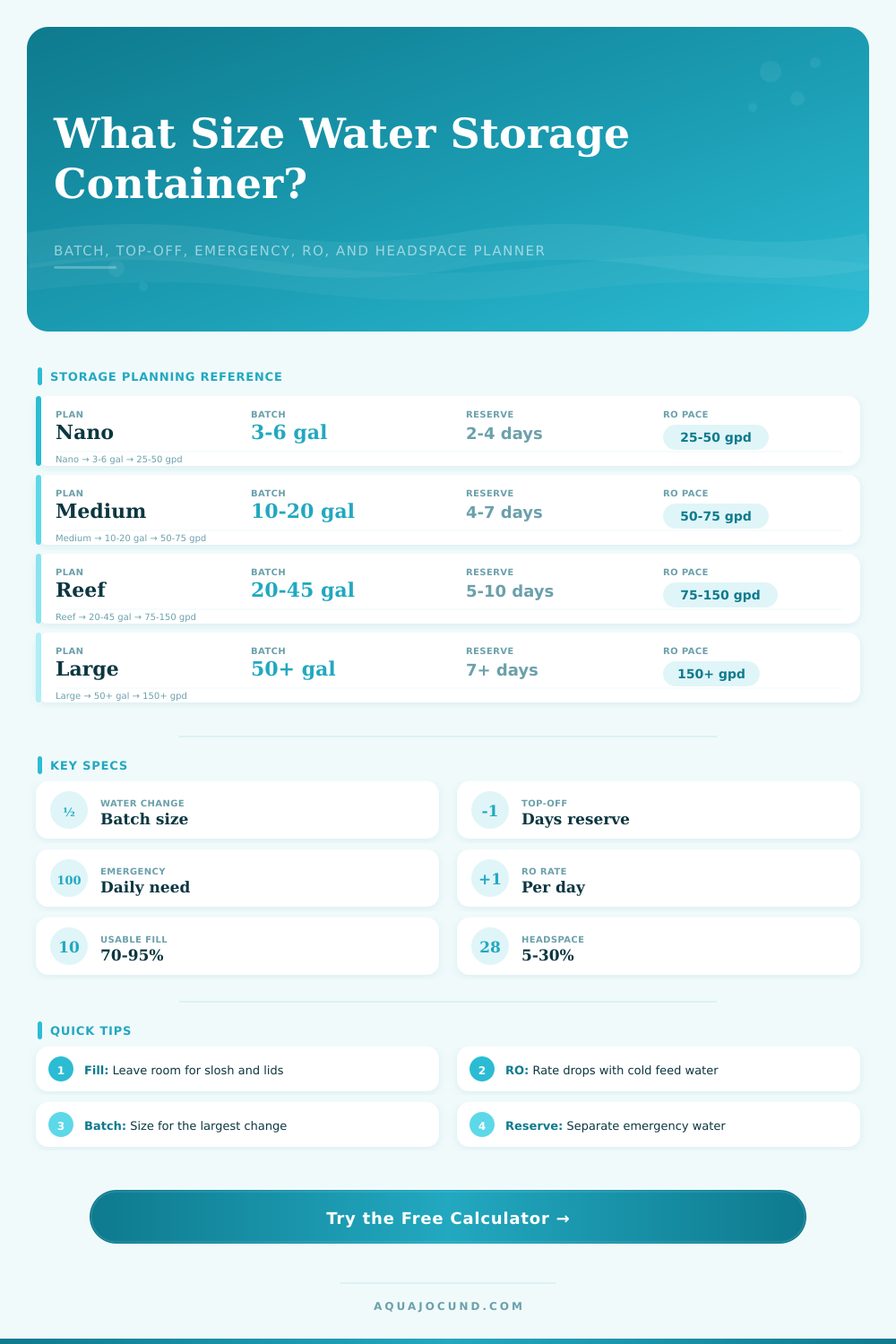
Plan aquarium water change batches, top-off reserve, emergency days, RO production time, usable fill, container count, and headspace.
💧Storage presets
⚙Container inputs
📋Container comparison grid
🗂Container profile table
| Container profile | Planning fill | Headspace habit | Best use |
|---|---|---|---|
| HDPE jug or carboy | 85-90% | Carry handle and cap air gap | Small changes and top-off |
| Round utility can | 85-90% | Leave rim room before moving | Mixing and medium batches |
| Food-grade barrel | 90-95% | Vent while RO runs | Large storage station |
| Slim vertical tank | 80-88% | Allow slosh at tall sides | Narrow closets or cabinets |
| Stackable cube | 78-85% | Do not fill to molded seam | Modular reserves |
| RO pressure tank | 65-80% | Drawdown varies with air charge | Automatic top-off buffer |
| IBC tote | 88-92% | Keep room for thermal expansion | Fish rooms and large systems |
| Collapsible bladder | 75-85% | Flat support and soft expansion | Temporary backup water |
📏Common storage sizes
| Nominal size | Metric equivalent | Usable at 85% | Typical aquarium task |
|---|---|---|---|
| 5 gal | 18.9 L | 4.3 gal / 16.1 L | Nano top-off or quick refill |
| 10 gal | 37.9 L | 8.5 gal / 32.2 L | Small planted water change |
| 20 gal | 75.7 L | 17 gal / 64.4 L | Medium batch storage |
| 32 gal | 121 L | 27.2 gal / 103 L | Common reef mixing can |
| 44 gal | 167 L | 37.4 gal / 142 L | Large freshwater change |
| 55 gal | 208 L | 46.8 gal / 177 L | Drum station or fish room |
| 100 gal | 379 L | 85 gal / 322 L | Multi-tank reserve |
⏱RO production reference
| Rated RO system | Per hour | 20 gal batch | 75 L batch |
|---|---|---|---|
| 25 gpd / 95 L/day | 1.0 gal / 4.0 L | 19.2 hours | 19.0 hours |
| 50 gpd / 189 L/day | 2.1 gal / 7.9 L | 9.6 hours | 9.5 hours |
| 75 gpd / 284 L/day | 3.1 gal / 11.8 L | 6.4 hours | 6.3 hours |
| 100 gpd / 379 L/day | 4.2 gal / 15.8 L | 4.8 hours | 4.8 hours |
| 150 gpd / 568 L/day | 6.3 gal / 23.7 L | 3.2 hours | 3.2 hours |
| 300 gpd / 1136 L/day | 12.5 gal / 47.3 L | 1.6 hours | 1.6 hours |
📘Reserve planning table
| Planning layer | Input used | Formula | Why it matters |
|---|---|---|---|
| Water change batch | Largest planned batch | Batch volume | Ensures one full change is ready |
| Top-off reserve | Daily evaporation and days | Daily top-off × days | Covers manual or ATO refill gaps |
| Emergency reserve | Daily need and days | Emergency daily × days | Provides backup for leaks or resets |
| Usable fill | Fill limit, headspace, profile | Nominal size × effective fill | Prevents overestimating usable water |
| RO production | RO rate per day | Required volume / RO rate | Shows how early to start production |
Remember when you’re changing tank water and you notice there’s not enough? Oh no, you fill some buckets, run over to the tank only to find you’re three gallons shy. Now what do you do? Scramble until you can get more into the tank and the filter runs dry. The problem here was a lack of planning.
How much water storage should you have? Well, it isn’t so much about getting something that sits on the floor as it is matching what you use with how much you need. It means looking at volume in layers instead of looking for the biggest drum possible.
How to Plan Your Water Storage
When starting out most people estimate how much they’ll want to make in one batch, enough to service their tanks each week. Eight gallons will replace twenty percent of a forty gallon tank. Seems easy. The gotcha comes into play when you think that all your containers are twenty gallons (they aren’t), so it’s safe to put your eight gallons in one of those twenty gallon container. It isn’t.
Each style of container has a maximum fill level at which point there is still usable water in the container. Carboys and HDPE jugs typically hold roughly 88% usable water. Utility cans are close to 90%. Food grade barrels may push up to 95% if you’re gentle with them. This page’s calculator does the math for you, reducing the raw amount based on how much actual water you can pour out before making a mess. And that reduction is the margin between success and… well, spilled water.
The other silent consideration in your storage plan is headspace. This is the unused volume above your stored items inside the container. Why? For two reasons. One, water expands when warm. Store RO water in the sun in your closet with no air gap and you’ll either pop the lid off or crack the plastic. Two, there’s always some sloshing around as you move the water. A full-to-the-brim jug is not only awkward to pick up (it’s heavy!) but also unsafe if it spills. A half-full jug leaves plenty of headspace so the rim stays dry and the center of gravity stable. Feels counter-intuitive to buy a container and then not fill it all the way up! But that dead space is your insurance against both damage and mess.
And then there’s the reserve for topping off. Unless you’re replenishing evaporated water, it will be continually removing water from the tank as water vapor escapes. It will then replace that water with whatever mineral or salt content was in the original water. If you want to maintain the same level, you’ll need another container of water. Such as a bucket, to simply sustain the level.
Depending upon the temperature (lower temps = slower evaporation), lighting (higher = faster), and flow rates (higher = faster), a gallon per day could easily be lost in a reef tank. In contrast, a planted tank with less light, low flow, and low temperature may only lose a quart per day. The tool will estimate the number of days worth of reserve you have given the amount of water lost each day. A week of reserve is what most folks strive for. It provides a buffer when your auto-top-off equipment malfunctions or you’re away on vacation.
The time aspect of the storage issue is RO production rate. A 75 gallon per day RO system will take roughly one hour to fill a ten gallon bucket. This rate is much slower if your feed water is cold. In the winter, membrane efficiency goes down. Depending on your circumstances, you may have to begin producing water two days prior to the change, instead of just the day of. On the page are the production times broken out for typical RO system ratings so you can see how long this process will take. It shows you that bigger is better in terms of time savings. However, it also shows you that bigger isn’t always cheaper because electricity and filter replacement costs stay the same no matter how fast or slow your system operates.
Most folks forget this layer until there’s a power outage resetting their equipment, or a burst pipe. Three to seven days of separate emergency water will bail out livestock when the tank goes dry. This isn’t much room for an enormous sense of peace of mind. If you’re short on space, the calculator prioritizes what layer fills up first. Typically, emergency and top-off water (the essential supply between maintenance cycles) rank higher than change batches.
In terms of ease of use, the size and shape of the container are just as important as how much it holds. For example, slim verticals fit in narrow cabinets but hold less usable water per square foot of footprint. Cubes can be stacked (modular) but may have lower fill limits with molded seams. Totes are great for big fish rooms but require a permanent location and a stand. Choose your container based on what you’re doing. Use small jugs if you need to make frequent changes. Use big barrels for longer storage.
It’s about knowing. You need to know how much water you’ll have, how long it took you to make, and whether or not it’s enough to get you through the weekend. That’s what good storage planning does. It makes a chaotic chore turn into a routine. If you know your numbers, you quit guessing and you start flowing. And don’t think of the empty space up top in the jug as wasted room. Think of it as your margin, the one thing keeping your system safe and your floors dry.