Water Change Cost Calculator
Estimate aquarium water-change cost from tank volume, monthly schedule, salt mix, RO waste, conditioner dose, and optional heating or mixing energy.
Full Cost Breakdown
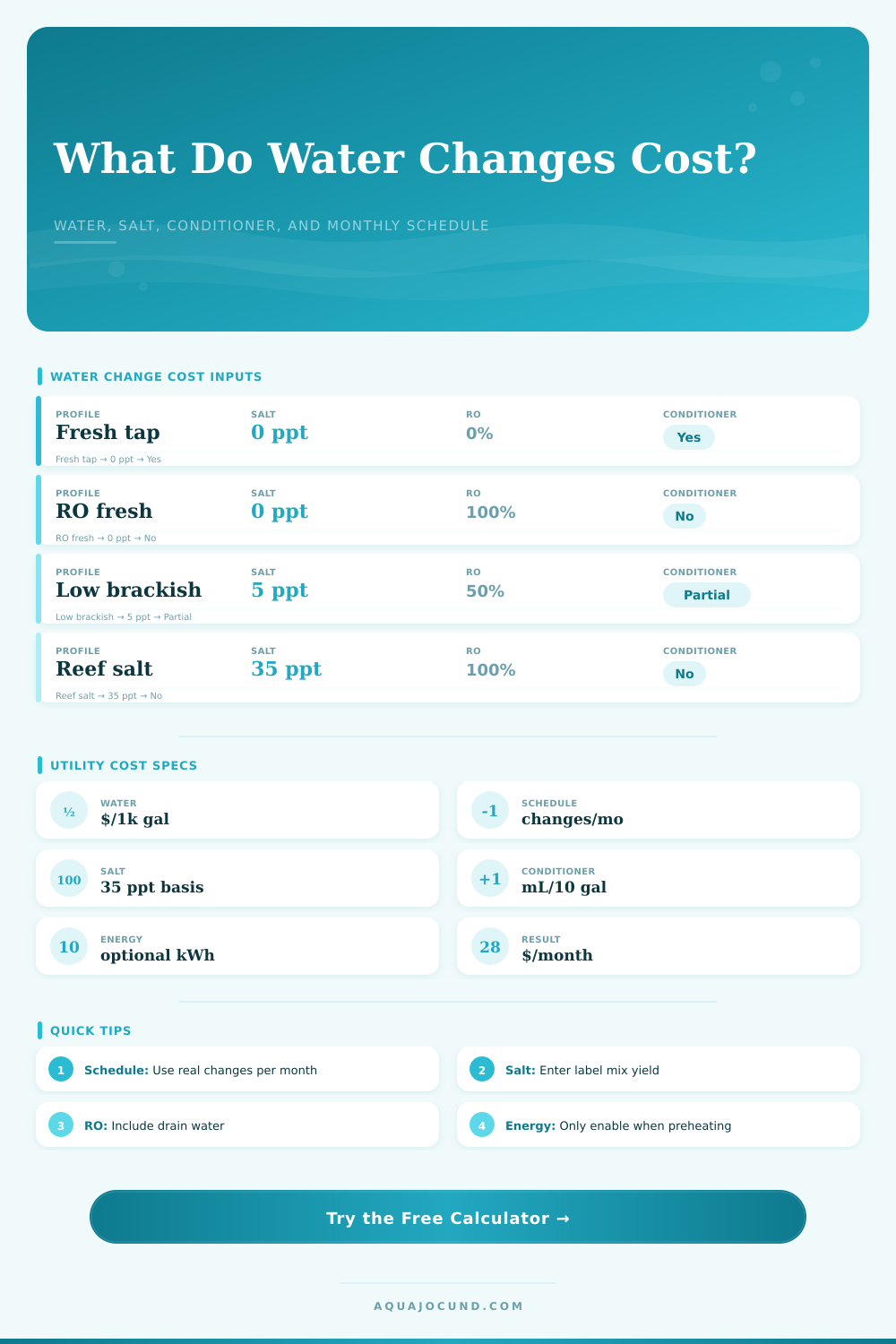
| Water profile | Salt target | RO fraction | Conditioner fraction |
|---|---|---|---|
| Freshwater tap | 0 ppt | 0% | 100% of refill |
| Freshwater RO remineralized | 0 ppt | 100% | 0% of refill |
| Mixed tap and RO planted | 0 ppt | 50% | 50% of refill |
| Low brackish | 5 ppt | 50% | 50% of refill |
| Mid brackish | 12 ppt | 75% | 25% of refill |
| FOWLR marine | 32 ppt | 100% | 0% of refill |
| Reef saltwater | 35 ppt | 100% | 0% of refill |
| High salinity reef | 36 ppt | 100% | 0% of refill |
| Common tank | Dimensions | Typical change | Monthly refill at weekly schedule |
|---|---|---|---|
| 10 gal | 20 x 10 x 12 in / 51 x 25 x 30 cm | 25% = 2.5 gal / 9.5 L | 10.8 gal / 41 L |
| 29 gal | 30 x 12 x 18 in / 76 x 30 x 46 cm | 30% = 8.7 gal / 33 L | 37.4 gal / 142 L |
| 55 gal | 48 x 13 x 21 in / 122 x 33 x 53 cm | 35% = 19.3 gal / 73 L | 82.8 gal / 313 L |
| 75 gal | 48 x 18 x 21 in / 122 x 46 x 53 cm | 40% = 30 gal / 114 L | 129 gal / 488 L |
| 125 gal | 72 x 18 x 22 in / 183 x 46 x 56 cm | 20% = 25 gal / 95 L | 108 gal / 407 L |
| Schedule pattern | Changes per month | Use when | Cost effect |
|---|---|---|---|
| Weekly | 4.3 | Routine freshwater, planted, reef, or stocked tanks | Monthly cost is about 4.3 times one change. |
| Every 10 days | 3.0 | Stable low to moderate load tanks | Lower monthly refill volume, but watch nitrate trend. |
| Biweekly | 2.15 | Lightly stocked or low nutrient systems | Consumable use is roughly half of weekly service. |
| Twice weekly | 8.6 | Grow-out, heavy feeding, or parameter correction | Cost scales directly with refill and preparation volume. |
| Cost component | Formula used | Main input | Practical note |
|---|---|---|---|
| Utility water | Source gallons x rate / 1,000 | Water rate and RO waste ratio | RO systems can use several gallons of source water per gallon of refill. |
| Salt mix | Liters x ppt, scaled to 35 ppt package yield | Salinity and package yield | Freshwater profiles have zero salt cost unless you enter other additive cost. |
| Conditioner | Treated tap gallons x mL dose x bottle cost per mL | Dose rate and tap fraction | Use the product label dose and your actual bottle size. |
| Energy | Heating kWh plus pump watts x hours | Temperature rise and mix time | Turn this off when replacement water is not heated or mixed separately. |
Keeping a tank means changing water regularly which causes you some anxiety each time the water bill shows up. On one hand, you know clean water is good for your fish, but on the other, you realize it’s an expensive task. Water is not free! Every gallon of water you change have a cost. This includes cost of the water itself. It also covers electricity used to warm the water to match the tank temperature, salt mix for salinity, and the conditioner you buy to neutralize the chlorine in tap water.
To calculate it, head over to the page and use the calculator. It does all the math, but in order to understand the reasons behind the difference, you must know what variables is.
How Much Does Changing Tank Water Cost?
To begin: where’s your water source? Is it tap water from a freshwater tank that gets changed regularly? That’s cheap water (pennies-per-gallon), but it add up if you do so often. Or maybe you have a brackish or reef tank? Then salt mix is an additional expense. Every ounce of minerals replaced has a price tag, and the tool takes that into account based off how high your target salinity is. A small freshwater tank require less chemistry different than standard marine levels.
Your overall expense is also influenced by reverse osmosis systems. While many hobbyists use RO units to remove heavy metals and nitrates, they are wasteful in terms of water used. For instance, a typical system generates three gallons of waste for each gallon of clean water, so before even considering salt, you tripled your water cost. You can enter your actualy waste ratio into the calculator for a more precise estimate. You can reduce costs by reusing your drain water (e.g., for houseplants) or having a more efficient RO unit.
Different water profiles change the equation regarding how much RO vs. Tap water is used. The page include a reference table illustrating that difference.
Water Heating, Heating water uses a lot of electricity. Replacing cold tap water with warm/heated tank water consume electricity. The water calculator accounts for this by adding an energy component to the equation. It considers your heater’s efficiency and temperature as well as the temperature difference. For example, if your tap water is colder at 60 degrees and your tank is warmer at 80 degrees, your heater will need to do more work. This energy consumption over time will add up more than your water costs (especially if you’re changing it out weekly over a month’s period). It is a small cost that affects your total profit.
Your overall expense will also be affected by when you perform your water changes. Do you top off your tank weekly with small amounts or do you change everything once a month with larger volumes? As long as you replace the same amount of water, it doesn’t matter. In general, replacing less but more often can minimize livestock shock and keep water parameter swings in check. This app allow you to modify how many times per month you want to do a water change, so you can compare a schedule like twice-weekly versus weekly.
Maintaining an aquarium is a combination of biology and economics. While you want it to be a good environment for your animals, you don’t want to spend too much doing so. Simply inputting your own numbers for utilities, conditioner, and salt gives you a clear picture of what’s actualy going on in terms of maintenance cost. It’s no longer vague; it becomes a list of manageable inputs.
Want to mix your salt efficienty? See how much money you’re saving. Need to know the cost of an RO filter change per gallon? When you know where the money’s going, you’ll have a better idea about which supplies and when on your schedule. You should of known that water continues to flow, but this time, you know what it costs.