Harem Ratio Calculator
Estimate female count, footprint pressure, sight-line breaks, spare females, and compatibility for aquarium fish harems.
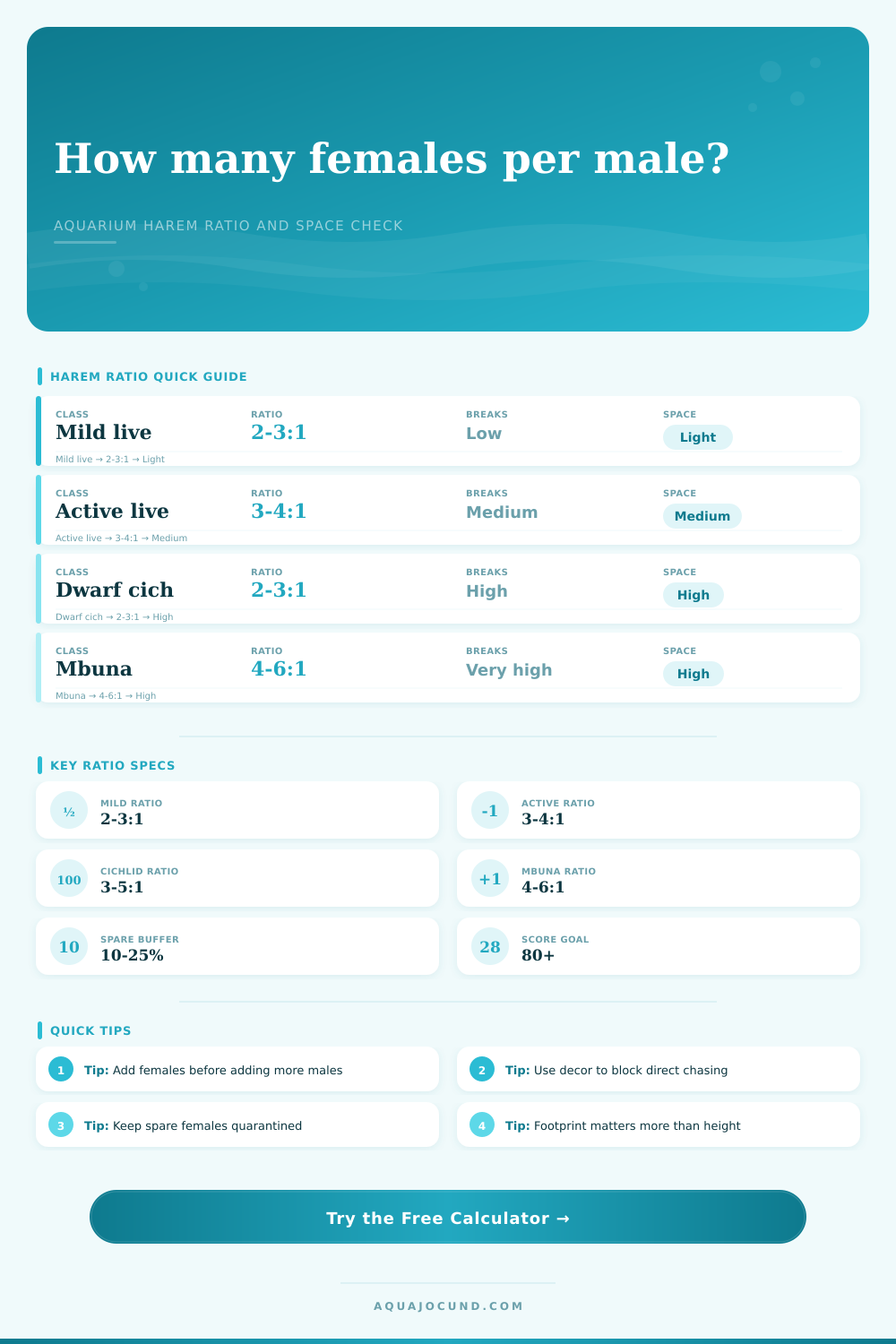
| Class | Typical aquarium fish | Base female ratio | Breaks per male | Planning note |
|---|---|---|---|---|
| Mild livebearer | Guppy, Endler, platy | 2-3 females | 0.5-1 | Ratio spreads constant courtship. |
| Active livebearer | Molly, swordtail | 3-4 females | 1 | Long tanks reduce repeated chasing. |
| Dwarf cichlid | Apistogramma, small cichlids | 2-3 females | 1-2 | Caves and divided territories matter. |
| Peacock or Hap | Aulonocara, mild Haps | 4-5 females | 1-2 | Avoid extra rival males in small tanks. |
| Mbuna | Labidochromis, Pseudotropheus | 4-6 females | 2+ | Rockwork and footprint set the limit. |
| Tank | Common footprint | Area | Good harem use | Extra caution |
|---|---|---|---|---|
| 10 gallon | 20 x 10 in / 51 x 25 cm | 200 sq in | Small livebearers or killifish | One male group only. |
| 20 long | 30 x 12 in / 76 x 30 cm | 360 sq in | Dwarf cichlid or active livebearer | Use clear territory breaks. |
| 40 breeder | 36 x 18 in / 91 x 46 cm | 648 sq in | Livebearers, gourami, small cichlids | Footprint is better than height. |
| 55 gallon | 48 x 13 in / 122 x 33 cm | 624 sq in | Long active fish and some cichlids | Narrow front-to-back space. |
| 75 gallon | 48 x 18 in / 122 x 46 cm | 864 sq in | Peacock, Hap, larger groups | Manage rival colors carefully. |
| Compatibility setting | Ratio add | Space multiplier | Use when |
|---|---|---|---|
| Species-only group | +0.0 | 1.00x | No known rival fish share the same zones. |
| Peaceful community | +0.2 | 1.10x | Calm tankmates use different spaces. |
| Bottom overlap | +0.5 | 1.20x | Caves, shells, or substrate zones are shared. |
| Color rivals | +0.7 | 1.25x | Similar males or display rivals are present. |
| Crowded community | +1.0 | 1.35x | High motion or limited refuge increases stress. |
| Aggression pressure | Suggested spare buffer | Why it helps | Check first |
|---|---|---|---|
| Mild | 10% | Replaces losses without skewing the ratio. | Quarantine capacity. |
| Moderate | 15% | Protects the group if one female hides or is moved. | Extra feeding access. |
| High | 20% | Gives room to adjust after pairing or spawning behavior. | Footprint and cover. |
| Very high | 25% | Useful for territorial cichlid groups under pressure. | Rockwork and exits. |
You know where this goes, good intention leads to most problems in an aquarium, namely a male chasing a female into a corner. How? Because you get caught up in how much water there is but neglect floor plan. To manage aggression and help you decide how many fish to add, the harem ratio calculator gives you a specific number and amount of floor space per female. In other words, it makes you think about horizontal space that they have to escape from pursuit instead of just how many gallons are in the tank.
Why is this important? This is important because fish moves mostly on the x and y axes. They require some clear break in the sight line to cease being pursued.
Why Floor Space and Plants Matter More Than Water Volume
Now, what exactly is this idea of a harem ratio? It’s all about lowering potential for harassment. In other words, you want to distribute the male’s attentions among multiple females in such a way as to prevent any one female from being pinned down.
By inputting your desired ratio and class of your species into calculator, it will estimate the female count for you; no guesswork on whether you have enough females to balance aggression. It tells you how many females to keep. Typically for mild livebearers (e.g., guppies), a two-to-three female:male ratio tend to work. However, for more active species like mollies or swordtails, you typically need more females since they chase further and tend to swim quicker. To take these behavioral variations into account, there’s a selector for aggression class.
One quiet variable in most setups is tank footprint. While a tall ten-gallon tank might be impressive, it have very little floor space. Because the calculator asks for width and length, it uses those measurements to determine how many escape routes there is. Have a small base? Even with a perfect female ratio, the males can still corner the females too easy to make this work. This is laid out clearly in a reference table on the page. The table shows common tank sizes and their actual usable area, reminding you why a wider footprint like a forty-gallon breeder can often be better for harems than a fifty-five gallon standard. Choose wide tanks instead of tall ones.
Another key input is line of sight breaks. A break is driftwood, dense plants, or rock pile that stops a direct chase. How many do you have? How many should of you have? The tool calculates this as well, based off the number of males. Because more males equates to more chaos, more males requires more visual barriers. An open, barren tank will drop your score considerably. It’s not about decor. It’s about providing places for a female to dissapears for a few seconds. Those few seconds is often the difference between stress and survival.
Compatibility settings can fine-tune things even more. Are you keeping just one species? Pressure will be less. Do you have similarly colored rivals or do you add some peaceable community tankmates? More stress. To accommodate that, the calculator use multipliers. Why? Visual likeness matter in territorial fish. Having another same-species male is more threatening than having a shy snail around.
Plan for the worst-case scenario, typically high activity when you feed or during breeding time. A few spare females are a good precautionary buffer. A fish dies. A fish gets pulled out for medical care. That balance quickly turn into harassment. It is recommended to keep ten spare females, with twenty-five percent kept in quarantine. That sounds like overkill until one realizes just how quick it can go sideways with a group. Better to have a fish you don’t need versus needing a fish you don’t have.
The score is over eighty. That means you’ve got an environment in line with how the species behave naturaly. A ratio, decor, space. It is not perfect, just lower risk. Tweak the inputs for maximum effect. More fish or more plants? Longer tank? Who knows until you try. But make your choices using data. Don’t just hope.
To conclude. You cannot see a happy harem. All that happens is they swims around and eat. You won’t see any math; you’ll see results. Careful planning of breaks and footprint allows for giving them space to breathe. And that’s the entire purpose of having fish in the first place.