🦐 Decapsulated Brine Shrimp Dosing Calculator
Estimate dry decapsulated brine shrimp, hydrated feed volume, per-feeding portions, waste margin, and stage-adjusted fry rations.
| Species or Size Stage | Reference Dry Rate | Common Feeding Split | Dosing Note |
|---|---|---|---|
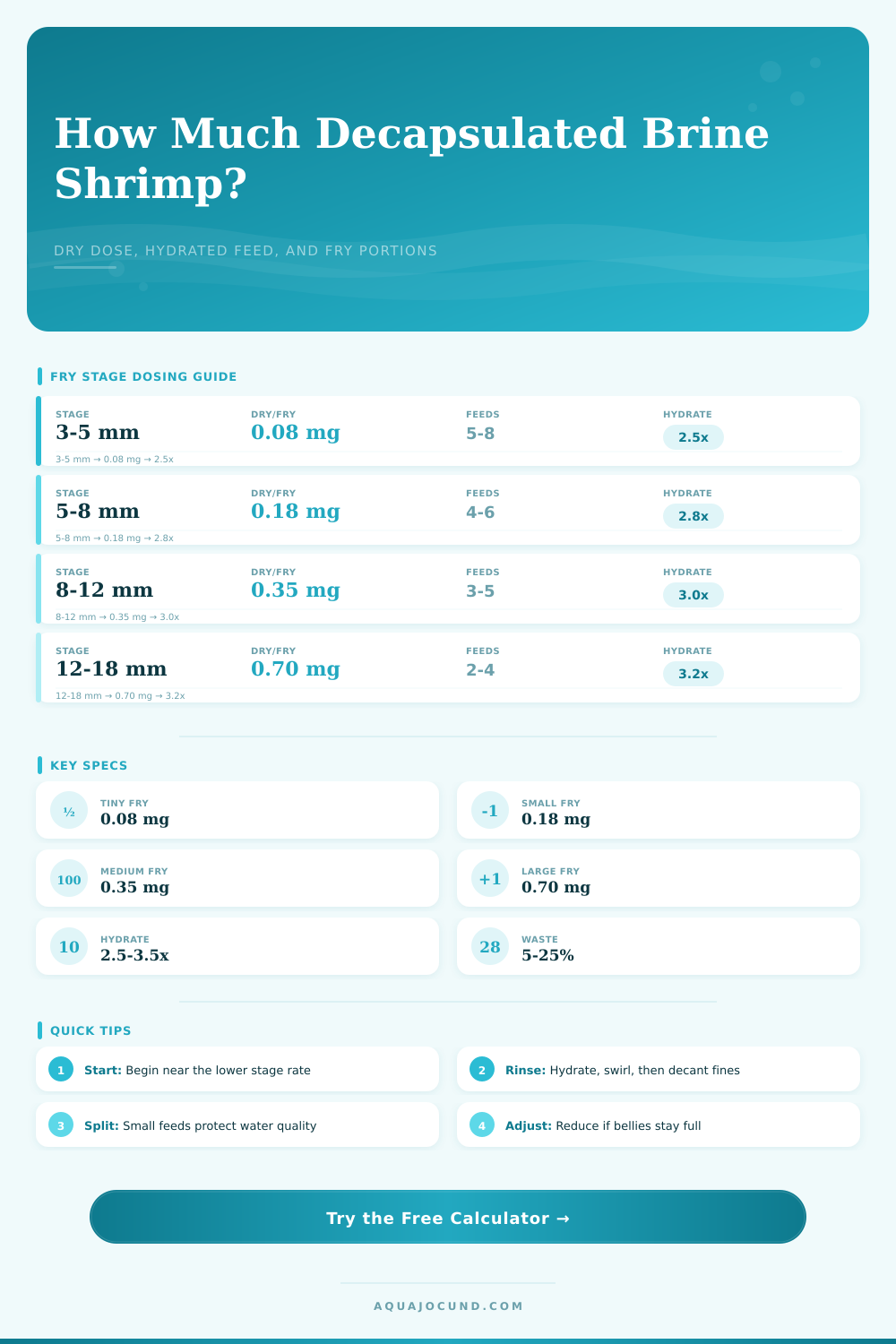
| Tiny larvae, 3 to 5 mm | 0.06 to 0.10 mg per fry per day | 5 to 8 feedings | Keep portions tiny and remove settled fines quickly. |
| Small fry, 5 to 8 mm | 0.12 to 0.25 mg per fry per day | 4 to 6 feedings | A good starting range for many betta, tetra, cory, and rainbow fry. |
| Medium fry, 8 to 12 mm | 0.25 to 0.50 mg per fry per day | 3 to 5 feedings | Watch belly fill and increase only when feed clears cleanly. |
| Large fry, 12 to 18 mm | 0.50 to 0.90 mg per fry per day | 2 to 4 feedings | Often ready for mixed grow-out foods alongside decap. |
| Livebearer newborns | 0.18 to 0.35 mg per fry per day | 3 to 5 feedings | Can usually take slightly larger particles earlier than egg-layer larvae. |
| Delicate micro fry | 0.03 to 0.08 mg per fry per day | 6 to 8 feedings | Use only very fine hydrated particles and conservative dosing. |
| Product Form | Planning Density | Hydration Range | Best Measuring Use |
|---|---|---|---|
| Fine dry decapsulated cysts | About 210 mg per 1/8 tsp | 2.5x to 3.2x wet weight | Scale first, then hydrate for pipette portions. |
| Powdered decapsulated cysts | About 170 mg per 1/8 tsp | 2.2x to 3.0x wet weight | Good for micro portions but easy to overfeed by volume. |
| Coarse dry decapsulated cysts | About 240 mg per 1/8 tsp | 2.6x to 3.4x wet weight | Works for larger fry that can chase visible particles. |
| Pre-hydrated refrigerated slurry | Dry equivalent estimated from water gain | 3.0x to 4.0x wet weight | Use hydrated mass and back-calculate dry feed. |
| Thick paste slurry | Dry equivalent varies by squeeze | 2.0x to 3.0x wet weight | Weigh a sample batch to set a reliable density override. |
| Mixed fry-food blend | Decap share may be 30% to 70% | Depends on ingredients | Reduce the decap rate if other proteins are included. |
| Nursery Scenario | Fry Count | Starting Rate | Typical Daily Dry Dose |
|---|---|---|---|
| Small betta spawn, first feeding week | 50 to 100 fry | 0.06 to 0.10 mg/fry | 3 to 10 mg dry per day |
| Guppy or platy drop | 30 to 80 fry | 0.18 to 0.30 mg/fry | 5 to 24 mg dry per day |
| Corydoras nursery box | 80 to 150 fry | 0.12 to 0.25 mg/fry | 10 to 38 mg dry per day |
| Angelfish or cichlid free swimmers | 150 to 350 fry | 0.15 to 0.30 mg/fry | 23 to 105 mg dry per day |
| Grow-out tray, mixed larger fry | 300 to 700 fry | 0.35 to 0.70 mg/fry | 105 to 490 mg dry per day |
| Feeding Method | Portion Control | Waste Margin | Clean-Up Window |
|---|---|---|---|
| Pipette spot feed | Strong control near fry clouds | 5% to 12% | 15 to 30 minutes |
| Gentle broadcast feed | Good for scattered fry | 12% to 22% | 20 to 40 minutes |
| Floating feeding ring | Useful for surface feeders | 8% to 16% | 20 to 45 minutes |
| Bare-bottom feeding dish | Easy to inspect leftovers | 5% to 10% | 30 to 60 minutes |
| High-flow grow-out tray | Particles disperse quickly | 18% to 30% | 15 to 30 minutes |
That’s a glass box full of water and whatever that stuff is floating around in it. Looks like dust motes from here. Looks like haze to the naked eye. It is a desert to those little mouths inside awaiting. Or a banquet. Depends on the fractions of a milligram.
Welcome to the world of raising fry. It isn’t about volume. It’s about precision. Why do most newbies kill off their initial batch? Because they didn’t feed them? No. They fed them too much. Uneaten food rots, and rot cause death.
Why You Should Use the Fry Calculator
The fry calculator does the math for you once you enter how many fry you have and their stage. Saves you the guess work on waste margins and hydration coefficients.
Decapsulated brine shrimp is a dry powder unless you add water. When you add water, the decapsulated bsh expands and gets heavier. How much? It typically weighs about 2.8 times its dry mass. The tool take this into account.
Why does it matter? You’re measuring in dry weight with your scale, yet delivering wet slurry with your pipette. Forget to take the hydration factor into account, and you’ll dose three times what you want. Fry don’t need that. Their stomachs are microscopic. Even one small larval fish may only be able to process a fraction of a milligram per day. The calc turns that biological limit into something you can weigh out in practice with a sensitive scale.
Of course, it all depends on what stage your fry is in. A strong fifteen-millimeter teenager isn’t like a tiny larval fry only five millimeters long. The younger ones need finer particles and more frequent feedings. If you set the size, the calculator reduces the daily amount to account for that. They eat less per bite but they take more bites. That matches up with their developing digestive system. Force-feeding a fry won’t make it grow any faster. Just clutter the water.
The reference table on the page explains it well. The rate decreases for fragile micro fry and increases as they get bigger (grow-out specimens).
The silent killer of nursery tanks is waste. Not everything that falls on the substrate is going to get eaten by a fish’s mouth. Some will get caught by the filter. Some will fall to bottom and start decaying before a fish’s mouth has a chance at finding it. Add a waste margin (say ten to twenty percent). It’s not being pessimistic. It’s being realistic.
The amount depends on how you set up your nurseries. If the water have a lot of flow, like on a high-flow tray, it’ll wash away the food faster, so you’ll need a bigger margin. If the water is a bit quieter and there’s nothing but bare bottom, allowing fry to pick off every last piece, then you can afford a tighter margin. The calculator includes this margin as part of your total dry dose. You’re prepping enough to cover your losses while not feeding more than what the tank itself should hold.
Feeding fry requires precision rather than guesswork. That’s up to you. However, you might prefer spreading the food in a thin layer instead of a thick pile, like a slurry. How you hydrate also affects the effective density of what you’re giving them. Soaking and removing excess water gives a denser slurry. Leaving it soupy means you’re more likely just adding water.
The hydration factor converts your dry gram target into a hydrated portion. Adjust according to your own soaking habit. Maybe you want a thick paste for pipetting? Maybe you want a thin splash on for broadcast? The math adjusts accordingly. Whether you use a teaspoon in the kitchen or a lab scale, you know that you’re delivering equal biological value to the fry.
For example, The preset buttons for certain species will get you started. Betta fry begin life small but quickly grow up. Newborn guppies is bigger and stronger. These examples show how you can use this tool to get started. Use them as an anchor. Then observe.
If their bellies are full at the next feeding, you have too much food. Underfeeding. If the water remains crystal clear and the fry are thin, you are underfeeding. Overfeeding. The calculator is your baseline. Observation is the adjustment. It’s a partnership of data and observation.
It’s not only about the dose, but also how it gets fed. Do you drop food into the fry cloud or do you broadcast? When broadcasting, there’s a wider margin for error. How you feed matters. That’s where this tool comes in. It narrows down the waste calculation based on your delivery method.
This will remind you that feeding isn’t simply feeding fish. You’re feeding a water chemistry equation. Anything that isn’t eaten becomes waste in the form of protein milligrams. The calculator assist with keeping things balanced.
Fry raising is the school of “less.” Measure precisely. Measure out exactly. Let the calculator do the guesswork for you. Make the invisible feel real. Weigh out the powder. Hydrate it. Watch them eat. See how much they eat. Banish the fog. Nurture the fry. Return to the scale and feed them what’s needed to grow, not more, not less.