🧪 Macro Fertilizer Mixing Calculator
Calculate KNO3, KH2PO4, and K2SO4 grams for a stock bottle from target NO3, PO4, K, dose size, solubility margin, and weekly dosing schedule.
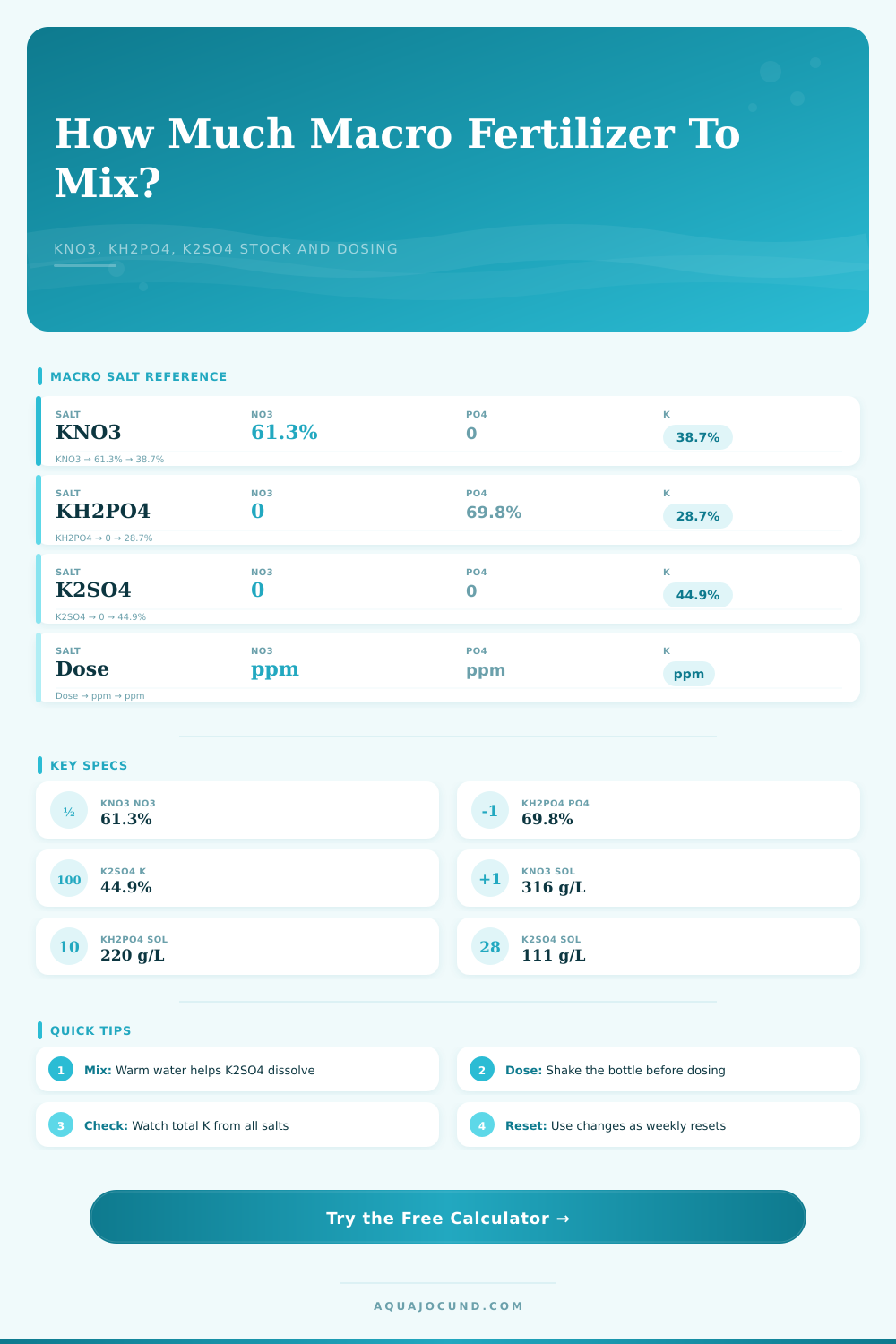
| Dry Salt | Molar Mass | Main Nutrient Fraction | Potassium Fraction | Solubility Reference |
|---|---|---|---|---|
| KNO3, potassium nitrate | 101.10 g/mol | 61.3% NO3 | 38.7% K | About 316 g/L at 20 C |
| KH2PO4, monopotassium phosphate | 136.09 g/mol | 69.8% PO4 | 28.7% K | About 220 g/L at 20 C |
| K2SO4, potassium sulfate | 174.26 g/mol | 44.9% K | 44.9% K | About 111 g/L at 20 C |
| Combined macro stock | Recipe based | NO3, PO4, and K | Includes all K sources | Limited most often by K2SO4 |
| Tank Size | Volume | EI Per Dose Example | Lean Per Dose Example | Typical Macro Frequency |
|---|---|---|---|---|
| 5 gal nano | 5 gal / 19 L | 2 ppm NO3, 0.3 ppm PO4 | 0.5 ppm NO3, 0.1 ppm PO4 | 2 to 3 times weekly |
| 20 long | 20 gal / 76 L | 5 ppm NO3, 0.8 ppm PO4 | 1 ppm NO3, 0.2 ppm PO4 | 3 times weekly |
| 40 breeder | 40 gal / 151 L | 7.5 ppm NO3, 1.3 ppm PO4 | 2 ppm NO3, 0.4 ppm PO4 | 3 times weekly |
| 75 gal high tech | 75 gal / 284 L | 7.5 ppm NO3, 1.5 ppm PO4 | 3 ppm NO3, 0.5 ppm PO4 | 3 to 5 times weekly |
| 125 gal display | 125 gal / 473 L | 6 ppm NO3, 1 ppm PO4 | 2 ppm NO3, 0.3 ppm PO4 | 3 times weekly |
| Schedule | Macro Days | Trace Days | Water Change | Calculator Use |
|---|---|---|---|---|
| Classic EI rhythm | Mon, Wed, Fri | Tue, Thu, Sat | Sun reset | Use larger per-dose macro targets |
| Daily PPS rhythm | Every day | Every day or split | Weekly or biweekly | Use smaller daily targets |
| Low-tech rhythm | 1 to 2 days weekly | 1 to 2 days weekly | As maintenance requires | Use lean profile presets |
| High demand stems | 3 to 5 days weekly | Alternate or daily | Weekly reset | Watch bottle strength and K total |
| Salt | Conservative Limit | Room Reference | Warm Mix Reference | Practical Note |
|---|---|---|---|---|
| KNO3 | 250 g/L | 316 g/L | 400 g/L planning cap | Usually dissolves before K2SO4 becomes the bottleneck |
| KH2PO4 | 180 g/L | 220 g/L | 280 g/L planning cap | Often dissolves clearly at aquarium stock strengths |
| K2SO4 | 90 g/L | 111 g/L | 140 g/L planning cap | Most likely salt to leave crystals in a strong stock |
| Combined stock | Use weakest margin | Compare each salt | Cool before final volume | Reduce bottle grams or increase dose mL if margin is tight |
When most of us began with planted tanks, we bought some bottled liquid fertilizer and did what label said. This will work for a while, but then it doesn’t. Before long, your stem plant stop growing or you see algae in the corner. You start to feel like you’re throwing money down the drain.
That’s when the transition begins, from using store-bought premixes to mixing your own dry salt mixes. Aquascaping becomes less recipe-following, and more chemically-minded. That’s not such a big jump, but it makes all the difference in how you care for your ecosystem.
How to Make Your Own Aquarium Fertilizer
Any complete macro mix have three salts at its center. One give some potassium along with nitrate (potassium nitrate). Another gives some potassium along with phosphate (monopotassium phosphate). The third is just pure potassium (potassium sulfate) with no contribution to the other two elements.
Why split these up? Plants require a specific ratio of nitrate and phosphate, but they typically need much larger amounts of potassium then these two salts alone could offer. Use just the first two and you’d either run out of potassium too soon (and thus not grow fast enough), or have dangerously high levels of nitrate and phosphate. That’s where the third salt come in.
Before weighing a single gram, you’ll want to know how much water’s going into the tank and what nutrient levels you’re aiming for. That’s why most folks stall out here, they do not know what their plants actualy need. Once you enter the volume and the desired ppm targets (which the calculator calculates), it will figure all the math for you. So don’t waste time trying to guess at the conversion factors.
Select a profile based off your plant style. Very few nutrients is required if you keep slow-growing plants in a low-tech tank. If you have a high-tech tank full of stems under blazing lights, then those plants will devour nutrients like a furnace. Select a profile that matches your real-world lighting and plant density… Not the profile that sounds cool.
Solubility is a silent killer because all salts has a maximum amount that they can dissolve in a given volume of water at room temperature. Typically, K2SO4 is the bottle neck. It’s very hard to dissolve compared to everything else. So if you jam too many salts into a little bottle, you’ll wind up with crystals on the bottom.
Those don’t get counted as dosed. So your doses will be wrong. Not only is it confusing, but it’s frustrating. Maybe you double the dose to make up for it… now you’re throwing off the ratio even more. With this tool, we compare all the dissolved salt components to their solubility limits and tell you if the margin is too narrow. Time to use a bigger dose size or bigger bottle.
Know how pure your salt is? It makes a big difference, even if you think it doesn’t. Typically aquarium grade salts are 98% pure. Lab grade is better but is also more expensive. In real world terms this means very little but it adds up over months of dosing. That’s why the calculator takes this into account automatically depending on which salt source you specify. You do not need to become a chemist and compensate for impurity. Just be truthful when specifying what salt you purchased.
If you use a kitchen scale that only rounds to the nearest gram, then you’ll introduce error into the calculation. Choose a scale with as much or more precision than the “precision” setting. The key? The key is consistency. Don’t worry too much about hitting the perfect ppm number each time. Instead, focus on establishing a consistent baseline that keeps the levels from spiking and crashing.
A regular water change (weekly) act as the reset button, eliminating extra nutrients and ensuring nothing becomes toxic. Imagine your dosing regimen as a beat. Dosage three times per week? Stick with dosage three times per week. Confuse it, and you confuse the tank.
After several weeks of following this routine, test your water parameters again. Are you overdosing? Are you underdosing? Adjust the goal based on what’s necessary.
Homemade fertilizer is more affordable than premixed liquid products and allows for more control. You know what’s going into the bottle. If your plants show symptoms of being phosphate limited or showing other evidence of nitrogen deficiency, you can adjust accordingly. It becomes a controllable process vs. Guesswork.
Sure, there are 60 minutes invested upfront, but each time you add some, you’re saving money and seeing benefits. No longer do you have to worry what might be hiding in commercial products. Instead, you focus on what your plants truly require. Knowing what goes into the bottle makes all the difference. It’s worth the trouble. It will make sense when you notice a direct link between the nutrient input and plant growth. It’s a minor adjustment to the routine, but has a huge impact on the health of your tank.