🐚 Crushed Coral Dosing for KH Calculator
Estimate the crushed coral bag size, KH reserve, dissolution pace, pH and CO2 effect, flow exposure, and maintenance interval for gradual alkalinity support.
Use 0.02 to 0.10 for light demand and higher values when water changes or bioload pull KH down quickly.
Crushed Coral KH Breakdown
| Media type | Purity factor | Modeled base release | Best calculator use |
|---|---|---|---|
| Fine crushed coral | 0.92 | 0.22% of bag per day | Small bags, faster KH response, needs closer testing. |
| Standard crushed coral | 0.90 | 0.16% of bag per day | General filter bags for gradual freshwater KH support. |
| Coarse coral rubble | 0.88 | 0.10% of bag per day | Large tanks where slow reserve is preferred. |
| Aragonite chips | 0.94 | 0.13% of bag per day | Cleaner high-carbonate media with steady release. |
| Oyster shell grit | 0.86 | 0.11% of bag per day | Budget-style shell grit estimates, often slower and less uniform. |
| Reactor-grade aragonite | 0.96 | 0.28% of bag per day | High-flow reactors or media chambers with strong contact. |
| Common tank | Dimensions | Volume | Typical coral bag for +3 dKH |
|---|---|---|---|
| 5 gal nano | 16 in x 8 in x 10 in / 41 cm x 20 cm x 25 cm | 5 gal / 19 L | 20 to 40 g in low to moderate flow. |
| 10 gal standard | 20 in x 10 in x 12 in / 51 cm x 25 cm x 30 cm | 10 gal / 38 L | 40 to 80 g, retested weekly. |
| 20 long | 30 in x 12 in x 12 in / 76 cm x 30 cm x 30 cm | 20 gal / 76 L | 90 to 150 g depending on pH and flow. |
| 29 gal | 30 in x 12 in x 18 in / 76 cm x 30 cm x 46 cm | 29 gal / 110 L | 130 to 220 g for gradual buffering. |
| 55 gal | 48 in x 13 in x 21 in / 122 cm x 33 cm x 53 cm | 55 gal / 208 L | 250 to 420 g in a filter bag or chamber. |
| 75 gal | 48 in x 18 in x 21 in / 122 cm x 46 cm x 53 cm | 75 gal / 284 L | 350 to 575 g with staged testing. |
| 125 gal | 72 in x 18 in x 21 in / 183 cm x 46 cm x 53 cm | 125 gal / 473 L | 600 to 950 g split across flow paths. |
| pH and CO2 condition | Dissolution effect | Calculator multiplier | Practical interpretation |
|---|---|---|---|
| pH 6.2 to 6.5, high CO2 | Fastest | About 2.0x to 2.6x | Small bags can move KH noticeably; test often. |
| pH 6.6 to 6.9, normal CO2 | Moderate-fast | About 1.3x to 1.6x | Useful for soft water that drifts downward. |
| pH 7.0 to 7.3, normal CO2 | Baseline | About 1.0x | Good default for most freshwater filter-bag estimates. |
| pH 7.4 to 7.7, low CO2 | Slow | About 0.5x to 0.7x | Coral acts more like reserve media than an active dose. |
| pH 7.8 to 8.2, strong aeration | Very slow | About 0.25x to 0.45x | Expect limited KH change unless flow and contact are high. |
| Maintenance signal | What it means | Calculator action | KH testing response |
|---|---|---|---|
| KH rises faster than target | Too much exposed media or high CO2 contact | Reduce bag mass or move to lower flow. | Test every 2 to 3 days until stable. |
| KH stays flat | Media surface is clogged or pH is too high for much release | Rinse the bag, increase flow, or use finer media. | Confirm test kit and retest after a week. |
| KH drifts down between water changes | Tank demand exceeds release rate | Add reserve media or split bags across flow paths. | Use the daily demand input to size service intervals. |
| Media bag compacts | Water bypasses the coral and surface area drops | Shake or rinse during scheduled maintenance. | Record KH before and after service. |
There’s something quietly satisfying about watching an aquarium stabilize. Feed your fish, change your water and watch the numbers hold.
That’s usually an illusion in planted tanks or in any tank where you’re keeping soft-water species. The ecosystem teeters on the edge of crashing. The pH drop. Your buffering capacity fails.
How to Use Crushed Coral for Stable Water
Then along comes crushed coral which isn’t a magic bullet but acts as a slow-releasing buffer. It buffers your alkalinity and releases it slowlyly.
That’s where the calc up top comes in. You enter your tank size, the increase in KH that you want and it does all the coefficient guessing for you. Based off how calcium carbonate dissolves, it converts that information into how many days the media will last and how many grams you’ll need. Then it requests existing and target alkalinity values. Finally, it asks about buffer demand (daily) of your particular tank.
Why is that important? Because a heavily planted shrimp tank isn’t going to consume buffers as fast than a bare bottom betta tank. So it incorporates that value into an estimation of how fast the coral will dissolve.
The key to understanding it are in dissolution. Unlike a liquid supplement that is added all at once, crushed coral dissolves over time, right? No it doesn’t. It dissolves over time. And how fast or slow it dissolves will vary greatly depending on water parameters (chemistry) as well as the amount of surface area exposed.
The finer the powder, the quicker it release ions and the faster it gets clogged up. The larger the pieces (like rubble), the slower it releases ions but can last months at a time. Depending on your parameters especially pH, you can control the speed with which it dissolves.
For example if you inject lots of CO2 into the tank that reduces pH. This increases rate of dissolution. The calculator takes that into account so if you have a high-CO2 tank, the calculators timespan will reflect that by reducing the timeline. Why? Because the acid will eat away at the coral fasterer.
A lot of folks overlook this. They think it’ll just sit there and last forever. It lasts until it is gone. And then they wonder why their KH keeps dropping after only 3 weeks. Oh yeah, the media dissolved.
Debris and biofilm get involved as well. Bacterial colonies forms on the surfaces of the coral and cover them over time, sealing them off from surrounding water. There’s a factor in the calculator to account for this surface clogging. It reminds you to remember that keeping the surface area driving the chemical reaction is part of your dosing strategy. Rinse the bag every few weeks to restore the surface area. If not, then you’re really dosing plastic wrapped in slime.
Treat the results as guidelines. These represent the best case scenario days until you reach your goal. There are many factors a computer model can’t anticipate for real world tanks, such as drastic temp fluctuations and changes in livestock densities.
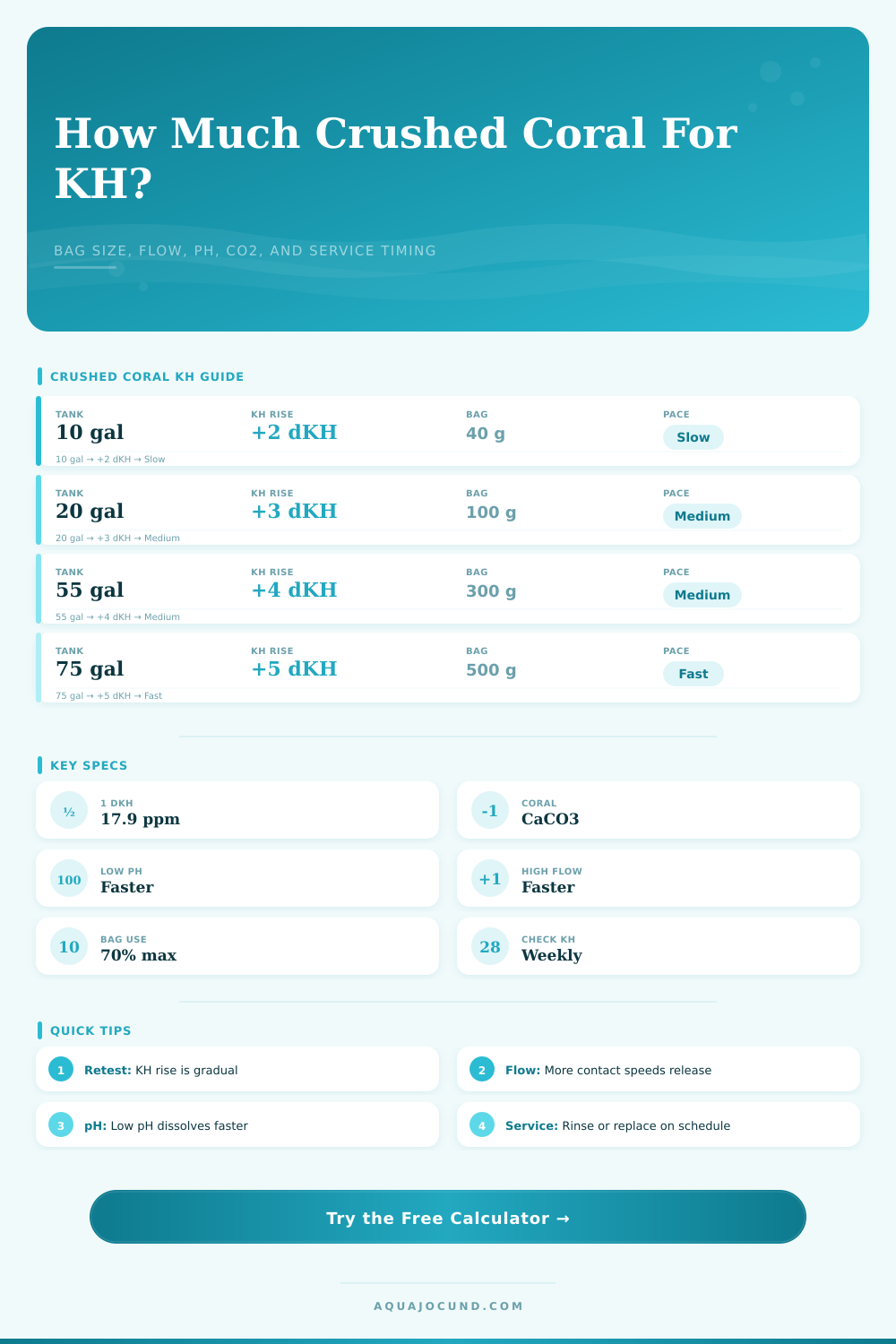
Use the reference tables as a sanity check. This shows the standard tank volume plus typical bag size at a given KH change. For example, you may only want to bump your KH by three degrees from a 20 gallon tank. To achieve this may require one-hundred-grams of typical coralline algae. If you’re starting with really hard water, it’ll hardly make a dent. It’s all relative. Chemistry is a context thing.
You’re not spiking the alk. You’re creating a reservoir. As your buffers are consumed by bacteria in your filter, the corals releases more buffer to make up for the deficit. The result is a feedback loop which smooths out the daily highs and lows.
Test, observe, adjust flow rate or bag size as necessary. A flat KH means the flow is too slow or the medium is too coarse. A rise that is too quick causes an overdose. You should of had patience to find that happy medium.
Stability of the water parameters is not so much about achieving specific numbers. Rather it is more about consistency. The crushed coral is the shock absorber. It absorbs the violent swings which will stress both your plants and fish.
You have established the parameters. You have trusted in the slow release. You let the chemistry do the work. It is a small thing. But it matters. You gave the tank something to lean on, something that helps hold the tank’s ground.