Magnesium Dosing Freshwater Calculator
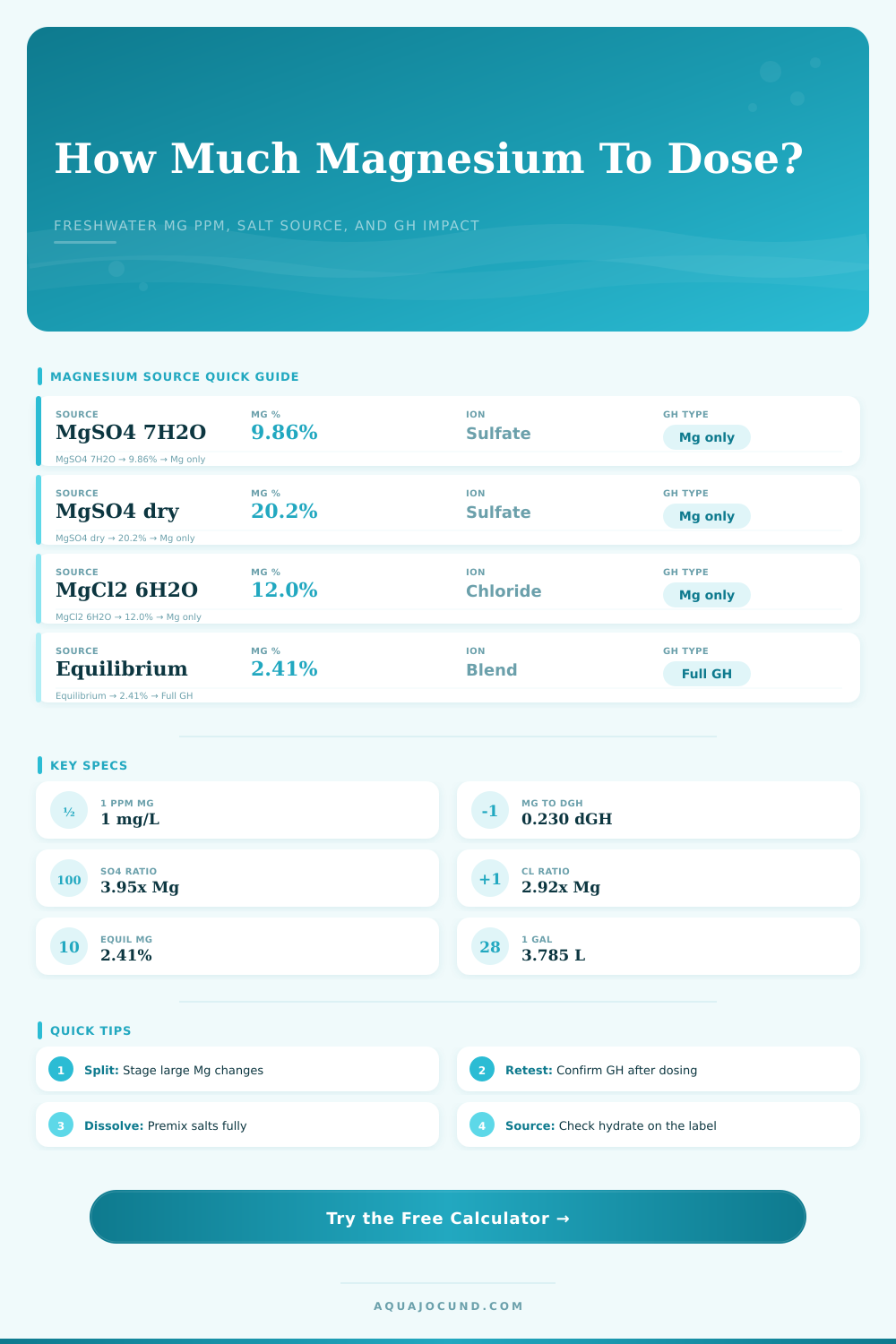
Target freshwater magnesium ppm, compare MgSO4, MgCl2, and Equilibrium doses, then stage the rise with GH impact shown.
| Source | Elemental Mg | Companion ion | Dosing note |
|---|---|---|---|
| MgSO4 7H2O | 9.86% | Sulfate, 3.95 ppm per ppm Mg | Common Epsom salt hydrate; verify additive-free grade. |
| MgSO4 anhydrous | 20.19% | Sulfate, 3.95 ppm per ppm Mg | More concentrated; keep dry and weigh carefully. |
| MgCl2 6H2O | 11.96% | Chloride, 2.92 ppm per ppm Mg | Useful when sulfate is already high. |
| MgCl2 anhydrous | 25.53% | Chloride, 2.92 ppm per ppm Mg | Very concentrated; hygroscopic and easy to overdose. |
| Equilibrium blend | 2.41% | Ca, K, sulfate mineral blend | Raises full GH more than the Mg-only hardness line. |
| Custom source | User entered | Unknown | Use the guaranteed Mg analysis from the product label. |
| Tank | Dimensions | Volume | MgSO4 7H2O for +5 ppm Mg |
|---|---|---|---|
| 10 gallon | 20 x 10 x 12 in / 51 x 25 x 30 cm | 37.9 L | 1.92 g |
| 20 long | 30 x 12 x 12 in / 76 x 30 x 30 cm | 75.7 L | 3.84 g |
| 29 gallon | 30 x 12 x 18 in / 76 x 30 x 46 cm | 109.8 L | 5.57 g |
| 40 breeder | 36 x 18 x 16 in / 91 x 46 x 41 cm | 151.4 L | 7.68 g |
| 55 gallon | 48 x 13 x 21 in / 122 x 33 x 53 cm | 208.2 L | 10.56 g |
| 75 gallon | 48 x 18 x 21 in / 122 x 46 x 53 cm | 283.9 L | 14.40 g |
| 125 gallon | 72 x 18 x 21 in / 183 x 46 x 53 cm | 473.2 L | 24.00 g |
| Mg increase | Mg-only GH | As CaCO3 | Freshwater use case |
|---|---|---|---|
| 1 ppm Mg | 0.23 dGH | 4.11 ppm | Fine trim for planted tanks. |
| 3 ppm Mg | 0.69 dGH | 12.34 ppm | Gentle single correction. |
| 5 ppm Mg | 1.15 dGH | 20.57 ppm | Common low-Mg tap water adjustment. |
| 8 ppm Mg | 1.84 dGH | 32.91 ppm | Better split for sensitive livestock. |
| 10 ppm Mg | 2.30 dGH | 41.14 ppm | Large correction; stage and retest. |
| Mg deficit | Suggested split | Per dose rise | Retest point |
|---|---|---|---|
| 0 to 2 ppm | 1 dose | Full correction | After circulation. |
| 2 to 5 ppm | 1 to 2 doses | 2.5 ppm or less | Next day if livestock are sensitive. |
| 5 to 8 ppm | 2 to 3 doses | 3 ppm or less | Before the final dose. |
| 8 to 12 ppm | 3 to 4 doses | 3 ppm or less | Between each dose. |
| 12 ppm plus | Custom plan | Use smaller steps | Confirm source and test kit. |
The water test kit reads three parts per million, but your planted tank need eight. And the number you get is only three. It doesn’t seem like a big difference on paper. But when you’re trying not to stress out your shrimp who live in substrate, that’s a huge difference. Math becomes sticky here. How much do you put into the tank?
There’s a bottle of this special blend or a bag of Epsom salt sitting on counter top, and now you want to know exactly how much to drop in there. Not enough and the plants continue to struggle. If you add too much, you might shock livestock. Enter the calculator above. This one runs numbers for you. Save yourself money on your water costs and understand what the inputs realy mean so you don’t make any expensive mistakes.
How to Add Magnesium Safely
Magnesium isn’t just magnesium. There are different forms of magnesium that change overall makeup of your aquarium’s chemistry depending on what you use. You can select magnesium from sulfate sources, which add sulfate. You can also choose magnesium from chloride sources, which add chloride. Alternatively, you can use equilibrium magnesium blends, which also contain potassium and calcium. This is all clearly explained in reference table found on the page.
Perhaps you’re using sulfate-heavy tap water so you don’t want to throw anymore into the equation. Maybe you have sensitive fry and you maintain soft water, so you probably wouldn’t of wanted to dump calcium in there without considering the hardness balance. Once you select a source for magnesium, the calculator will convert mass to match… But you need to select proper source for your water profile.
The other hidden variable is volume. The assumption is if it’s a ten gallon tank then it has ten gallons of water. Nope. Decor takes up space. Substrate takes up space. Water height is what counts, not the rated size of the tank. And that is where most folks gets lost. If they enter actual amount of water in the tank, then they have a true volume to work with.
The calculator factors for rectangular tanks, cylinder tanks, and even the goofy bow front shapes that don’t conform to clean geometry. A two percent error on volume is a two percent overdose. That’s enough to make all the difference between a healthy dose and a deadly spike when you’re talking about a small nano tank.
How fast you dose that number is just as important (and faster than slow is too fast… Shocking the system with a big dose all in one go). This is where dosing is staged: split up your dose to allow for adjustment and retesting. This helps the livestock/bacteria adjusts to the change in ion balance and gives you a chance to test again.
Yes, test kits don’t work perfectly: they can drift. You don’t want to overshoot, so test after applying half of the dose and see where you actualy are. Then decide if you need more or less on the remainder. It is just a little step, but it is better than overshooting.
Magnesium does affect general hardness (GH) which is something that you want to watch as a side effect. Magnesium raise the GH but not nearly as much as other salts like calcium. For each part per million of magnesium added, the GH will rise about four parts per million. So it’s not a one to one ratio. This allows you to manage your overall GH knowing that magnesium will contribute to it if that’s what you’re trying to do.
For example, if you’re trying to maintain low GH for some shrimp species or discus, then you’ll have to include this contribution in the equation. It displays how much GH it will add and whether you think its worth it or not.
Spoon estimates are garbage; weigh the salt, it’s not negotiable. Salt size varies, as does moisture content. A cheap gram scale is needed. First dissolve the salt into a cup of tank water, then pour in slowly around an intake. This spreads out the ions evenly instead of having them settle in a dense pocket on bottom. Local spikes from uneven mixing can harm nearby life.
The objective is stability; slight imperfection in the parameter can be tolerated better than fluctuations. Plan out the move with the tool and do it gradually. Test again and make adjustments as necessary. You’ll have made what was once a risky chemical adjustment a controlled process that your livestock will thank you for being patient with.
Because it’s gradual and the ions are balanced, the water remains clear and the plants thrive. It’s not about getting a number right on target, its about maintaining an environment stable enough for life to grow.