🌱 CSM+B Dosing Calculator
Calculate the exact CSM+B dose for your planted aquarium — dry powder or liquid solution
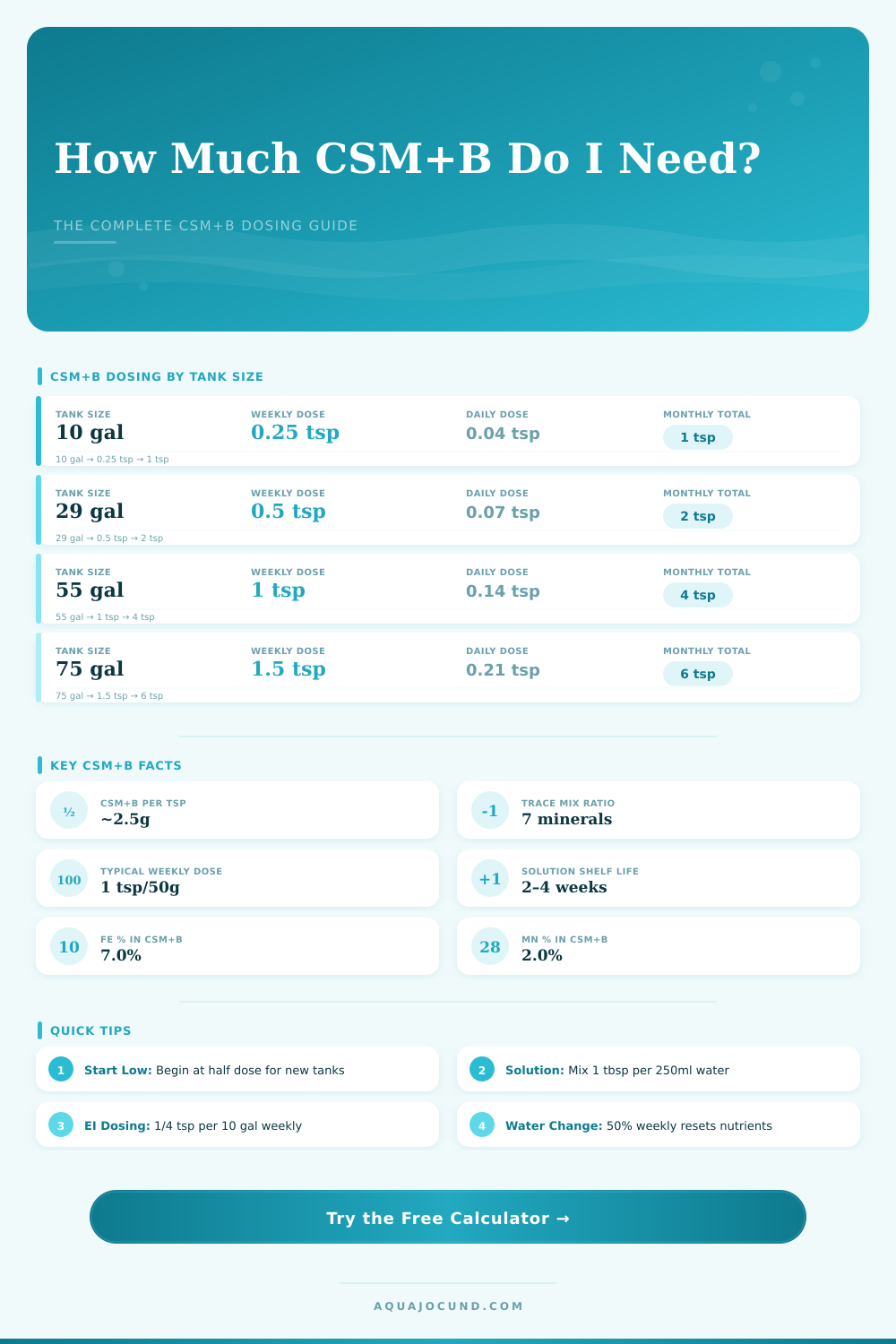
| Tank Size | Volume (gal) | Weekly Dry Dose | Weekly Dose (g) | Daily Dose (g) | Solution ml/dose |
|---|---|---|---|---|---|
| Nano | 5 | 1/8 tsp | 0.31g | 0.04g | 11 ml |
| Small | 10 | 1/4 tsp | 0.63g | 0.09g | 22 ml |
| Small | 20 | 1/2 tsp | 1.25g | 0.18g | 45 ml |
| Medium | 29 | 3/4 tsp | 1.88g | 0.27g | 67 ml |
| Medium | 40 | 1 tsp | 2.5g | 0.36g | 89 ml |
| Large | 55 | 1.5 tsp | 3.75g | 0.54g | 134 ml |
| Large | 75 | 2 tsp | 5.0g | 0.71g | 178 ml |
| X-Large | 100 | 2.5 tsp | 6.25g | 0.89g | 223 ml |
| X-Large | 125 | 3 tsp | 7.5g | 1.07g | 267 ml |
| Show | 180 | 4.5 tsp | 11.25g | 1.61g | 401 ml |
| Method | Rate (per 10 gal) | Frequency | Best For | Water Change |
|---|---|---|---|---|
| EI (Estimative Index) | 0.25 tsp/wk | 3x/week or weekly | High-tech, high-light | 50% weekly |
| PPS (Perpetual Preservation) | 0.125 tsp/wk | Daily small doses | Balanced/stable tanks | As needed |
| Lean / Low Tech | 0.0625 tsp/wk | 1–2x/week | Low light, slow growth | 25–30% weekly |
| Diana Walstad | 0.05 tsp/wk | Weekly minimal | Natural / soil substrate | Minimal |
| CSM+B per 250ml | Concentration (g/L) | ml per 10 gal/dose | ml per 55 gal/dose | Shelf Life |
|---|---|---|---|---|
| 5g (1 tsp) | 20 g/L | 3.1 ml | 17 ml | ~3 weeks |
| 7g (1.4 tsp) | 28 g/L | 2.2 ml | 12 ml | ~3 weeks |
| 10g (2 tsp) | 40 g/L | 1.6 ml | 8.5 ml | ~2 weeks |
| 14g (2.8 tsp) | 56 g/L | 1.1 ml | 6 ml | ~2 weeks |
| Tank / Project | Volume | Weekly Dose (g) | Monthly Total (g) | 100g Lasts |
|---|---|---|---|---|
| Shrimp Nano | 5 gal / 19L | 0.31g | 1.25g | ~80 weeks |
| Planted 10 gal | 10 gal / 38L | 0.63g | 2.5g | ~40 weeks |
| Community 29 gal | 29 gal / 110L | 1.88g | 7.5g | ~13 weeks |
| Dutch Style 55 gal | 55 gal / 208L | 3.75g | 15g | ~7 weeks |
| Discus 75 gal | 75 gal / 284L | 5.0g | 20g | ~5 weeks |
| Show Tank 180 gal | 180 gal / 681L | 11.25g | 45g | ~2 weeks |
You get the right substrate and you start a new planted tank with high hopes. You add the fish and wait for the green explosion, but nothing happens. Worse yet, algae take over. Typically this isn’t the fault of the CO2 or the lights. Usually it’s the trace minerals.
In the aquarium hobby, the usual answer is CSM+B, but dosing it properly seems to feel like chemistry homework. You don’t want a cloud of precipitate in your water column; you want lush plants. Plug in your tank size, select your method and let the calculator do the work for you on this page.
How to Use Trace Minerals in Your Aquarium
No more converting to gallons or guessing about coefficients. Select your approach, hit the calculate button, and there’s your number. Now go ahead and start with that number as a place to begin…but know the reason behind that number is how you’ll keep your tank healthy long after you’ve pushed the calculate button.
Most hobbyists uses the Estimative Index (EI) approach more than any other. In short, with this method you assume that you’re feeding so many nutrients that your plants will never be starved. How does it work? Aggressively. You dose high and then do giant water change to reset the doses. You have to be disciplined because if you miss one water change, your params shoots right through the roof. The calculator takes into account this factor by having a base line of how much you dose each week. In a typical 55-gallon tank, that’s about a teaspoon to an and a half a week. Sounds like a lot? It’s a lot, but plants eats up those minerals quickly while the lights are on.
The Perpetual Preservation System (PPS) is often more stable, and it is usually better if you want something gentle on your water parameters. Because it’s focused on low nutrient levels (stability), there isn’t as much need to do large water change and it can be done less frequently. You can toggle back and forth in the calculator and notice how much smaller the dose goes down with PPS. That’s because you’re trying to achieve balance, not excess.
Philosophy makes all the difference. EI is about dumping enough so there cannot possibly be deficiency. PPS is about having enough so stability are guaranteed.
Dry powder is versatile. Clump-free means dissolved. Clumped means sinking and wasting money. Mix carefuly! A premixed liquid is even better. The calculator will let you know what dilution to make. Seven grams of CSM+B in 250 mL of water is what most people use, and it dissolves well. Store it in the refrigerator, as it doesn’t last forever. Chelated iron is the most sensitive mineral in the mix, and heat and light break it down. Oxidation is quick, and when it happens, iron turn into a rusty sediment… Useless to plants. That’s why solutions are rated with a shelf life of two to four weeks, but dry powder last years (if it stays dry).
The golden rule of aquarium dosing is: start low! Substrate will release nutrients, which can change tank dynamics for new tanks. Plants may take time to take root and if you dose full strength on day 1, you could end up with a algae bloom. There’s also a buffer option in the calculator above, but again, that’s more like a safety net rather than a command to act. Start out at half the calculated dose for the first couple of weeks.
Observe your plants. Do they have new growth? Are the leaves green? Are the stems strong? Slowly bump up if so. Melting or brown spots could indicat that you’re either overdosing or underdosing (depending on the species).
Why do plants need trace minerals? They need them for growth and photosynthesis but only in very small quantities. Too little leads to stunted growth, and too much is toxic. Finding the sweet spot is easy…just not effortless. It just takes some care. And the calculator provides the roadmap. Drive the vehicle, but pay attention as to your particular tank’s reaction. Remember each aquarium is different. These are guidelines. Let your eyes be the last word.
Begin with the math. Trust the biology. That is how you get the water clean and the plants growing green. You should of known that.