Assassin Snail Population Calculator
Project assassin snail count from starter snails, breeding pairs, egg rate, hatch survival, prey snail supply, carrying capacity, and months.
Calculation breakdown
Month-by-month projection
| Month | Start snails | Eggs | Counted young | Prey limit | Removed | End snails |
|---|---|---|---|---|---|---|
| Calculate to build projection. | ||||||
| Breeding profile | Eggs per pair per month | Hatch survival | Prey use | Planning note |
|---|
| Tank or vessel | US volume | Metric volume | Working capacity | Starter range |
|---|---|---|---|---|
| 5 gal pest control | 5 gal | 18.9 L | 6-12 assassins | 1-2 snails |
| 10 gal planted tank | 10 gal | 37.9 L | 12-25 assassins | 2-4 snails |
| 20 long aquarium | 20 gal | 75.7 L | 25-55 assassins | 3-6 snails |
| 40 breeder | 40 gal | 151.4 L | 50-110 assassins | 5-10 snails |
| 55 gal community | 55 gal | 208.2 L | 70-140 assassins | 6-12 snails |
| Breeder tub | 30 gal | 113.6 L | 80-150 assassins | 8-16 snails |
| Prey supply condition | Snails available monthly | Model effect | Best use in calculator |
|---|---|---|---|
| Low visible prey | 0-25 | Strong reproductive cap | Use for maintenance after pest numbers collapse. |
| Light bladder snails | 25-75 | Moderate food limit | Fits small planted tanks with occasional pest snails. |
| Ramshorn bloom | 75-200 | Good growth support | Use when prey snails are seen daily on glass and plants. |
| Trumpet snail substrate | 150-350 | High but buried access | Lower prey access if substrate is deep and compact. |
| Feeder culture | 250+ | Food rarely limiting | Use for breeder bins with added prey snails. |
| Status band | Capacity fill | Prey balance | Calculator action |
|---|---|---|---|
| Building | Under 60% | Supply covers demand | Projection can continue without a capacity cap. |
| Tight | 60-90% | Supply near demand | Watch the prey limit and monthly removal setting. |
| Capped | Above 90% | Demand above supply | Capacity or prey supply is controlling the final count. |
| Declining | Any fill | Very low prey | Growth stalls unless prey supply or breeder count changes. |
Assassin snails keep aquariums pest free (ramshorn, bladder snails, etc.). They’re harmless to fish. In planted tanks, they’ll clean up without bothering any inhabitant.
What many people don’t realize is that these predators multiply like mad when there’s plenty of food. If you’re going to use them to keep your tank free from unwanted guests, be aware of population growth before adding them to your tank. One pair rapidly becomes a colony large enough to overwhelm a small space… or become starving if the prey supply run out.
How to Control Assassin Snails in Your Tank
Use the calculator above to have it do the math for you. Understanding what variables is will help you trust the output, and not make the most common mistakes.
They are male and female. Assassin snails don’t breed unless they have both sexes available. That means you can’t just plop down five snail in the tank and expect a 50/50 mix of males and females. Your ability to breed may be limited. Don’t rely on an unsexed group for your starting number, because half of them might be useless for breeding. Separate confirmed pairs from total count to ensure you’re tracking actual egg production.
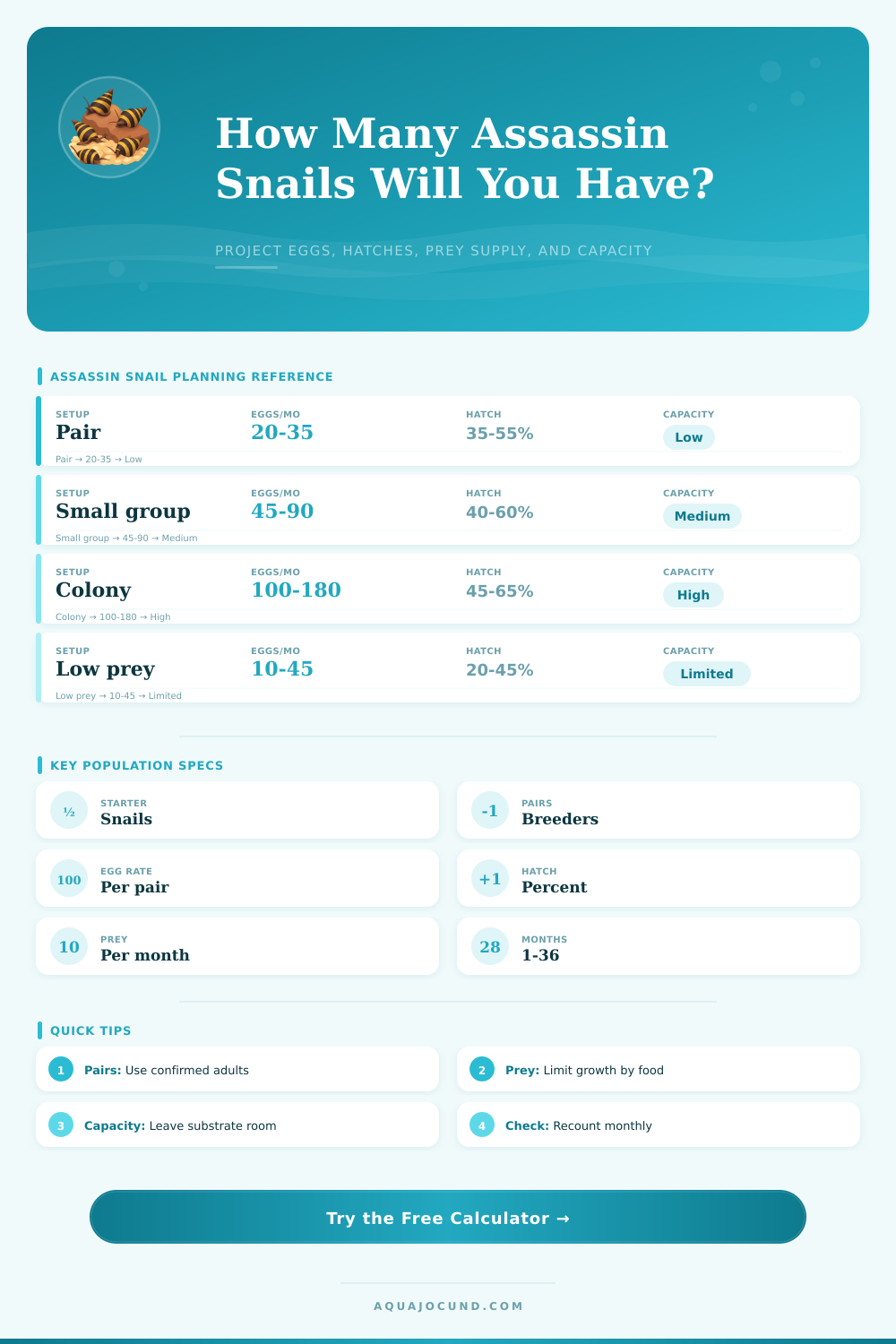
Egg output is directly related to breeding pair (not total numbers). A single pair producing twenty eggs per month is doable. But multiply that by five and suddenly there’s one hundred eggs produced every month which alters how you manage that tank.
Reality check: Only some eggs will hatch. Some juveniles won’t survive. Fungus, predation, and plain old getting lost in the substrate will kill off many. There’s a percentage field in the calculator for this. Typically it’s 35-60%. This will depend on your tank setup. If you have pristine water, you may want to believe that most hatched. Nope, even though you have top-notch filtration, tiny snails are still vulnerable. By leaving some wiggle-room for natural mortality, you keep the projections honest, so don’t worry about overstocking yourself down the road.
The final brake on population control is food supply. When no prey snails is left, either the assassin snails breed less frequently or stop breeding altogether. That’s a good thing (not a bug) for most aquarists. We don’t want them to kill off all our pest snails and then die from starvation.
The model factors in how much food each assassin eats per month compared to how much prey is available per month. If you have only a few pests, reproduction will stop and the population will reach equilibrium with fewer individuals than if prey were plentiful. Feeding alternative foods to try to force the population doesn’t work very well. They’re obligate carnivores when it comes to snail meat.
Substrate cover and tank size also impact carrying capacity. You can have significantly more snails happily livig in a tank covered in plantings, leaf litter, and deep sand versus a tank that’s bare bottom. This is why there is a density multiplier in the tool, it simply represents the physical reality of things. If you don’t provide some sort of hiding spot for snails, they won’t be happy. They’ll get stressed out by being hunted by other fish, like loaches and aggressive cichlids. This can kill them even when plenty of food is available. Set this to match your actual hardscape to get a much more true final result than simply basing it off gallonage alone.
The other practical consideration most people overlook is monthly removals. Whether removing too many to avoid crowding your tank or trading off some of them at the local fish store, those removals add up month after month. To account for such intentional culling and natural loss, set aside a low percentage of removals in the projection so it doesn’t assume all the juveniles will remain in place forever. After all, it’s biologically unlikely that every juvenile stays indefinitely, which is true for any managed aquarium anyway.
Now if you look at the month by month, it breaks down just how much the capacity limit kicks in. There should be a plateau in there where no matter how much breeding power you have, the population won’t increase anymore. Your tank is telling you that this is as big as it gets. Understanding that point turns a guessing game into a clear plan for trades and maintenance before you buy more stock.
Control: Get at least one confirmed breeding pair of assassin snails. Start small, just one or two confirmed breeding pairs. That way, if things get out of hand, it won’t explode on you and you can still monitor what’s going on.
For the first half year or so, watch the number of pests very carefully. If their numbers crash really hard, your assassins will level off at something sustainable without any intervention. If there are few pests left but your assassins continues to increase, then it might be time to rehome a portion to stores or friends to maintain balance in the ecosystem.
Remember, you want harmony, not max density. Let the numbers tell you how many more to stock because you want a healthy snail AND a clean tank long term.