Discus Fry Feeding Calculator
Estimate discus fry ration, feedings per day, daily food amount, growth stage, uneaten load, and water-change pressure for nursery planning.
Calculation breakdown
| Feed type | Default ration | Dry matter basis | Waste factor | Best calculator use |
|---|
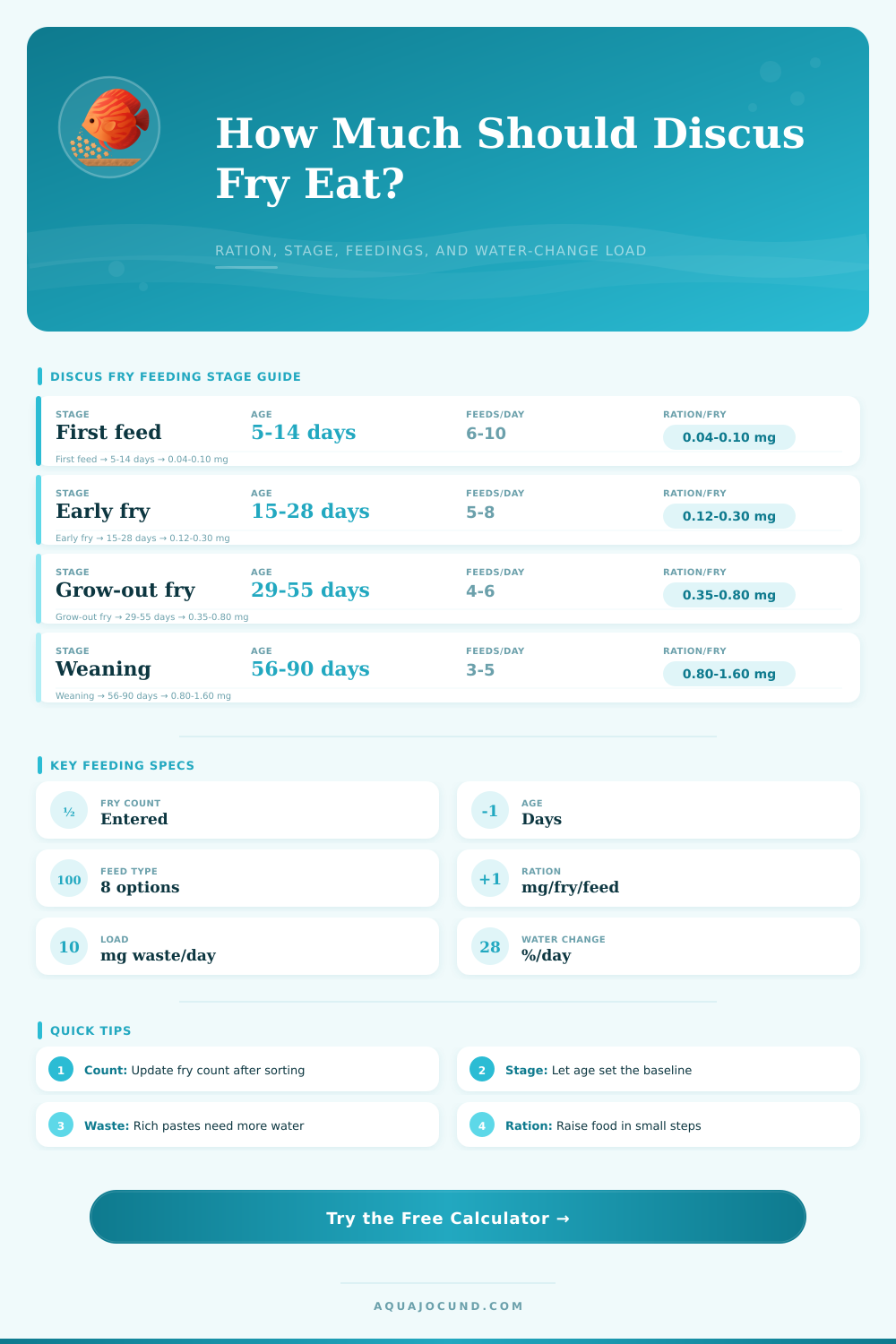
| Growth stage | Age range | Typical feedings/day | Ration guide | Load note |
|---|
| Nursery setup | US volume | Metric volume | Example fry group | Feeding-load note |
|---|---|---|---|---|
| Small pair tank corner | 10 gal | 37.9 L | 40-80 fry | Best for early observations with light external feeding. |
| Standard fry nursery | 20 gal | 75.7 L | 80-160 fry | Common size for first prepared-feed transitions. |
| Breeder grow-out | 29 gal | 109.8 L | 120-220 fry | Useful when daily feed grams start rising quickly. |
| Large grow-out | 40 gal | 151.4 L | 180-320 fry | More dilution for paste, crumble, and mixed feeding. |
| Rack grow-out tank | 55 gal | 208.2 L | 250-450 fry | Model water-change load before increasing ration. |
| Load band | Residual feed load | Water-change match | Calculation action |
|---|---|---|---|
| Light | Under 3 mg/L/day after cleanup | 20-40% daily often models well | Keep ration steady and watch leftovers. |
| Moderate | 3-7 mg/L/day after cleanup | 40-75% daily gives more room | Check whether feedings can be spread out. |
| Heavy | 7-12 mg/L/day after cleanup | 75-120% daily is commonly needed | Raise siphon efficiency or reduce paste-style feed. |
| Very heavy | Above 12 mg/L/day after cleanup | More than 120% daily may be modeled | Split fry, lower ration, or increase water-change capacity. |
As your discus fry become free swimming you’re nervous. You want to make sure everything is ok with them but it’s difficult because they’re tiny, translucent specks in the aquarium. New keepers will assume if there’s lots of food then the fish will grows up quickly. That’s typically not true as over feeding results in a biological breakdown inside tank before you realize what happened.
By entering the age and number of fry, this calculator do those calculations for you. No more guessing or calculating conversions and coefficients. Instinct becomes plan. Knowing how old (and not just how big) your fish are is foundational to any nursery plan.
How to Feed and Care for Discus Fry
Metabolic rates shifts in an orderly manner with development: very young fry depend on parental fluids, so you don’t want them eating too much at once but you do want them eating often. They develop a voracious appetite when they begin consuming microworms or brine shrimp. Keep up with this transition because the calculator assumes you’re at one or the other point on this scale. A three week old isn’t going to need same amount of calories as a six week old, for instance.
Get this timing correct and the fish won’t get bloated, nor are they likely to starve. Steady growth will result instead of a spike in deaths.
Discus’ sensitivity to nitrogenous waste makes maintaining good water quality a major concern when keeping discus. High-protein crumbles or dense pastes of food contribute far more waste than live feeds. In addition, uneaten food break down rapidly at elevated temperatures. To account for residual waste, the calculator estimates how much waste remains after each feeding based off factors such as siphon efficiency, amount of water changed per day, and your tank’s size. It displays the amount left over every day.
That number tells you if you’re already maxing out the capacity of your bioload or if your existing routine will sustain higher rations. It also tells you whether or not it’s time to upgrade your cleanup strategy (i.e., increase water changes) prior to feeding more.
Guess what? Most folks do exactly the opposite and simply add food. They don’t realize that adding food isn’t the same thing than adding clarity.
The type of food matters; it affects your workflow. Some foods leave minimal waste while others don’t. Certain foods need lots of prep time (e.g., new hatching brine shrimp) while others is ready-to-use immediately (e.g., prepared food). Food type influences daily routine. What works for one doesn’t work for another.
The waste factor shows how much fish poop after eating. Waste factors for different feed types are clearly displayed in the reference table on the page. Ration means how much food I should of give them. Default ration values are also shown on the same table.
Convenience vs. Labor: Feed your fish four times a day using pre-prepared food? Then be prepared for more water changes. Plan accordingly. The calculator will help you see the tradeoff between convenience and effort. For example, if you’re currently using live food and want to switch to paste, you’ll see that your water change requirements might double. Avoid midnight emergency siphonings by planning ahead.
Metabolism increases with water temperature; therefore, this is an important but complex variable in our equation. When water is warm, the fry consume more food while their excrement breaks down more rapidly as well. Since the warmer water will process toxins and other nutrients at a higher rate, you need to be even more careful about how frequently you feed them. In short, you can’t get away with being as sloppy as you might be with harder tropical fish, precise is the name of the game.
Depending on the temperature you enter into the program, it update the values accordingly so that they’ll match your conditions. This shows that keeping discus isn’t really about following a set of rules. Rather, it’s a changing balance of variables, requiring constant adjustment in real time.
In short, growing out discus fry is about data-driven observations. It means observing them, looking for belly color changes and other signs of sluggishness/discoloration. But instead of making an uninformed guess on where to start, these inputs set a base-line from which your settings remains stable while allowing nature to take its course with minimal stressors.
Keep it clean, feed according to stage, and let nature handle the rest. Let me repeat that, feed accordingly for stage. Feed as appropriate. Feed when they want to eat. That’s how tiny little specks turn into adult-sized beauty.