🥚 Egg Layer Spawn Interval Calculator
Estimate the next aquarium egg-layer spawning window from species group, conditioning days, water temperature, last spawn date, clutch recovery, and male/female readiness.
Calculation breakdown
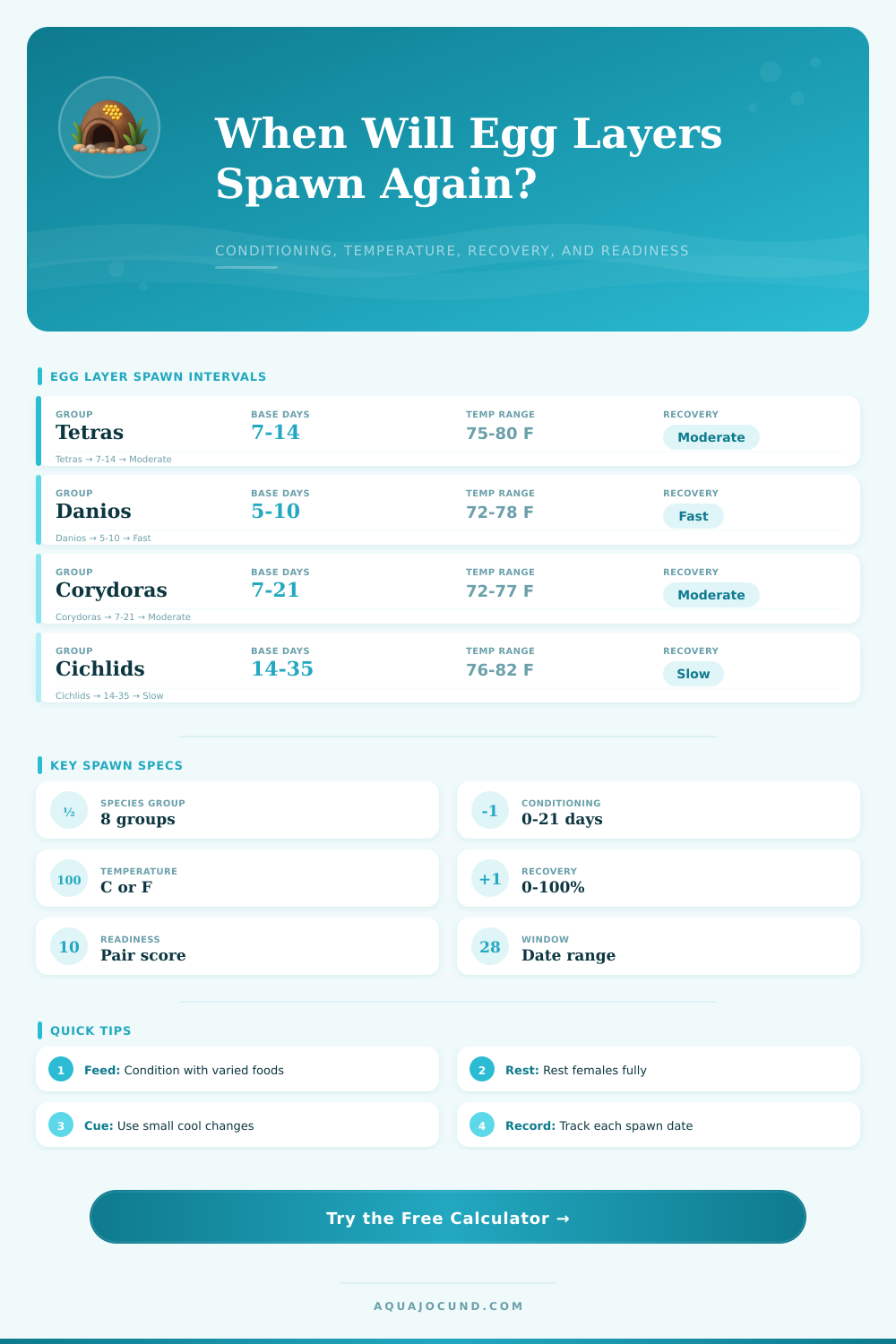
| Species group | Typical repeat interval | Preferred temperature | Recovery pace | Common trigger |
|---|
| Temperature position | Interval effect | Readiness effect | Use with caution |
|---|---|---|---|
| Below preferred range | Adds 10-35% time | Lower courtship score | Do not force warm jumps; raise slowly if appropriate. |
| Lower preferred range | Slightly slower cycle | Stable recovery | Often useful for conditioning before a trigger. |
| Middle preferred range | Baseline interval | Best all-purpose score | Good default for repeated breeding records. |
| Upper preferred range | Shortens interval modestly | Higher courtship score | Watch oxygen and female fatigue. |
| Above preferred range | Can stress fish | Penalty after short boost | Delay attempts unless the species naturally tolerates it. |
| Condition state | Female signs | Male signs | Recommended action |
|---|---|---|---|
| Too soon | Thin, low belly, hiding | Weak color or chasing only | Rest and feed; skip the trigger attempt. |
| Building | Eggs forming, body filling | Some color and display | Continue varied foods and stable water. |
| Ready | Rounded, active, feeding well | Strong color and courtship | Prepare mop, plants, cave, or spawning tank. |
| Peak | Very full but not distressed | Peak color, guarding, or displaying | Use the species-appropriate trigger soon. |
| Plan result | Readiness score | Recovery gap | Next step |
|---|---|---|---|
| Ready window | 75-100 | 0-2 days | Set up the spawning site and remove eggs or adults as needed. |
| Nearly ready | 60-74 | 1-5 days | Continue rich feeding and watch female fullness. |
| Condition longer | 40-59 | 4-10 days | Delay triggers; improve food variety and stability. |
| Rest required | 0-39 | 7+ days | Prioritize recovery, separation, and health checks. |
That’s where the calculator comes in handy. You don’t need to be a mathematician to determine when her biological clock resets. Egg laying fish pays dearly in terms of both physical and metabolic cost to spawn. Pushing her too early can result in poor quality eggs (not all will even get fertilized) and weaken her immune system.
When entering data into the “clutch recovery” section of the calculator, you’re guessing about the percentage of her energy tank that has been replenished from the previous event. Below seventy percent is typically a no go; she’ll need more time regardless of how eager her partner appear. Consistency isn’t found by chasing frequency. Respect the biological downtime.
How to Use the Breeding Calculator
There’s another factor affecting this timeline, the temperature of the water. Warmer water raise metabolic rates and can reduce how long you have to wait for another possible spawn. However, warm water can also raise oxygen demands and stress levels if water quality shifts. Since a fish at 72 degrees operates different than one at 78 degrees, the tool takes your actual tank temperature into account.
When things slow down because of cooler water, it provides a natural gap where getting ready is more important then actually spawning. It’s not a failure, it’s a maintenance phase that maintains viability for long haul.
The second direct lever you have is conditioning food quality. While flake-only diets will condition your fish, they don’t generally create enough of a deep physiological change necessary for optimal fertility. Live and/or frozen variety foods delivers the lipid/protein-rich nutrition for building up those egg. These dietary factors are used to calculate the readiness score on the results page, along with other visible cues like physical rounding and male display behaviors.
If it’s high, it means both sex are synced (sometimes easier said than done). Females rebuild and deplete before they’re ready again, whereas males stay good-to-go for days/weeks at a time. This is where the breeder’s skill lies, getting the two cycle in sync.
Triggering is something many hobbyists do wrong, they think more triggers = better. This could trigger spawning and cause a cold water shock that leads them to spawn. However, you will spike their cortisol levels, which will in turn suppress any future reproductive attempts. Over time, gentle triggering such as adding a new clean spawning mop or perhaps doing a modest water change will be far more effective.
The reference table on the page outlines typical intervals for different species groups, so you’ll see that tetras cycle much faster than cichlids. Keep in mind that what works for one species doesn’t work for all. Danios might be ready within a week whereas an angelfish pair might need several weeks to fully recover properley.
Even with the best laid plans, there is an invisible factor called “stress” that derails it all. Noisy surroundings, recent moves, or aggressive tank mates can completely stall it out. To give you a more realistic window and since stress is involved, the calculator accounts for this and will often push the timeline back based off disruptions. This saves you from watching frustrated fish try and fail. It forces you to view not only the biological clock but entire environment. Reading the animal, not the calendar.
That’s what successful breeding is all about. And that’s where this tool acts as a framework. It translates those physical signs into something actionable. What to do now and when to wait and when to prepare spawning site. It tells you when to let them go and when to put the brakes on.
It’s a balance between environmental triggers and recovery time, establishing a rhythm that supports health across many generations. That first deflated look from the female isn’t a crisis but part of a cycle. Respect the rest periods as much as active ones. Sustainable breeding works that way.