Zoanthid Frag Count Calculator
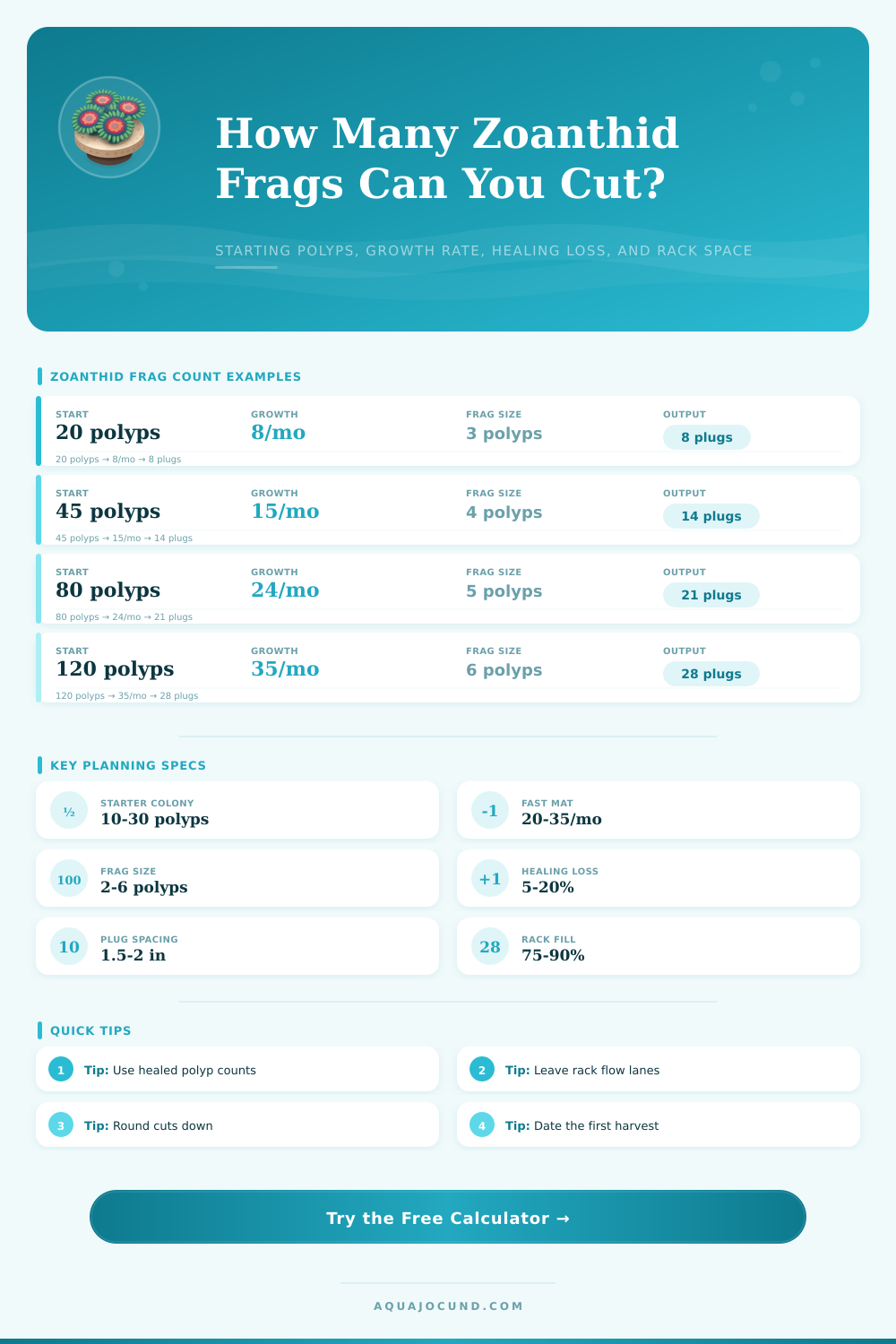
Estimate how many zoanthid frags you can make from starting polyps, monthly growth, healing loss, target plug count, and rack capacity.
Calculation breakdown
| Profile | Typical growth | Suggested frag size | Planning note |
|---|---|---|---|
| Mixed zoa rack | 8-18 polyps/month | 3-5 polyps | Use the average of several colonies. |
| Eagle eye / fast mat | 18-35 polyps/month | 3-4 polyps | Usually tolerates tighter harvest timing. |
| Rasta / steady mat | 10-22 polyps/month | 3-5 polyps | Good balanced default for grow-out racks. |
| Utter chaos / chunky polyps | 8-16 polyps/month | 4-6 polyps | Leave more tissue for stable healing. |
| Hornet type / slower | 6-12 polyps/month | 4-6 polyps | Plan longer between cutting sessions. |
| Designer slow grower | 5-10 polyps/month | 5-8 polyps | Best modeled with conservative loss. |
| Plan | Polyps per frag | Healing loss | Best use |
|---|---|---|---|
| Micro propagation | 2-3 | 15-25% | Fast multiplication when the rack has backup colonies. |
| Balanced grow-out | 3-4 | 8-15% | Most hobby rack planning and predictable healing. |
| Retail-ready plug | 4-6 | 5-12% | Cleaner plugs with visible healed coverage. |
| Premium slow grower | 5-8 | 10-20% | Protects higher-value polyps and slower mats. |
| Rack size | Metric size | Spacing | Typical usable plugs |
|---|---|---|---|
| 6 x 4 in | 15.2 x 10.2 cm | 1.5-1.75 in | 6-10 zoa plugs |
| 8 x 6 in | 20.3 x 15.2 cm | 1.5-1.75 in | 12-20 zoa plugs |
| 12 x 8 in | 30.5 x 20.3 cm | 1.75-2 in | 24-40 zoa plugs |
| 16 x 10 in | 40.6 x 25.4 cm | 1.75-2.25 in | 40-70 zoa plugs |
| Condition | Loss range | Healing window | Calculator setting |
|---|---|---|---|
| Clean cut, stable mat | 3-8% | 7-14 days | 5% |
| Normal hobby fragging | 8-15% | 10-21 days | 12% |
| Small micro cuts | 15-25% | 14-28 days | 20% |
| Stressed or recently moved colony | 20-35% | 21-35 days | 25% or wait |
Start with a small chunk of zoanthids. Fast forward several months and the zoos has grown large enough to fill your entire rack. There’s no room left for any more frags.
How’d that happen? That’s how many times this happens in reef keeping. You’re looking at something growing everyday which seems exponential, but planning for it appear linear.
Plan Your Zoanthid Growth
Use the zoanthid frag count calculator. The calculator connects what looks good visually with what make sense logistically. It tells you when to expect your mats to be full and how much you’ll get back after harvesting and accounting for healing loss. Instead of just calculating space, the planner asks for number of healthy polyps you start with as well as a projected growth rate per month.
Obviously this is going to vary from species to species based off lighting conditions and water parameters. A rapidly growing variety such as Rasta or Eagle Eye will yield a different figure. This is different than something like a slow growing designer strain, which can take months before it create another head. Based on those estimates, the calculator will tell you how long it will be until you’ll have enough tissue to split into required amount of frags. It will also prevent you from taking so much away that you risk killing off the mother colony. This is why so many people’s mats dies after only one harvest; they took out too much.
The variable that trips up most new growers is something they can’t see: healing loss. When you slice up a zoanthid, some polyps may never expands again. Perhaps their stress level was too high. Maybe they got cut too badly or didn’t like the water flow during recovery period. To account for this, the calculator includes an automatic percent deduction based on how well you think things will do. This way, the resulting figure represent only those plugs which are likely to appear healthy enough to be sold/displayed. If you pull out six-polyp retail plugs, you’ll have a lower mortality rate then if you were cutting apart two-polyp micro frags, for example. Tweaking this input keeps you from over-estimating what you’re getting in your haul.
The tool’s included reference data shows you what kinds of ranges to expect given different conditions. That way, you set reasonable expectations instead of having hope everything survives perfectly. All this production has a hard ceiling: rack capacity.
No matter the number of polyps, where will you put ’em? How much surface area do you have? What is the right spacing between plugs? And so on. If they’re crammed together, there won’t be enough space for proper flow and debris removal. Crowded plugs also gets shaded from light, which slows growth and extension. This increases the chance of disease due to waste buildup in stagnant spaces between colonies. To that end, the calculator also accounts for plug size and center-to-center spacing, so it can accurately tell you just how many empty spots still exist on your grid. So before cutting anything, you’ve already thought through the logistics. Your harvest matches your physical infrastructure, not your enthusiasm.
In addition, there’s the timing aspect as well, zoanthids don’t all grow at the same rate in their different life stages nor do they grow at the same rate all times of the year. For instance, a newly settled colony may be months away from adding any additional polyps, yet once established it can double in size within a few weeks. If you estimate a date for when you want to have some frags, then you could look back to see how long it would take based on growth rate and know if you’ll meet the goal with what you’re growing today. If the numbers indicate you lack sufficient tissue to reach your mark, you’d know instantly that either you’ll need to decrease the number of plugs you intend to cut or you’ll need to give things more time.
That sort of forward thinking takes the guessing out of this hobby and turns it into a plan you can manage instead of just leaving things to chance. The key to successfully growing zoanthids is striking a balance between what the animals can support biologically with what you want to achieve ambitiously. There is no use in cutting them many times to try and encourage growth, or in ignoring how much space they take up in your tank. These projections enable sustainable harvesting. You can keep the donor colonies healthy and maintain the health of any new frags, all while making the best use of your rack space.
From chaos (a colorful heap of polyp animals) emerges structure (an orderly plan that satisfies your ambitions but still honors the animal). And though I enjoy seeing them grow, the gratification stems from knowing just how much farther they’ll stretch out before you need to make room for the next batch.