LPS Coral Spacing Calculator
Estimate center spacing, sweeper clearance, night aggression margin, flesh expansion, growth room, and island layout capacity.
Recommended Spacing
| LPS type | Typical sweeper reach | Flesh expansion | Best spacing approach |
|---|---|---|---|
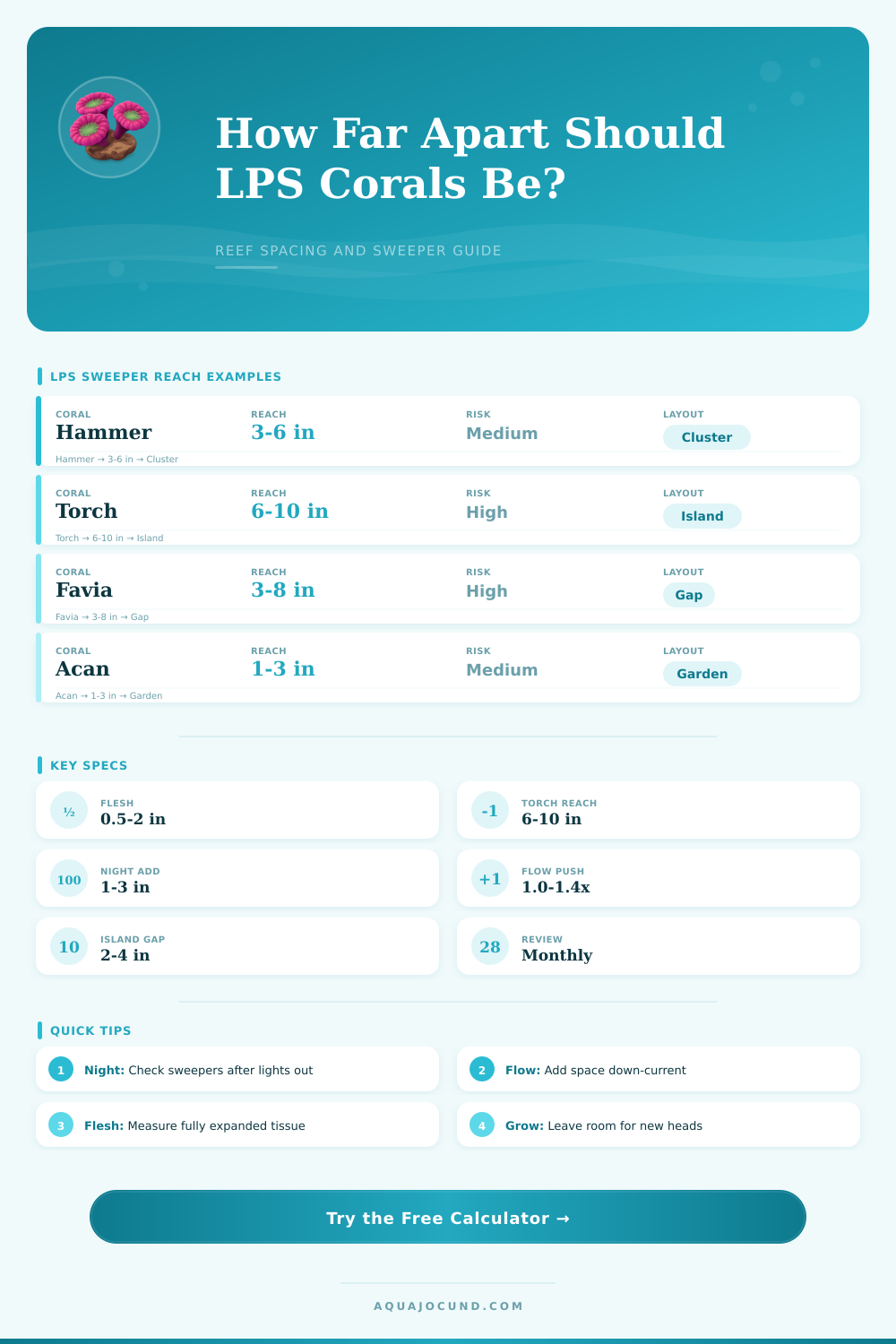
| Torch coral | 6-10 in (15-25 cm) | 1-2 in (2.5-5 cm) | Separate island or end of ledge |
| Hammer coral | 3-6 in (8-15 cm) | 1-2 in (2.5-5 cm) | Same-family cluster with gap |
| Frogspawn coral | 3-6 in (8-15 cm) | 1-2 in (2.5-5 cm) | Euphyllia garden with flow check |
| Favia or favites | 3-8 in (8-20 cm) | 0.5-1 in (1-2.5 cm) | Clear perimeter on rock face |
| Acan or micromussa | 1-3 in (2.5-8 cm) | 0.25-1 in (0.6-2.5 cm) | Garden spacing away from stingers |
| Galaxea | 8-12 in (20-30 cm) | 0.5-1 in (1-2.5 cm) | Dedicated high-clearance ledge |
| Chalice | 2-6 in (5-15 cm) | 0.25-0.75 in (0.6-2 cm) | Flat shelf with growth lane |
| Scoly or open brain | 1-3 in (2.5-8 cm) | 1-2 in (2.5-5 cm) | Sand bed buffer around flesh |
| Layout | Extra buffer | Use when | Spacing note |
|---|---|---|---|
| Same-family cluster | 0-1 in (0-2.5 cm) | Similar Euphyllia with known tolerance | Still leave room for swollen flesh |
| Mixed LPS garden | 1-2 in (2.5-5 cm) | Different genera share one zone | Use the most aggressive coral reach |
| Aggressive island | 3-4 in (8-10 cm) | Torch, galaxea, favia, unknown frags | Keep perimeter clear all around |
| Down-current ledge | 2-3 in (5-8 cm) | Flow pushes sweepers one direction | Add more room downstream |
| Sand bed spacing | 1-2 in (2.5-5 cm) | Scoly, trachy, open brain, acan | Protect inflated tissue from rock edges |
| Tank style | Usable LPS zone | Typical spacing limit | Planning note |
|---|---|---|---|
| 20 long reef | 24 x 8 in (61 x 20 cm) | 2-4 medium colonies | Place aggressive corals at ends |
| 40 breeder | 30 x 14 in (76 x 36 cm) | 4-7 medium colonies | Good for separate islands |
| 55 gallon reef | 38 x 10 in (97 x 25 cm) | 4-6 linear colonies | Watch narrow front-to-back gaps |
| 75 gallon reef | 42 x 14 in (107 x 36 cm) | 6-9 mixed colonies | Leave swim lanes and coral lanes |
| 120 gallon reef | 48 x 18 in (122 x 46 cm) | 8-12 mixed colonies | Use islands for long sweepers |
| Observation | Add margin | Risk signal | Action |
|---|---|---|---|
| No sweepers seen | 0.5-1 in (1-2.5 cm) | Low but not zero | Recheck after feeding |
| Short sweepers | 1-2 in (2.5-5 cm) | Occasional contact risk | Keep clear edge gap |
| Long sweepers | 2-3 in (5-8 cm) | Likely night reach increase | Use island or ledge end |
| Unknown new frag | 2-4 in (5-10 cm) | Behavior not verified | Start wider, reduce later only if safe |
The seller tells you that the torch coral you bring home has waving tentacles, it’s healthy! The tank seems empty so you put it next to a hammer coral. Three nights later, the hammer coral is half dead and the torch thrive. What happened? It involves spacing and aggression.
In the above example, the hammer coral show how far the invisible stinging cells carried by water flow can reach, which is more than what you see during the day. A dedicated spacing tool will help you visualize that invisible threat before committing to an arrangement that could cost you some expensive livestock. After inputting your tank’s dimensions, the calculator (above) do all the tricky math regarding sweeper flow dynamics and reach for you. Now you don’t have to guess if a two-inch safety buffer is enough.
How to Space Corals Correctly
While most of us consider coral placement in terms of real estate, meaning the number of colonies we can place on rockwork without skeletal overlap, it’s rarely the skeleton that’s the issue. It’s the soft tissue that hangs past the hard calcium carbonate frame. Many large polyp stony corals will spread their oral disc and send sweeper tentacles out into nearby territory when lights turn off. Under the bright lights during the day, this often results in an expansion that doubles or triples the size of colony. Because it’s happening when you’re not looking, estimating how much that increased flesh measures is tough. You’ll need to account for that based on how the species you chose behave. Fortunately, the tool does as well; there’s a place to enter both the expected flesh expansion and also the margin of night aggression.
Why is that? Because sometimes you just don’t know what you’ve got. Placing a new frag of unknown origin means giving it a little more room so that it won’t bleach you awake from unexpected chemical warfare that happened while you were asleep. Silent violence in aquarium takes the form of aggressive corals releasing their nematocysts to inflict damage on their neighbors even if they aren’t making physical contact.
And then there’s the whole issue of flow, which complicates this geometry even more. In today’s reef tank, water doesn’t sit motionless. Currents generated by powerheads pull on tentacles of sweepers, elongating their reach far past what you see when they’re at rest. For example, if a sweeper has a reach of three inches, a strong gyre flow can extend that range so it reaches up to six inches into the dangerous zone. The calculator accounts for the strength and direction of flow. If a coral is positioned in an area with heavy flow, it needs even more space. This means it needs much more breathing room than if it were placed somewhere sheltered in the back corner of the tank. Center-to-center distance isn’t as much of factor here as the direction of aggression in relationship to the flow.
The other layer of planning that most hobbyists don’t think about until too late is growth. Yes, not all corals stay small forever. What is a 4″ colony today could become a 6″ colony tomorrow with good lighting and stable parameter conditions. They won’t always just co-exist if you pack them tightly together now… they’ll fight each other or merge eventually. To avoid the unpleasant process of moving stressed corals every month or two as you run out of space, the planner lets you project their growth in months or years. This way, you can plan to space them correctly at first based on what they will look like then. Better yet, leave a little empty rock when you first set up rather than creating a crisis later.
Presetting common scenarios (e.g., torch island) is a starting point. However, you’ll do better by customizing them. Lighting and flow will vary between tanks, which changes the behavior of corals. What was a peaceful neighbor on one tank may become defensive and stressed out on another if water speed increases. While the typical reach for each species can be seen from the reference tables on the page, the ultimate choice depends off your own environment. If you keep euphyllia, you’re always best off giving them more room. It’s less expensive to purchase an ever so slightly smaller rock structure than it is to pay for a dead coral colony.
Proximity matters. Too much distance means no lushness. If there is not enough, things gets mangled. This thing will turn vague ideas about density into hard data so you know when you’re doing it right. From there, you’ll know how big of a hole to leave between plants. You will also know where to avoid putting things with sweepers. “Flesh expands” isn’t just some cliché phrase, because now you have a number for this expansion. Now you can build out a rock scape knowing it won’t need constant care. It’s a way of working with the animals instead of making them fit decor looks. Measure twice, place once. Set it in place once, and let the tentacles do their thing. You should of checked the math first.