Cleanup Crew Per Gallon Calculator
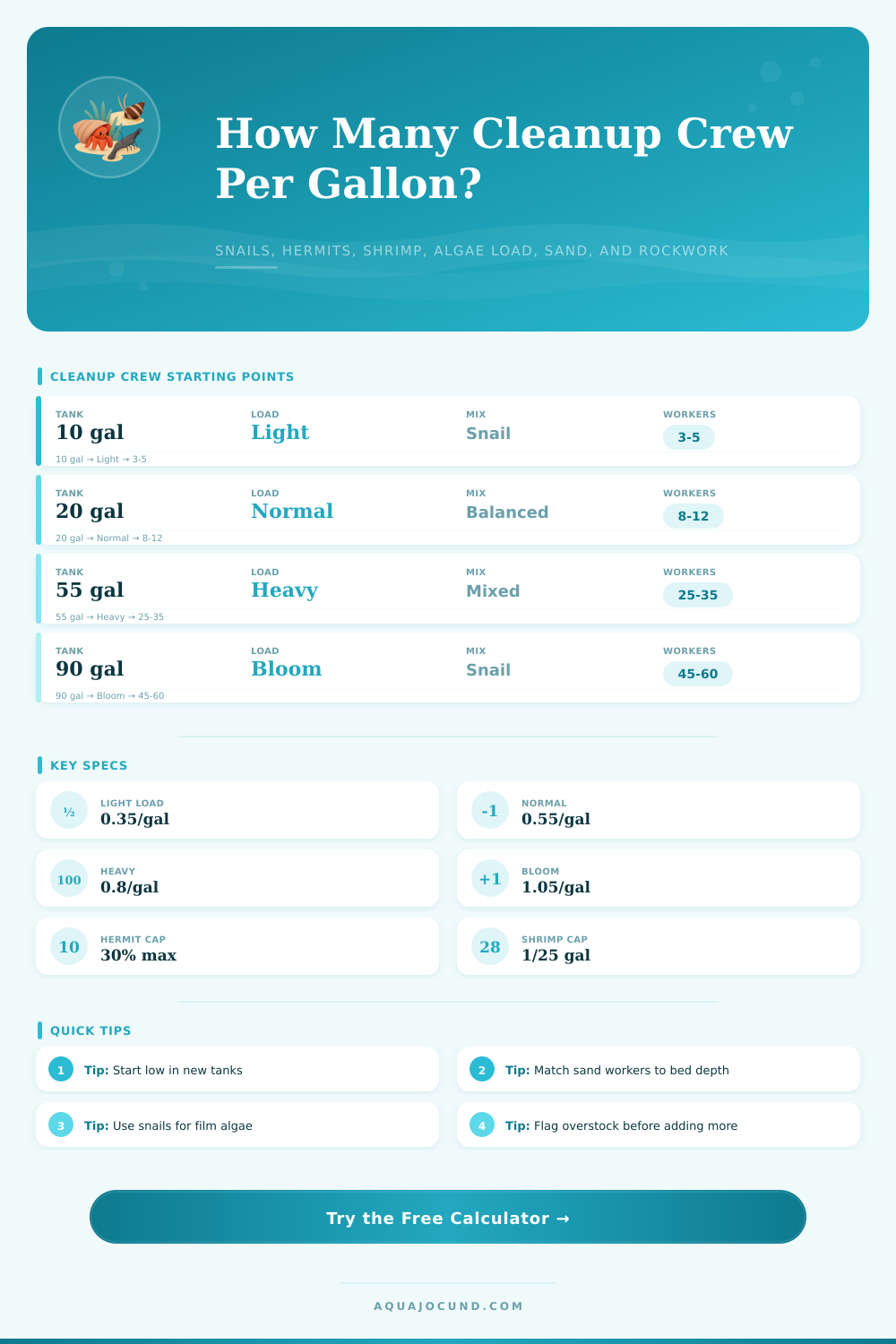
Estimate snails, hermits, and shrimp from tank volume, algae pressure, sand bed, rockwork, reef maturity, and stocking load.
Calculation Breakdown
| Worker group | Main role | Planning rate | Best matched input |
|---|---|---|---|
| Film algae snails | Glass, rock film, light diatoms | Base share 45-70% | Light to normal algae |
| Trochus and turbo style snails | Stronger grazing on rock and panels | Higher weight per worker | Dense rockwork or heavy algae |
| Nassarius style snails | Sand stirring and leftover food response | 0-25% of snail group | Standard or deep sand |
| Small hermits | Detritus picking and crevice work | 15-35% cap | Rockwork and mix preference |
| Cleaner shrimp | Visible scavenging support | About 1 per 25 gal | Shrimp-assisted mix |
| Common tank | Dimensions | Volume | Normal crew range |
|---|---|---|---|
| 10 gallon nano | 20 x 10 x 12 in / 51 x 25 x 30 cm | 10 gal / 38 L | 4-7 workers |
| 20 long reef | 30 x 12 x 12 in / 76 x 30 x 30 cm | 20 gal / 76 L | 9-14 workers |
| 40 breeder | 36 x 18 x 16 in / 91 x 46 x 41 cm | 40 gal / 151 L | 18-28 workers |
| 75 gallon reef | 48 x 18 x 21 in / 122 x 46 x 53 cm | 75 gal / 284 L | 34-52 workers |
| 125 gallon display | 72 x 18 x 21 in / 183 x 46 x 53 cm | 125 gal / 473 L | 56-86 workers |
| Adjustment | Low setting | Middle setting | High setting |
|---|---|---|---|
| Algae load | Light: 0.35 per gal | Normal: 0.55 per gal | Bloom: 1.05 per gal |
| Sand bed | Bare bottom lowers sand crew | 1-3 in adds sand snails | Deep sand raises sand share |
| Rockwork | Open aquascape factor 0.95 | Moderate rock factor 1.05 | Rock wall factor 1.22 |
| Maturity | New reef factor 0.70 | Mature reef factor 1.00 | Legacy reef factor 1.18 |
| Stocking pressure | Calculation effect | Warning behavior | Interpretation |
|---|---|---|---|
| Light | 0.92 waste factor | No special warning | Use the lower end of the crew range |
| Moderate | 1.00 waste factor | Standard reminder | Balanced starting estimate |
| High | 1.15 waste factor | Feeding and nutrient note | Crew helps surfaces, not water quality |
| Overstocked | 1.25 waste factor with cap | Overstock warning shown | Correct load before adding many animals |
So there you are, with a pristine set of water parameters and a beautiful aquascape; you’re convinced your tank’s in good shape. Fast-forward roughly 3 weeks. Now you see a subtle green film on the glass. In the next moment, it’s on the rocks as well. That algae isn’t just unsightly; it tells you that there is too much food for your biological filtration to consume.
This is when you can get the most use out of a cleanup crew per gallon calculator. By converting your tank size and waste load, it eliminates guesswork when making stocking decisions. Cleanup animals are more than decorations; they are necessary workers in most hobbyist tanks. Plugging your volume and algae pressure into the calculator does all the math for you, no need to question conversion factors, wonder about what number should of been used, etc. It also considers things not addressed by simplistic “per gallon” guidelines such as rockwork density, sand bed depth, etc. For example, the level of support required for a deep-sand reef with complex rock work differ from that needed for a bare bottom nano tank. It will tweak its baseline recommendation to match physical reality of your setup. No more overdoing it…or under-doing it.
How to Use the Cleanup Crew Calculator
So the actual planning begins with understanding what goes into the tank. What I mean by that is algae load include more than just the visible stuff on the glass, it includes total nutrient flux in your water column. High bioloads from fish combined with heavy feeding schedules greatly increase waste factor. This is how the calculator reads the pressure and recommends increasing worker density to match the rate of detritus production. However, its important to realize it’s not magic. No amount of snails can fix poor water chemistry or excessive feeding. They’re the cleanup crew, not the waste management system.
Beyond quantity of animals, you’ll want a good mix of species. For example, snails excel at removing diatoms and other stuff on surfaces; hermits clear waste from crevices inaccessible to shrimp. The calculator takes into account those respective duties based off your desired stock mix. Also, it recognizes hard limits; for instance, limiting hermit crabs so they don’t become pests and damage your livestock. This avoids the tendency to have too many aggressive grazers, such as scavengers. These will then out-compete slower-moving grazers or otherwise pester corals.
When it comes to adding the animals, timing matters. Newly set up tanks will not have enough algae developed to feed a whole team from day 1. Typically this lead to starving livestock after several weeks if you overload them from the beginning. To be conservative and protect your livestock, the calculator takes into consideration age of the tank (reef). Younger systems don’t yet have a lot of established food sources so it reduces recommendation accordingly.
And then there’s the issue of sand depth. Shallower sand beds are more dependent on surface grazing organisms; deeper sand beds need specialized stirrers to avoid anaerobic pockets. The tool shifts snail/crustacean balance based off this variable as well. For bare bottoms, it scales back on sand dwellers and pushes recommendation toward rock-grazers. There is no point in purchasing animals whose role is irrelevant to your setup.
Aggressively fighting an algae bloom can quickly lead to overstocking. While your desperation may tell you that throwing fifty snails in a ten gallon sounds great, it’ll crash the system. The calculator alerts you to potential overstocking and tells you not to go past safe density limits. It tells you to stock gradually rather than all at once. Introduce half the recommended amount, observe performance, then tweak accordingly.
The number of rocks also complicates the setup because there is more surface area for algae growth, meaning more work for your cleaning crew. Dense aquascapes hide food particles and require more thorough scavenging activity. More rocks means more cleanup and more hiding spots. That’s why I account for rock coverage when calculating worker numbers. So that every nook and cranny behind each stone recieve adequate cleaning. A little goes a long way, and it can be the difference between a clear display and a green haze.
In the end, this is an ecosystem builder instead of an animal-checklist buyer. It matches biological requirements with physical limits of the tank. This gives you a solid foundation to start from, whether you’re setting up a planted tank or a reef tank. Still, feeding habits and water quality must be monitored. The difference is if you have the proper crew in place, then maintaining the tank is doable. Use numbers generated and adjust accordingly. Watch and see how they respond to the environment. Adjust again as needed.
There are no instant tanks, only well-maintained ones, ones where inhabitants below the surface has a decent shot at doing what they do best. That green stuff that concerned you? Well, with the appropriate number of crew members, now it’s just one more element of natural order.