Copepod Population Calculator
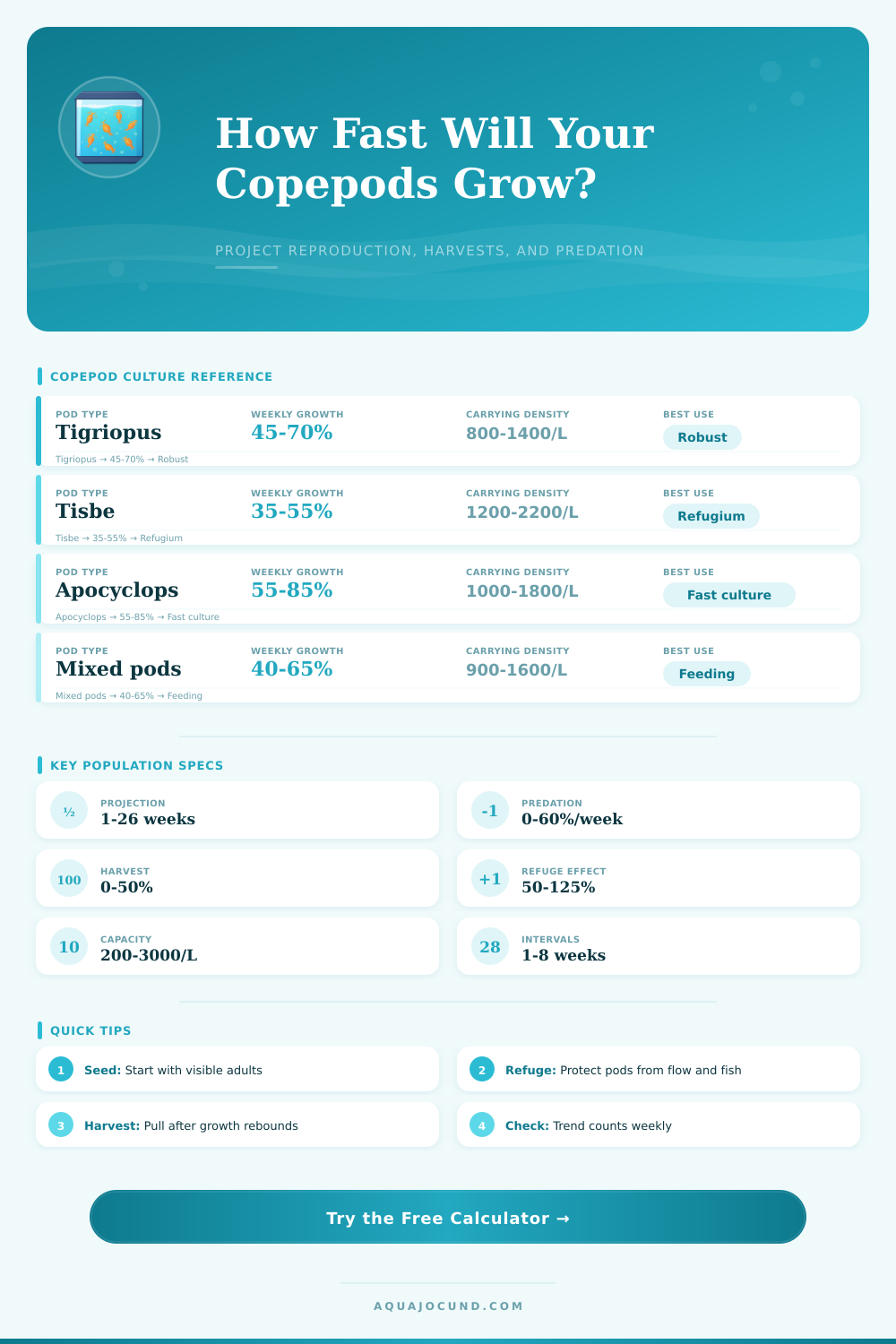
Project copepod count from starter pods, weekly reproduction, predation pressure, refugium volume, harvest interval, carrying capacity, and total weeks.
Calculation breakdown
Week-by-week projection
| Week | Start pods | New pods | Predation | Harvest | End pods |
|---|---|---|---|---|---|
| Calculate to build projection. | |||||
| Pod type | Default growth | Default capacity | Habitat pattern | Planning note |
|---|---|---|---|---|
| Tisbe benthic pods | 45% weekly | 1600 pods/L | Rock, rubble, macroalgae | Strong refugium population for display tanks |
| Tigriopus harpacticoids | 60% weekly | 1100 pods/L | Surfaces and culture vessels | Robust with visible adults |
| Apocyclops fast growers | 72% weekly | 1400 pods/L | Water column and surfaces | Fast rebound when food is steady |
| Parvocalanus nauplii | 50% weekly | 900 pods/L | Water column | Useful for larvae, more sensitive to harvest |
| Acartia pods | 42% weekly | 850 pods/L | Water column | Keep harvest conservative |
| Mixed reef pods | 52% weekly | 1300 pods/L | Mixed refuge zones | Best general estimate for bottled blends |
| Established refugium mix | 38% weekly | 1800 pods/L | Mature macroalgae bed | Slower but stable once packed with habitat |
| Bottle starter blend | 48% weekly | 1000 pods/L | Early colonization | Use moderate predation until settled |
| System | Metric refuge | US refuge | Capacity at 1200/L | Starter range |
|---|---|---|---|---|
| Nano rear chamber | 4 L | 1.1 gal | 4800 pods | 500-1500 pods |
| Small sump section | 12 L | 3.2 gal | 14400 pods | 1500-4000 pods |
| Medium refugium | 40 L | 10.6 gal | 48000 pods | 3000-10000 pods |
| Large macro bed | 75 L | 19.8 gal | 90000 pods | 8000-20000 pods |
| Dedicated culture bin | 100 L | 26.4 gal | 120000 pods | 10000-30000 pods |
| Population condition | Interval | Harvest amount | Reserve target |
|---|---|---|---|
| Newly seeded or sparse | 4-8 weeks | 0-10% | 70% or more |
| Growing below capacity | 3-5 weeks | 10-18% | 60% or more |
| Stable and dense | 2-4 weeks | 15-25% | 50% or more |
| Dedicated culture vessel | 1-3 weeks | 20-35% | 40% or more |
| Heavy display predation | 4-6 weeks | 0-12% | 65% or more |
There are no magic numbers with copepods. Instead, copepod culture follows expected rules of population biology. Once you understand the rules, you have a predictable source of food for your corals and fish in your refugium. Define your habitat conditions, and the calculator on the page do the math for you.
First, focus on carrying capacity (how many pods per liter of water). Every liter of water can only handles so many pods. That limit varies based off oxygen exchange, food availability, and surface area. A dense bed of macroalgae support more individuals than empty sump. The reference table show how various habitats alter that ceiling. If you overestimate density or underestimate volume, starvation will occur before reproduction catches up. This will result in a population crash.
How to Keep Healthy Copepod Populations
Some species reproduce faster then others. Some reproduce more slowly but more steadily. Tisbe reproduces slow but steady, while Tigriopus reproduces faster but at a lower density. Apocyclops increases rapidly when fed well, but lives in the water column. Because each species occupies a specific role, mixing them together act as a safeguard against failure.
When you select a pod type within the tool, you’re selecting a particular growth curve. The faster growing species will hit capacity sooner, but crash harder once resources become exhausted. New culture drops sharply due to predation. Currents pin them into corners, fish munch on them and skimmers take them away. You can estimate this by entering a percent loss per week in the model.
Novices often believe there’s no predation at all (until they have tankful of pods). That kind of optimistic thinking fails to appreciate the need for greater seeding rates. The hungry mandarins will consume pods quicker than the pods can propagate. Seed your culture heavily enough to outcompete the ravenous appetite.
Good harvesting practices is essential for long term success. Don’t over-harvest and disrupt the population momentum by pulling out all the pods at one time. There’s a “safety reserve” option in the calculator that prevents over-harvesting. If you leave 25% of the population intact, then it will contain breeders. Even if half your population get pulled off or eaten up, leaving the other quarter alone will let them re-populate in just a few weeks.
Volume and timing matter, How full is your tank? If it’s every week, you’re keeping them on their toes and in recovery mode. Every other week? Two or three weeks? That’ll let the population peak naturaly. It won’t be nearly as stressful on the colony. To balance short-term needs with long-term stability, harvest less often but in larger amounts when necessary. If you have a lot of animals in a big display tank and they’re hungry predators, you need to go small and more frequent. Don’t run the risk of pulling the rug out from under your source entirely.
Growth is fueled by food. Consistent detritus or microalgae is required for reproduction to take place. The quality factors reflects this fact. If your sump has few pods, even with high initial pod counts, growth will be slow. By feeding regularly using phytoplankton cultures, you will effectively double your capacity while maintaining healthy adult that reproduce continuously. That’s how a trickle becomes a steady stream.
Begin conservatively, If you don’t know, assume less than what appears. It is better to have a quick increase over a slow, steady death. The projections should of been for the tool. Your duty is providing an environment where that math can happen. Provide constant food. Shield pods from both fish and flow. Let pods breathe. Respect their biology and you’ll never run out of plenty.