Betta Jar Volume Calculator
Estimate temporary holding water volume, fill height, displacement, water change volume, surface area, and short-hold density for betta jar transfers.
Betta Jar Volume Result
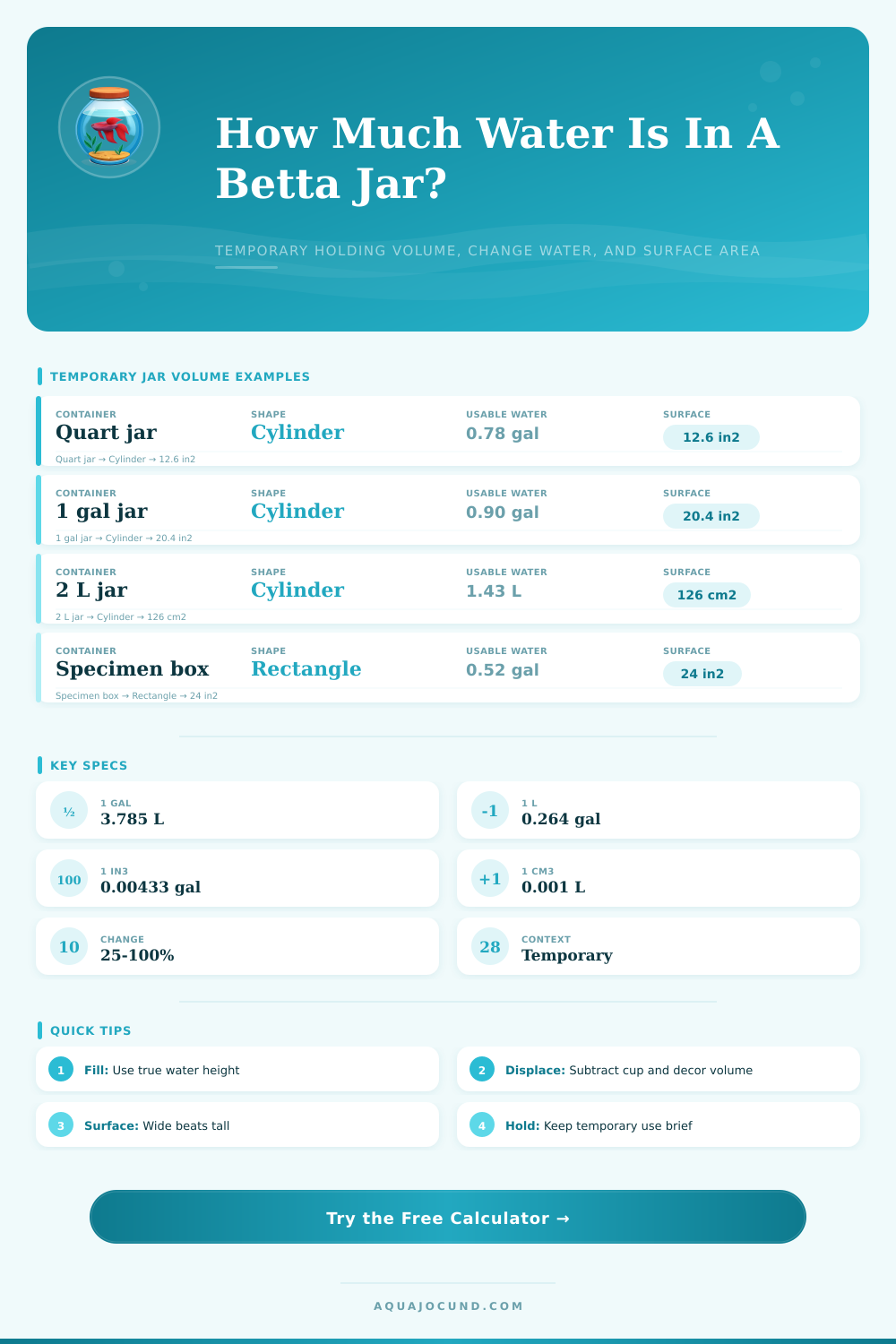
| Container | Typical inside dimensions | Usable volume | Surface area |
|---|---|---|---|
| Photo cup | 3 in dia x 3 in fill / 7.6 cm dia x 7.6 cm fill | 0.09 gal / 0.35 L before displacement | 7.1 in2 / 46 cm2 |
| Pint jar | 3.1 in dia x 4.7 in fill / 7.9 cm dia x 11.9 cm fill | 0.15 gal / 0.58 L before displacement | 7.5 in2 / 49 cm2 |
| Quart jar | 4 in dia x 7.5 in fill / 10.2 cm dia x 19.1 cm fill | 0.41 gal / 1.54 L before displacement | 12.6 in2 / 81 cm2 |
| 1 gallon cylinder | 5.1 in dia x 11 in fill / 13 cm dia x 28 cm fill | 0.97 gal / 3.68 L before displacement | 20.4 in2 / 132 cm2 |
| Specimen box | 7 x 4 x 5 in / 18 x 10 x 13 cm | 0.61 gal / 2.29 L before displacement | 28 in2 / 181 cm2 |
| Emergency tub | 12 x 8 x 5 in / 30 x 20 x 13 cm | 2.08 gal / 7.87 L before displacement | 96 in2 / 619 cm2 |
| Usable water | 25% change | 50% change | 100% reset volume |
|---|---|---|---|
| 0.25 gal / 0.95 L | 0.06 gal / 0.24 L | 0.13 gal / 0.47 L | 0.25 gal / 0.95 L |
| 0.50 gal / 1.89 L | 0.13 gal / 0.47 L | 0.25 gal / 0.95 L | 0.50 gal / 1.89 L |
| 1.00 gal / 3.79 L | 0.25 gal / 0.95 L | 0.50 gal / 1.89 L | 1.00 gal / 3.79 L |
| 2.00 gal / 7.57 L | 0.50 gal / 1.89 L | 1.00 gal / 3.79 L | 2.00 gal / 7.57 L |
| Step | Cylinder | Rectangle | Output use |
|---|---|---|---|
| Gross volume | pi x radius2 x fill height | length x width x fill height | Raw jar water before subtraction |
| Net volume | gross minus displacement | gross minus displacement | Usable temporary holding water |
| Surface area | pi x radius2 x opening factor | length x width x opening factor | Water-air contact estimate |
| Change volume | net volume x selected percent | net volume x selected percent | Measured replacement water |
| Density read | adjusted load per gallon | adjusted load per gallon | Short-hold context flag |
| Context | Calculator emphasis | Helpful volume read | Surface note |
|---|---|---|---|
| Brief photo or inspection | Known water volume and low displacement | Small measured cups can work for minutes | Keep surface unobstructed |
| Water change holding | Replacement volume and holding time | Use the change card to pre-measure water | Prefer wider containers |
| Short observation jar | Density, surface area, and duration | Use conservative buffer | Watch narrow necks |
| Emergency temporary container | Maximum usable water and surface | Wide tubs outperform tall jars | Surface area is a primary limit |
I’m sure you can imagine exactly how your betta should live. Most people imagine something similar, a heated, filtered tank with some lights that aren’t too bright and lots of room to swim. However, reality doesn’t always match expectations. Maybe you’re bringing your fish home from the local fish store. Perhaps you have to hold the fish while you’re changing water. All of a sudden you find yourself staring at a plastic cup or glass jar and asking yourself whether it’s OK. Is it a harmless transfer or a stressful ordeal?
Physics and geometry will dictate the answer more than good intentions. What’s in the container is much more important then what the lid says. The biggest mistake people make with temporary housing are getting hung up on volume. By definition, a quart jar contain 32 fluid ounces of water. Your betta doesn’t live in ounces; it lives in surface area and how much dissolved oxygen is available. If you add some decoration or even a cup to that jar, what happens? You’ve displaced some water. Less water mean less space to dilute wastes and perform gas exchange.
How to Keep Betta Fish Safe in Temporary Containers
The calculator takes care of all that math for you after you input your dimensions so you don’t have to worry about any conversions or coefficients. It will tell you how much has been displaced and it will show you the real usable amount. The total volume may look like a lot. However, if it is all rock, there is not much space for fish to swim, breathe, and be happy.
The other measurement that we tend to forget about until something goes wrong are surface area. Because bettas are labyrinth organ users, they must has regular access to air. While a tank with the same volume that’s shallow and wide will contain just as much water as one that’s tall and narrow, the latter have much less surface area on which oxygen exchange occurs. That little bit of surface area can quickly become a limit when the water quality decline (not an uncommon occurrence in small), unfiltered volumes. To help you visualize if your fish can easily get up there, the tool calculates that contact area too.
These dimensions are meant for planning purposes only and that is exactly how you should use them. The other factor here is timing. You can use a cup that has minimal chemical impact compared to one that sits on the water twenty minutes. Oxygen will be depleted more quickly and waste products will build-up faster during a two hour observation vs. It is a twenty minute transfer. By entering the duration of your hold into the calculator you can determine how stressed the fish is and what level of water they’re going to need.
If you are keeping the fish there for several hours due to an emergency, then you should of get out a larger bucket. But if you’re changing filters and only going to have them in there for five minutes, you’ve got a bit more wiggle room. It all depends on how long you intend on leaving them there.
This type of specific thought process also applies when doing water changes. To change 30% of your water, you need to know exactly how much to remove so you can replace it with clean water that has a similar chemical makeup and temperature. If I knew exactly how much water I was removing, then I wouldn’t dump half my tank, nor would I mess up by not topping it off enough. Before I begin siphoning, it’s just as easy to use those ratio tables on the page to measure out the proper amount to add back once I’m done. This makes the whole process less stressful for the keeper (who doesn’t have to guess at volumes halfway through) and also less stressful for fish.
First and most importantly… Note that no jar is meant as long term housing. The goal is always to minimize the time spent in one. If you keep it there or perform a transfer, move it out of the temporary environment and back into a well-set-up tank ASAP. This information will help you do that. You will go from not knowing how to build better bridges to confidently building them from point A to B, because you now know the limitations of your temporary equipment.
I think we should all be careful not to confuse “owning the appropriate gear” with “taking care of your betta”. In other words, regardless of what you use, whether it’s a borrowed jar or a permanent tank, time, surface area, and volume is still just as important. Carefully measuring these parameters ensures a safe and comfortable environment for your fish during his/her temporary stays…stays that hopefully don’t last long enough to cause lasting harm.