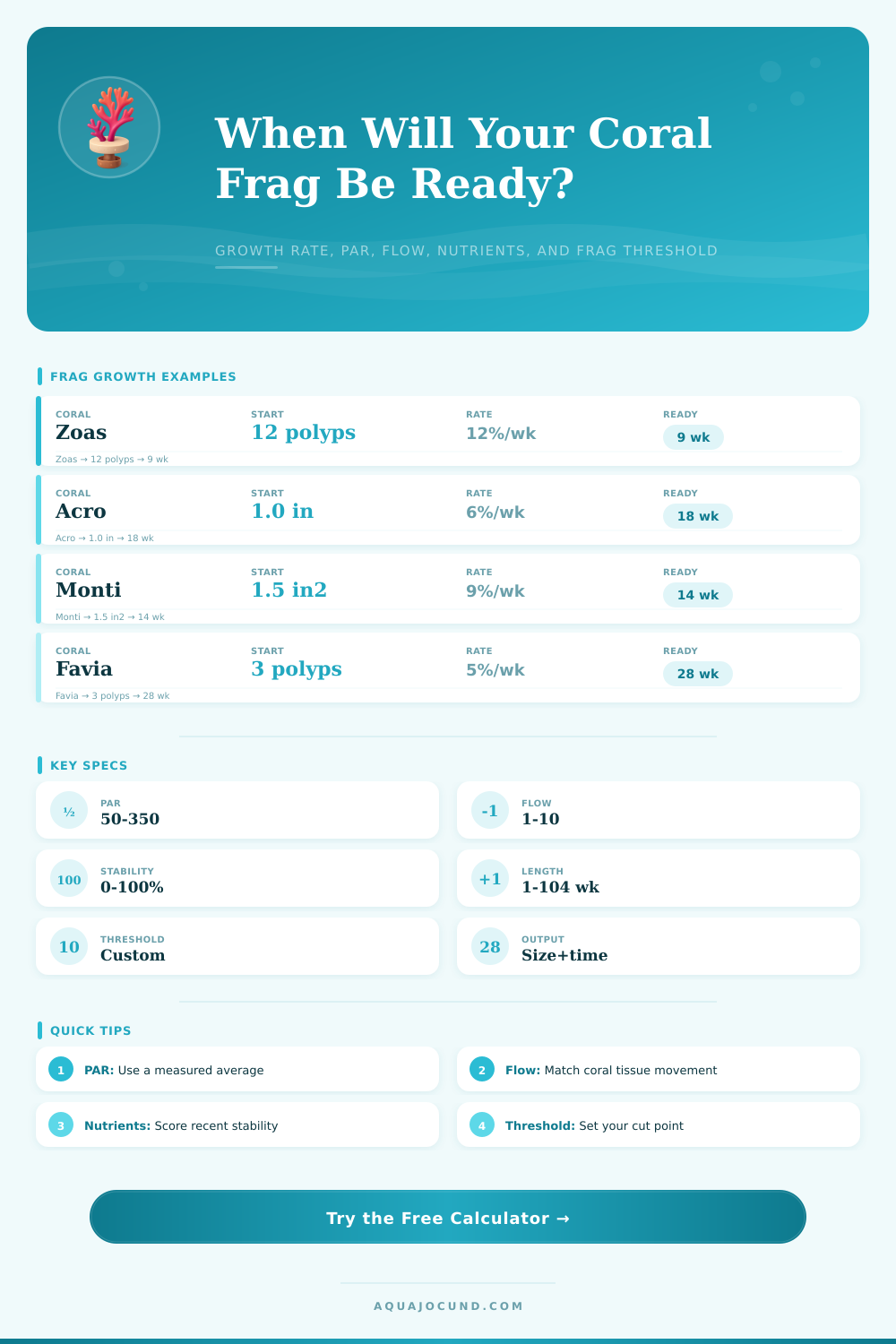
Coral Frag Growth Projection Calculator
Project frag size, polyp count, environmental growth modifiers, and the week a fragging threshold is likely to be reached.
Growth breakdown
| Point | Week | Projected size | Projected count | Threshold status |
|---|---|---|---|---|
| Run calculator | 0 | - | - | - |
| Coral type | Base growth | PAR range | Flow score | Threshold example |
|---|---|---|---|---|
| Zoanthid / palythoa | 12% per week | 60 to 180 | 3 to 6 | 40 polyps |
| Acropora branching SPS | 6% per week | 220 to 380 | 7 to 10 | 2.5 in branch |
| Montipora plate/encrust | 9% per week | 150 to 320 | 5 to 8 | 4 sq in |
| Euphyllia branching LPS | 4% per week | 80 to 180 | 2 to 5 | 4 heads |
| Favia / favites | 5% per week | 80 to 180 | 2 to 5 | 8 mouths |
| Green star polyp mat | 14% per week | 80 to 220 | 4 to 8 | 6 sq in |
| Mushroom / ricordea | 7% per week | 40 to 120 | 1 to 4 | 5 discs |
| Chalice / echinophyllia | 4.5% per week | 80 to 180 | 2 to 5 | 6 eyes |
| Acanthastrea / micromussa | 5.5% per week | 60 to 150 | 2 to 5 | 8 heads |
| Modifier | How calculator scores it | Low effect | High effect |
|---|---|---|---|
| PAR match | Best near the middle of the coral type range | 0.70x | 1.12x |
| Flow match | Best inside the type flow band | 0.75x | 1.08x |
| Nutrient stability | 0 to 100 percent stability score | 0.75x | 1.08x |
| Alkalinity swing | Penalty increases above 0.30 dKH per week | 0.82x | 1.02x |
| Trim loss | Applied after the fragging threshold is reached | 0% | 50% |
| Example | Starting size | Typical PAR | Projection | Fragging threshold |
|---|---|---|---|---|
| Zoa plug | 8 to 15 polyps | 80 to 150 | 8 to 16 weeks | 35 to 50 polyps |
| Acro nub | 0.75 to 1.5 in | 250 to 350 | 16 to 32 weeks | 2 to 3 in branches |
| Monti cap chip | 1 to 2 sq in | 180 to 280 | 12 to 24 weeks | 4 to 6 sq in |
| Euphyllia head | 1 to 2 heads | 90 to 160 | 20 to 40 weeks | 3 to 5 heads |
| Favia tile | 2 to 4 mouths | 80 to 160 | 24 to 44 weeks | 7 to 10 mouths |
| GSP island | 1 to 2 sq in | 90 to 200 | 6 to 14 weeks | 5 to 8 sq in |
Starting out, you get a high-end Acropora nub or small plug of Zoanthids for as much money per square inch as gold and then you stare at it for months as it mounts up and slowy comes back down from its initial shock. When will it finally get big enough to divide without killing the parent colony? Not if, but when. It’s that time that gets the best of most fraggers’ patience or nerve.
Use the calculator above to do the math for you. Just plug in your own coral species and your tank parameters. This saves you from making an educated guess based off what works for someone else who likely has different conditions than you.
Why Coral Growth Depends on Care
This matters because growth projection will depend on what you define as growth. Some people measure the number of polyp. Others measure branch length. Still others may measure surface area in square inches. With this tool, you can choose which one matches best with how you measure your frags.
For example, if you’re keeping branching SPS then measuring length make sense. If you have encrusting Montipora or GSP mats then only area is an honest way to measure. Why? A branch can grow longer without necessarily increasing its weight much. In contrast, a mat grows outward to look big visually but gains weight at a slower rate. Mixing these causes confusion/frustration when you think something grew when realy it just spread out.
Pick the approach that fits how you cut frags. It’s never just one thing. Growth rates comes from many environmental factors pushing against or with each other. Light, which is what drives photosynthesis, is engine. Flow delivers the goods. It clears away wastes and brings new goodies to the polyps. But even if light conditions are perfect, insufficient flow prevent the necessary removal of waste and delivery of fresh food to the corals. They literally starve right before your eyes.
That’s where the modifier part of the tool comes in, it allows you to rate your flow match. If you get a good number, that means you’ve got return pumps running at a level that generates chaotic, turbulent movement (what most reef corals evolved with). A lower number suggest laminar flow. This creates dead spots and severely slows down tissue growth.
Beyond the actual numbers read from your test kit, nutrient stability is important. If you have high nitrate, it’s not necessarily a problem if levels are stable. If your corals see nitrate levels fluctuate wildly week after week, it’s game over. Rollercoasters (i.e., spikes & crashes) will kill any growth potential. The calculator penalizes poor scores for nutrient stability because physiologically, this create stress and inhibits calcification. The same holds true for swings in alkalinity. A little bit of daily alkalinity drift is fine. But a big weekly swing requires your coral to spend energy constantly remaking the structure of its own skeleton instead of merely adding to it. This is energy that comes straight out of “growth” reserves.
That brings us to the economics of fragging: When should I harvest? If you’re cutting too soon, frags is small and may take longer to heal and grow out (reducing your hourly wage). Cut too late, however, and they might grow too much or cast shade on the underlings, wasting precious real estate you can fill with more stock. That’s where the threshold input comes in, once your frags reach that min. Size, you’ll consider them ready for a trim. The expected harvest window then gives you an idea of when you’ll be at that stage, use it to schedule your week’s work rather than being caught off guard by something that just “looks big” one random Tuesday evening.
No secret setting exists that will cause corals to double in size overnight. You just need accurate measurement and regular care. Hobbyists routinely underestimate the impact of their own care practices on growth rates. Within a month, you can halve your expected growth rates with one missed water change, a dead protein skimmer, or a clogged skimmer sock.
The projection tool provides a baseline for comparison. If your real world growth doesn’t match estimated growth, it’s typically an indicator of something environmentally wrong that you haven’t noticed. Think of the numbers as a diagnostic tool, not a promise. You cannot have a good projection without good measurements. Use a ruler (or some other reference point) as part of the picture and take pictures of the coral from the same perspective every time. That way, you’re not using your memory to determine if there has been any real growth. Memory is often bad at noticing small changes over time.
After getting decent information, it’s then just math. You’ll know what the limits are that your tank is providing for its inhabitants. Refine what you CAN control to move closer to the high end of those numbers. Never just want to maintain. Always want to grow.