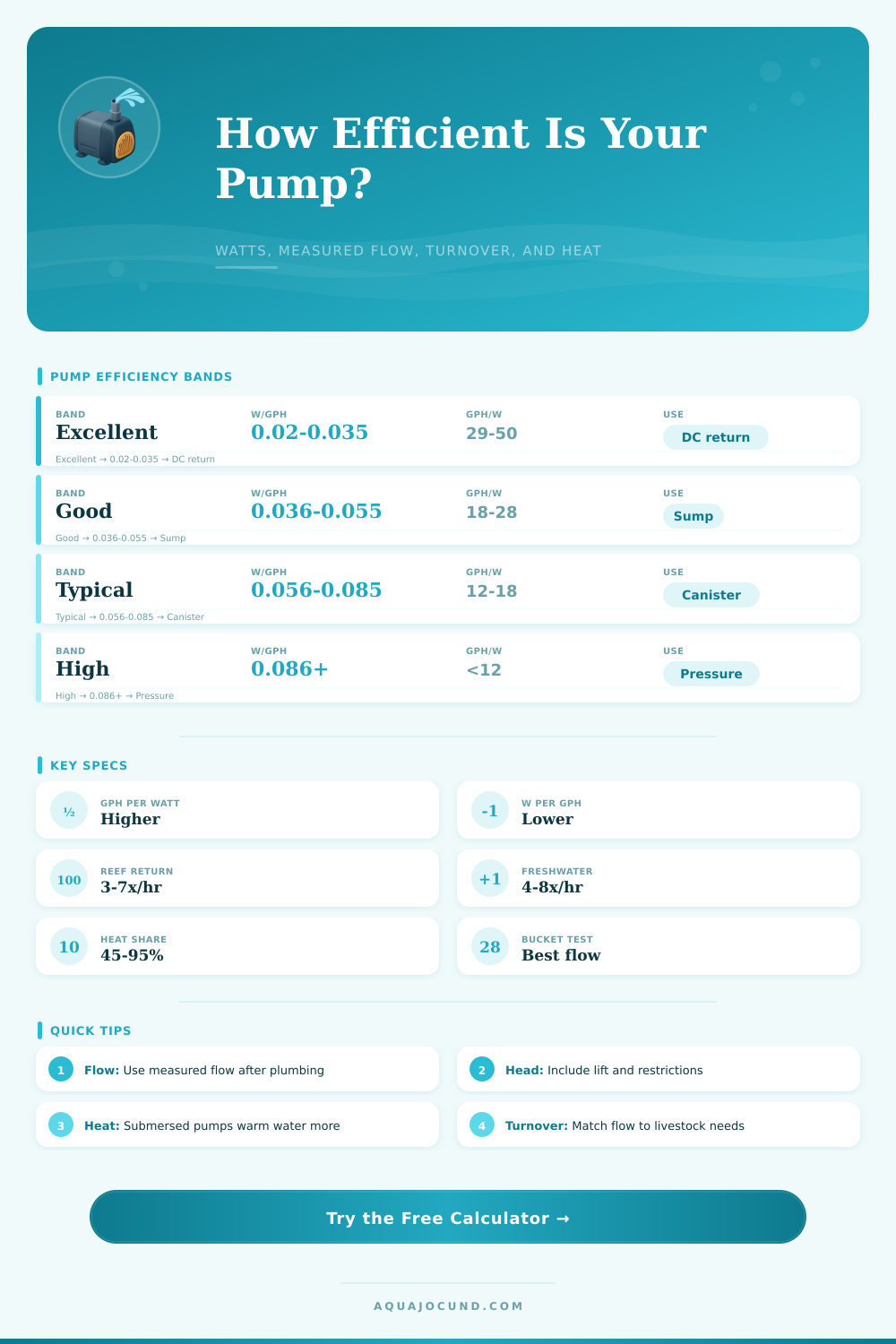
Pump Wattage Per GPH Calculator
Compare aquarium pump watts against measured flow, head height, turnover, W/GPH efficiency, and heat added to the water.
Use actual water volume after rock, substrate, sump level, and displacement.
Bucket-test flow at the return outlet, not the box rating.
Pump Efficiency Result
Excellent
Low W/GPH and enough turnover. Often a clean DC pump, short plumbing, or oversized pipe.
Balanced
Moderate W/GPH with target turnover met. Good everyday zone for most aquarium returns.
Flow Limited
Turnover falls below target. Head height, narrow hose, dirty impeller, or media restriction may be the cause.
Heat Watch
Watts are high for the volume. Submersed pumps can add a steady heater-like load to small systems.
| Pump class | Typical W/GPH | Head behavior | Heat share | Best measured use |
|---|---|---|---|---|
| Nano DC pump | 0.025-0.050 | Soft curve, low head | 90-95% | Small tanks, desktop filtration, gentle circulation. |
| Small AC utility pump | 0.055-0.100 | Flow drops quickly | 90-95% | Simple lift, bucket mixing, small sumps. |
| Hang-on-back motor | 0.020-0.045 | Very low lift | 80-90% | Measured filter output after cartridge and sponge loading. |
| Canister filter motor | 0.050-0.090 | Media and hose sensitive | 55-75% | Outlet flow after baskets, tubing, and lily pipes. |
| AC sump return | 0.060-0.110 | Stable but warm | 85-95% | Reliable return flow where heat load is acceptable. |
| DC sump return | 0.030-0.065 | Adjustable curve | 80-92% | Return pumps tuned to a specific turnover target. |
| Pressure-rated pump | 0.090-0.180 | Handles high head | 35-65% | Reactors, long runs, vertical lift, and manifolds. |
| Pond circulation pump | 0.025-0.075 | Wide-flow design | 70-95% | Large tubs and ponds with broad plumbing. |
| Band | W/GPH | GPH per watt | What it usually means |
|---|---|---|---|
| Excellent | 0.020-0.035 | 29-50 | Strong measured flow for the watts, usually low restriction or efficient DC operation. |
| Good | 0.036-0.055 | 18-28 | Efficient enough for most return and filter jobs after realistic head loss. |
| Typical | 0.056-0.085 | 12-18 | Common for canisters, smaller AC pumps, or average sump plumbing. |
| High draw | 0.086-0.130 | 8-12 | Often caused by high head, narrow hose, dense media, or pressure-rated design. |
| Recheck | Above 0.130 | Below 8 | Clean the impeller, verify flow test, inspect plumbing, or confirm the pump is meant for high head. |
| System | Example volume | Typical measured flow | Turnover target | Efficiency note |
|---|---|---|---|---|
| 5 gal betta | 19 L | 15-35 GPH | 3-7x/hr | Low turbulence matters more than maximum flow. |
| 10 gal shrimp | 38 L | 30-60 GPH | 3-6x/hr | Gentle flow and sponge loading can reduce measured output. |
| 20 long planted | 76 L | 80-160 GPH | 4-8x/hr | Flow spread is as important as raw GPH. |
| 40 breeder community | 151 L | 180-320 GPH | 4.5-8x/hr | Canisters should be tested with media installed. |
| 75 gal reef return | 284 L | 225-525 GPH | 3-7x/hr | Display flow usually also comes from powerheads. |
| 125 gal display | 473 L | 500-1000 GPH | 4-8x/hr | Large plumbing diameter improves GPH per watt. |
| Condition | Efficiency effect | Heat effect | Measurement advice |
|---|---|---|---|
| Zero to 2 ft head | Best GPH per watt | Mostly based on motor location | Bucket test at the actual outlet height. |
| 3 to 6 ft head | Normal sump-return range | Submersed pumps add steady heat | Use measured flow after elbows and valves. |
| 7 to 10 ft head | Flow may fall sharply | Pressure pumps may shed heat externally | Compare against a pressure-rated pump curve. |
| Dense media or spray bar | Acts like extra head | Watts may stay similar while flow drops | Test with baskets, pads, nozzles, and spray bars installed. |
| Dirty impeller or intake | W/GPH gets worse | Heat per gallon moved rises | Retest after cleaning to see the true gain. |
The label says the pump will push three hundred gallons an hour so you purchase one. You set it up, plug it in and the water hardly stir around your fish.
No, there was no mistake made by the manufacturer. There’s no bait-and-switch happening here. This issue boils down to physics. Head pressure and plumbing resistance decrease output at the point the impeller first draw water upward. Frustration comes when relying only upon raw flow rates, which fail to account for such physical limitations.
Why Your Aquarium Pump Is Not Working Well
Instead, consider efficiency rather then peak volume. After entering in your measured flow information, the calculator do the math for you. You won’t have to guess at the amount of wasted energy due to friction and gravity.
If most hobbyist rely on the maximum rated value found on the package, it’s because they’re assuming the best case scenario: no filters, open pipes, and no elevation whatsoever. Unfortunately, this perfect situation is hardly what you’ll see in a show room tank. Real world tanks, like those in a person’s home, feature restrictions, such as hose elbows, which create snags in the plumbing and slow water down. Every foot of lift cost you flow. Dirty filter media makes the path bumpy instead of smooth… all while reducing water flow and increasing energy use.
For example, it’s a way for you to understand this dynamic. How hard is the pump working to move a unit of water? That’s where the wattage per gallon per hour come into play. It removes all the marketing speak and tells you just how much work the pump has to do to get one gallon of water. Low means the pump gets the job done with ease. High means something about the setup is causing it to fight, such as being too high or having too many restriction in the plumbing. You can have a strong motor, but if the setup isn’t efficient, then the motor simply heat up instead of circulates.
Because this tool takes into account real world measurements at the outlet, not what manufacturers say they are, it makes you take a step back and realize true efficiency of the set up.
Most people forget about one of the side effects: Heat. Each watt consumed by the pump will be converted into heat at some point. Most of it will end up in your tank (if the motor is in the tank or in a poorly ventilated sump) and might contribute to temperature spikes, especially during the summer. Those temperature increases put stress on livestock. Depending on where you place the pump, the calculator will estimate its heat load and help you assess whether the filter will act as an unwanted heater. This is important when keeping sensitive livestock such as coral or shrimp that require stable water temperatures.
Another key thing to consider is the turnover rate. Do you have strong currents disturbing fish? Do you have stagnant conditions allowing waste accumulation? Every system has its own required turnover rate. Gentle flow works well in a betta tank. Heavy circulation are necessary with a cichlid setup. Refer to the table below which links livestock type with desired turnover hours. This allows you to determine whether your existing pump provide enough turnover (meeting biological requirements) or only causes an annoying sound. Poor water quality result from low turnover. Higher turnover increases animal stress levels.
This is something you can’t eyeball. While the size of the tank may give you some idea of the flow, guessing just doesn’t cut it. To do this, get a bucket and use a stop watch to determine the time required to fill up a known volume of water at the return end. Do not forget to run through any media baskets, valves and hoses used in the system. Unless it’s your regular regimen, don’t clean the impeller before doing this test. You want to know how well the tank performs on a day-to-day basis; not what it might of been capable of if everything was new.
With those numbers in hand, the analysis is simple. You can tell whether the pump is running efficient or whether it is laboring under excessive power demand. Armed with that information you can make smart decisions about improvements. Perhaps all you need is a larger diameter tube rather than a more powerful motor? Maybe dropping the head a little will be enough to fix it completely. Understanding how heat, power, and flow work together help build a robust system.
Buying pumps is simple; maximizing them takes time. Optimizing a pump properly can be the difference between an efficient, quiet system and a loud, inefficient one. It is a loud and inefficient system. Start measuring pipe flow and stop using box rated numbers. It’ll save you money in both electricity bills as well as your fishs life.