Fish Room Air Exchange Calculator
Estimate ventilation from room volume, aquarium surface area, humidity load, target ACH, make-up air, and temperature penalty.
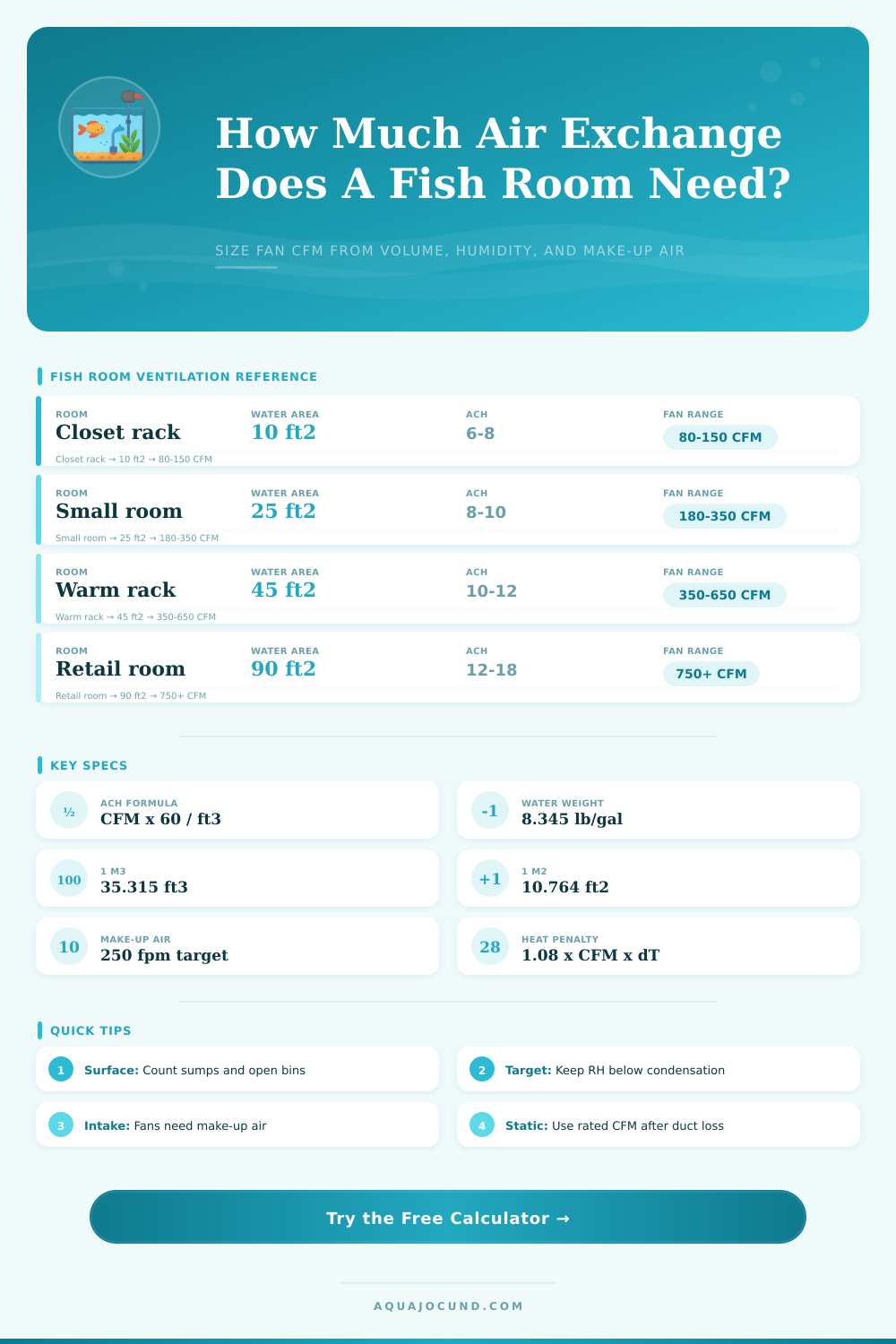
| Profile | Evaporation factor | Suggested ACH | Use case |
|---|---|---|---|
| Mostly covered tanks | 0.025 gal/ft2/day | 4-6 ACH | Glass lids, small sump exposure |
| Mixed lids and open tanks | 0.055 gal/ft2/day | 6-8 ACH | Typical home fish room |
| Open freshwater rack | 0.085 gal/ft2/day | 8-10 ACH | Open tops, moderate aeration |
| Warm planted or discus room | 0.115 gal/ft2/day | 10-12 ACH | Warm water and high wet area |
| Reef tanks with open sump | 0.125 gal/ft2/day | 10-14 ACH | Surface agitation and sump splashing |
| Air-driven breeder racks | 0.135 gal/ft2/day | 12-16 ACH | Many sponge filters and bubbles |
| Retail holding systems | 0.145 gal/ft2/day | 14-18 ACH | Large exposed systems |
| Indoor pond or vats | 0.155 gal/ft2/day | 12-20 ACH | Wide open water surface |
| Room | Dimensions | Volume | CFM at 8 ACH |
|---|---|---|---|
| Closet fish wall | 6 x 8 x 8 ft (1.8 x 2.4 x 2.4 m) | 384 ft3 / 10.9 m3 | 51 CFM |
| Small fish room | 10 x 10 x 8 ft (3.0 x 3.0 x 2.4 m) | 800 ft3 / 22.7 m3 | 107 CFM |
| Bedroom conversion | 12 x 12 x 8 ft (3.7 x 3.7 x 2.4 m) | 1152 ft3 / 32.6 m3 | 154 CFM |
| Basement room | 14 x 18 x 8 ft (4.3 x 5.5 x 2.4 m) | 2016 ft3 / 57.1 m3 | 269 CFM |
| Store holding area | 20 x 24 x 9 ft (6.1 x 7.3 x 2.7 m) | 4320 ft3 / 122.3 m3 | 576 CFM |
| Item | Formula or target | What it means | Calculator use |
|---|---|---|---|
| Room volume | length x width x height | Total air in the fish room | Sets ACH CFM |
| ACH CFM | volume x ACH / 60 | Fan airflow for air changes | Compared to humidity CFM |
| Make-up free area | CFM / 250 fpm x 144 | Low-noise intake opening target | Adds restriction penalty if undersized |
| Temperature penalty | 1.08 x CFM x dT | Sensible heat moved by exhaust air | Shows heating or cooling load |
| Water vapor load | evap gal/day x 8.345 | Moisture added by tanks and sumps | Sets humidity CFM |
Exhaust fan
Best for direct air exchange when dry make-up air is available and duct length is reasonable.
HRV or ERV
Useful when outdoor temperature swing is large and the room needs steady fresh air.
Dehumidifier
Removes water without high air exchange, but does not replace stale air or odors.
Transfer grille
Lets the exhaust fan pull make-up air from the house instead of fighting a sealed room.
You will hear dehumidifier running before you spot any condensation on drywall. That means something in the room are causing it to be humid. Water Evaporating from Tanks; Water evaporates from tanks into air, especially when water is warm and the room is not. Building materials is not able to handle such conditions found inside a fish room. Mildew in the sump area? Walls rotting? It’s not as much about breathing fresh air for both you and the fish as it is avoiding mildew and rotting walls.
Once you know the square footage of your room and the square inches of tank surface, calculator does all the math for you. You do not need to guess at airflow coefficient and evaporation rate. Air is exchanged. Filtration flow rate is what most aquarists think about but they overlook air exchange rate of the room. That’s a big mistake. A filter can keeps the water clean, but it doesn’t get rid of all the vapor that evaporates from open tanks daily. Think of your fish room as primarily a humidity generator rather than an aquarium space itself.
How to Control Humidity in Your Fish Room
The amount of water in the room (the volume) are important, but so is surface area of the water. The surface area of water that is an inch deep in a warm room emits lots of moisture, especially when you use air stones or powerheads to create agitation. To use tool, you must be honest about the measured inputs. You should measure real open water area. This includes top of your display tank(s) and any refugiums or sumps that is not covered.
A lot of folks forget to account for their sump. Depending on its size and how aggressively you run it, that can add a lot to the amount of humidity load. By allowing you to specify additional areas for tanks and sumps, the tool do take that into consideration. It’s important, however because sumps tend to run hotter and will generally have more surface agitation than covered display tanks.
Also, you’ll want to determine what your target air changes per hour rate is. Eight is a pretty good baseline for general home use. However, warmer water setups like retail holding rooms may require higher rates to maintain a stable environment. Makeup air is another culprit in this mess. There has to be some way for fresh air to get into a space for a fan to blow it out.
If you have a super-strong exhaust fan and seal up the room, then the exhaust fan fights against negative pressure and moves much less air then it’s rated for. That’s why we say both the size of the exhaust and the size of the intake are important. Whether it’s through an open door frame with enough clearance or a purpose-built vent, replacement air needs to have smooth unimpeded paths. The table on page compares how different static pressures and duct losses decreases actual airflow.
There’s also factor of temperature. If you’re taking warmed, humid air out of a heated fish room during the winter then you’re also losing lots of heat energy. The calculator measures that temperature penalty and allows you to see how it will affect your heating bill. Conversely, in the summer, that same process help extract waste heat produced by aquarium equipment and lights. It is the same thing, but in opposite seasons. Think of it as buying electricity to protect your structure and make yourself comfortabley.
Most hobbyists agree that having a simple exhaust fan running constantly is more effective than using a dehumidifier which should of been cycled on/off every couple of hours. Avoid excessive humidity. Humidity above the dewpoint can cause problems. This is the point at which water condenses on cool surfaces like exterior walls, windows, and electrical outlets. Although that varies different than your room temperature and local climate, staying under fifty-five percent is a safe rule of thumb for most homes.
So, how much humidity do you have? There’s no requirement for perfection here (just control it consistantly). Plan once/measure twice. Installing ventilation in an already-completed room is very hard. Don’t skimp on fan size based off correct surface area measurement. Don’t leave paths for make up air blocked. Maintain low humidity so that your walls aren’t rotting around you before you see any evidence of it. Moisture shouldn’t be something you notice by the sounds of equipment fighting it.