Metabolic Rate Temperature Q10 Calculator
Estimate aquarium fish metabolic change, feeding shift, oxygen demand, and safety band from a baseline temperature to a new temperature.
Calculation Breakdown
| Fish Group | Typical Q10 | Safe Temperature Band | Oxygen Caution |
|---|---|---|---|
| Tropical community fish | 2.2 | 72–80°F / 22–27°C | Moderate rise above 78°F |
| Betta and gourami | 2.0 | 76–82°F / 24–28°C | Watch warm still tanks |
| Goldfish and fancy carp | 1.8 | 64–74°F / 18–23°C | High biomass needs aeration |
| African cichlids | 2.1 | 75–82°F / 24–28°C | Strong surface movement helps |
| Discus and warmwater cichlids | 2.4 | 82–86°F / 28–30°C | Warm water holds less oxygen |
| Marine reef fish | 2.3 | 75–80°F / 24–27°C | Check gas exchange and flow |
| Tank Size | Dimensions Imperial | Dimensions Metric | Example Oxygen Shift |
|---|---|---|---|
| 5 gallon | 16 x 8 x 10 in | 41 x 20 x 25 cm | +17% at +2°C Q10 2.2 |
| 10 gallon | 20 x 10 x 12 in | 51 x 25 x 30 cm | +37% at +4°C Q10 2.2 |
| 20 long | 30 x 12 x 12 in | 76 x 30 x 30 cm | +61% at +6°C Q10 2.2 |
| 40 breeder | 36 x 18 x 16 in | 91 x 46 x 41 cm | -14% at -2°C Q10 2.2 |
| 75 gallon | 48 x 18 x 21 in | 122 x 46 x 53 cm | +27% at +3°C Q10 2.2 |
| 125 gallon | 72 x 18 x 21 in | 183 x 46 x 53 cm | +42% at +5°C Q10 2.0 |
| Temperature Change | Q10 1.8 | Q10 2.2 | Q10 2.8 |
|---|---|---|---|
| -6°C | 0.70x | 0.62x | 0.54x |
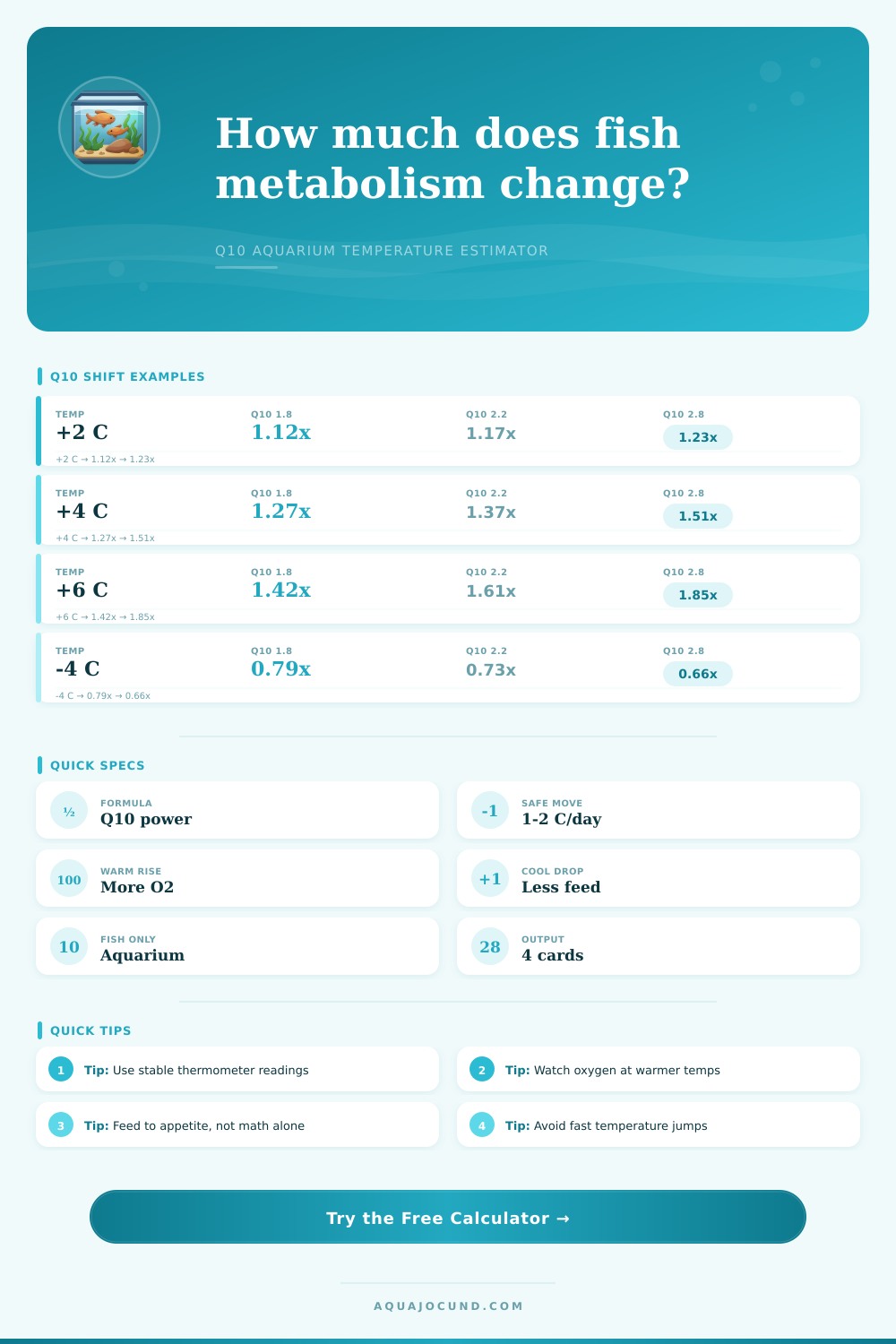
| -4°C | 0.79x | 0.73x | 0.66x |
| -2°C | 0.89x | 0.85x | 0.81x |
| +2°C | 1.12x | 1.17x | 1.23x |
| +4°C | 1.27x | 1.37x | 1.51x |
| +6°C | 1.42x | 1.61x | 1.85x |
| Multiplier Result | Metabolic Meaning | Feeding Estimate | Safety Band |
|---|---|---|---|
| 0.70x or lower | Large slowdown | Reduce strongly | Check cold stress |
| 0.85x to 1.15x | Small change | Minor adjustment | Usually stable |
| 1.16x to 1.40x | Moderate rise | Increase only if eaten | Add oxygen buffer |
| 1.41x to 1.80x | Strong rise | Watch waste load | Use caution |
| Above 1.80x | Very strong rise | Do not chase with food | High risk change |
When the water heats up, a fish’s metabolism increases because fish is cold blooded. Their bodies will processes faster. This affects how much oxygen they use, how much waste they create, and how much food they consume. The calculator help you see those shifts before they become a problem at night when the room goes quiet and the heater kicks on or off again.
Q10 is the underlying idea. It measures a biological rate and how quickly that rate change in response to a change in temperature (e.g., for each ten degree difference in temperature). For most aquarium fish, it range from 1.8… 2.4. That means that a two degree Celcius rise in your water will result in an approximately seventeen percent rise in their metabolism. Four degrees? That’s a jump of thirty-seven percent (the math compounds rather rapidely). So minor inaccuracies in thermostats can have big biological effects.
How to Use Fish Metabolism Calculators Safely
How do you apply it to your everyday life? Well, the tool will do this math for you. It is important, however, to know what the numbers mean. If you has a metabolic multiplier greater than one point two, the fish are metabolically surging. They will want to eat more, use up oxygen at a quicker rate, and create more waste (ammonia).
From the reference grid, you can see that discus metabolize faster then goldfish. This is a good thing because metabolic shifts happen slower with goldfish making gradual adjustments easier rather than rapid increases in waste loads that overburden biological filtration. Most people screw up at this point, which is feeding. It’s easy to equate the amount of food given to the metabolic multiplier. Don’t. The metabolism calculator assumes what it thinks might be eaten; it doesn’t calculate how much is actualy eaten. So if you simply use straight math to determine how much to feed but never observe if they eat, you’re going to pollute tank by not accounting for what won’t be eaten. Uneaten food generates ammonia spikes, depletes oxygen levels, and rots more quickly in warmer water. Think of the feeding adjustment as an upper limit instead of something to strive for. Let them tell you when to feed (appetite); let the math tell you how much to expect your filter handle (filtering stress).
In this case, oxygen demand becomes dangerous as warm water has lower levels of dissolved oxygen and warm fish need higher level. By increasing the safety margin input by 25% when making your oxygen estimates, you create a buffer that will ensure enough flow rate and surface agitation regardless of high activity levels. For high biomass or heavily stocked tanks, the lack of space mean there’s little room for error. Any temperature change needs to happen gradually, the calculator assumes it would of occur over multiple days, not immediately. Moving one to two degrees daily is a good speed. This allows their internal chemistry time to catch up while keeping stress on the fish down and preventing their immune system from being shocked by too-rapid a change.
Red flags to look out for include gasping and other labored breathing near the surface, indicators that your current level of dissolved oxygen isn’t high enough for the faster metabolism. So what should you take away? If you think of it like this: Metabolism is something you don’t see, but you can see what it leaves behind. So use the calculator as a way to predict the unseen. The point of planning for change is to avoid reacting after the water quality has already dropped. You want to keep your fish healthy and comfortable regardless of season. Let the numbers tell you how much to adjust and then let your eyes tell you if things are running smoothly. It’s all about maintaining balance between seeing and knowing how to get there by using both observation and numbers. That’s what makes an aquarium thrive.