⏱ Solenoid On Time Calculator
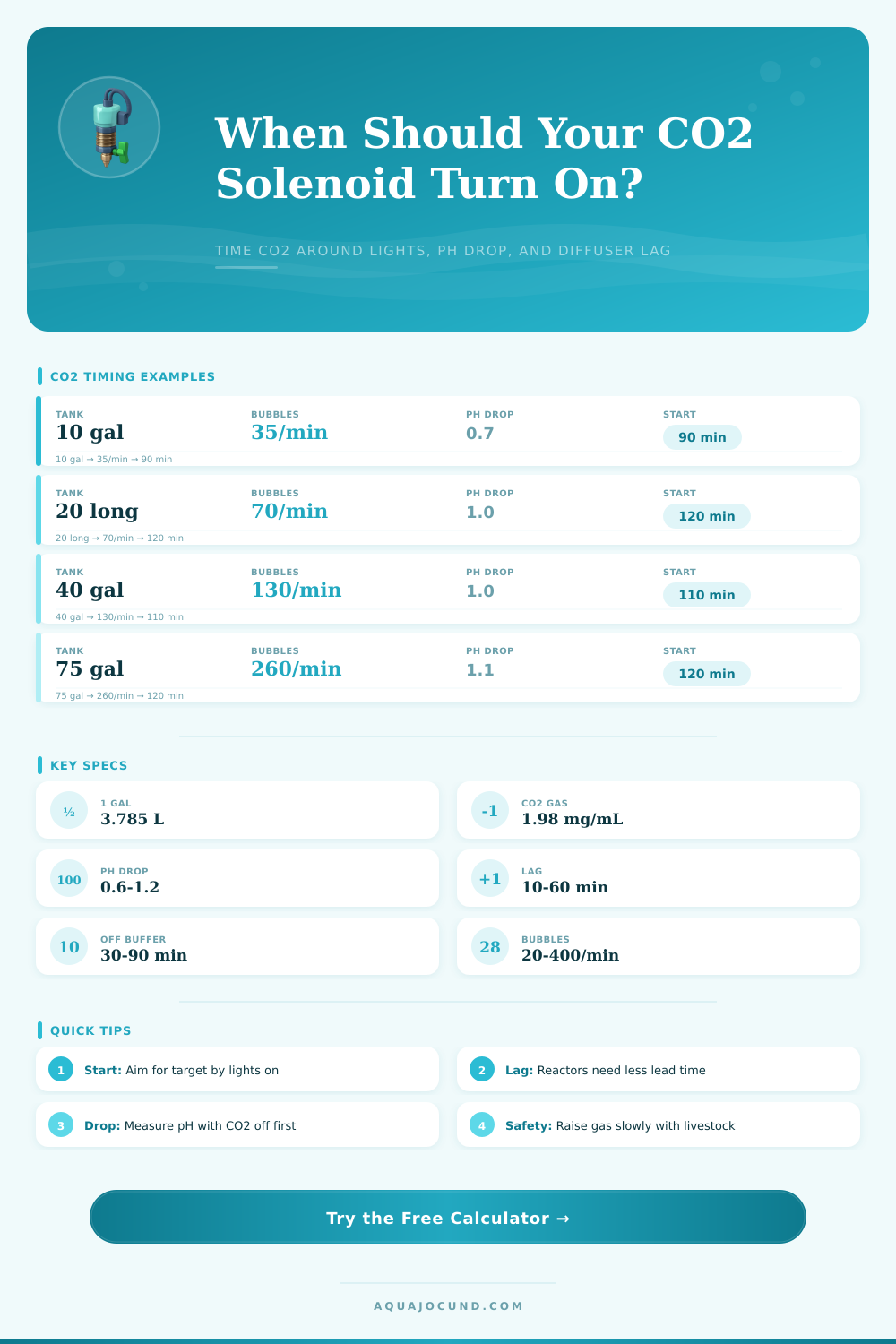
Estimate when aquarium CO2 should start before lights, when it should shut off, and whether the bubble rate can reach your target pH drop after diffuser lag and degassing.
| Tank Style | Common Lead Before Lights | Common Shutoff Buffer | Reason To Adjust |
|---|---|---|---|
| Nano planted, ceramic diffuser | 75 to 120 minutes | 45 to 60 minutes | Small volume changes quickly, but surface agitation can strip CO2 fast. |
| 20 to 40 gal stem tank | 90 to 150 minutes | 45 to 75 minutes | Most systems need enough time for the full tank to reach the pH-drop target. |
| Large high-light display | 105 to 180 minutes | 60 to 90 minutes | Large water mass and high flow can delay a stable drop at the checker location. |
| Efficient inline reactor | 45 to 105 minutes | 45 to 90 minutes | Higher dissolution efficiency usually reduces required pre-light lead time. |
| Target pH Drop | Approx CO2 Multiplier | Typical Use | Schedule Note |
|---|---|---|---|
| 0.4 to 0.6 | 2.5x to 4x | Low demand plants or livestock-first tanks | Shorter lead time and lower bubble rate are usually enough. |
| 0.7 to 0.9 | 5x to 8x | Moderate planted aquariums | Start early enough that the target is reached as lights begin. |
| 1.0 to 1.2 | 10x to 16x | High light aquascapes after careful tuning | Requires stable diffusion, good flow, and livestock observation. |
| Above 1.2 | More than 16x | Special cases only | Use caution and verify oxygen, fish behavior, and true resting pH. |
| Diffuser Type | Typical Lag | Efficiency Range | Degassing Sensitivity |
|---|---|---|---|
| Ceramic disk in display | 20 to 50 minutes | 55% to 80% | Moderate, because bubbles travel through the water column. |
| Inline atomizer | 10 to 30 minutes | 60% to 85% | Moderate to high if return flow ripples the surface hard. |
| Inline reactor | 5 to 20 minutes | 80% to 97% | Low when fully dissolved and returned below the surface. |
| Ladder, bell, or cup | 45 to 120 minutes | 35% to 70% | High if contact area is small or bubbles collect near the surface. |
| Observation | Likely Cause | Timing Change | Other Check |
|---|---|---|---|
| Target pH drop arrives late | Lead time too short or gas rate too low | Start 15 to 30 minutes earlier | Confirm diffuser is clean and working pressure is stable. |
| Fish gasp before lights peak | CO2 climbs too fast or oxygen is low | Use gentle mode and lower bubble rate | Increase surface exchange after the CO2 period. |
| Drop checker stays blue | Poor distribution or long indicator delay | Do not chase the checker minute by minute | Measure pH drop with a meter or reliable liquid kit. |
| CO2 remains high after lights off | Shutoff too late or degassing too low | Increase off buffer by 15 minutes | Verify nighttime aeration and circulation. |
Carbon dioxide injection should of been timed properly as well. Because it diffuses slow, you don’t want the dissolved gas to wait too long for the plants to use it; plants will photosynthesize using dissolved gas. If there’s no gas dissolved in the water, the plants can’t use it. But algae will grow like mad when plants are idle and doesn’t require much gas. It’s a race of timing, not necessarily of volume. You’ve got to know how physics controls it in your tank.
Using your light schedule and tank volume, the calculator provides an initial estimate based off these factors. Changing state of water takes time, and this time increases with size of your tank. For example, it might only take twenty minutes for a small ten gallon tank to reach that desired ph drop while it could be two hours for a seventy five gallon. Why? Mass has momentum or inertia.
Timing Your Carbon Dioxide
Another factor is the rate at which gas are injected into your system, aka “diffuser lag.” When you open the solenoid, it doesn’t immediately cause water to saturate with gas. Ceramic disks produce big bubbles that require some time to dissolve and break down. Atomizers and inline reactors force the gas to travel through smaller pathways where it gets better contact with the water column. That greatly reduces this delay. If you’re using a slow diffuser then you’ll need more lead time; if you use a fast one, you can get away with starting closer to lights on. The tool accounts for these mechanical differences.
Turning the lights off causes a reverse problem: plants cease taking up carbon dioxide and instead release it via respiration. Without a shutoff buffer, the solenoid will run for this duration and build up gas you cannot use. This leads to dangerous spikes that stress your livestock at night. This can cause suffocation risks so you need to give yourself a little bit of time (30-60 min) after turning off the lights before turning off the gas. Turning the gas off thirty to sixty minutes before darkness keeps system stable so your plants stays happy during their active hours and your fish don’t face suffocation risks.
Aquariums are closed systems with variable components so there will be safety margins required. What appears to be a precise drop of one point in pH on paper can be changed by other factors like temperature change and organic load. Resting pH measured upon starting up after an overnight period without any carbon dioxide give you a baseline. Compare this to a reading taken midway through the day and see if your timer is functioning. Did target come too early? Then dial back the rate or delay start time. Was it late? Then start sooner. Remember, look for signs of lethargy close to substrate or gasping at surface; these are clear signs that something isn’t right.
You’re not going for perfect (just stable). It’s better to have something consistent and rhythmic than precisely accurate down to the next second. Let the system reach a balance after setting a buffer and a lead time. Give it a week before adjusting. The plants will shift their energy use accordingly and the algae will no longer be able to compete once it gets fed every day at the same time. You’re creating a circadian rhythm of water chemistry.
The more you do this, however, the less guess work there is. You’ll learn how long it takes for the bubbles to finish the job. There’s no need to fret over whether or not there’s enough gas; instead, you can focus on what plants is doing. And that’s because you respect the buffer and honor the lag. Yes, the clock ticks while waiting for you to press the button, but after it’s set, you’re in control and can enjoy your fish tank.