Breeding Box Volume Calculator
Estimate true box water volume, fry and adult load, exchange through slots, dwell-time safety, oxygen margin, and stress density.
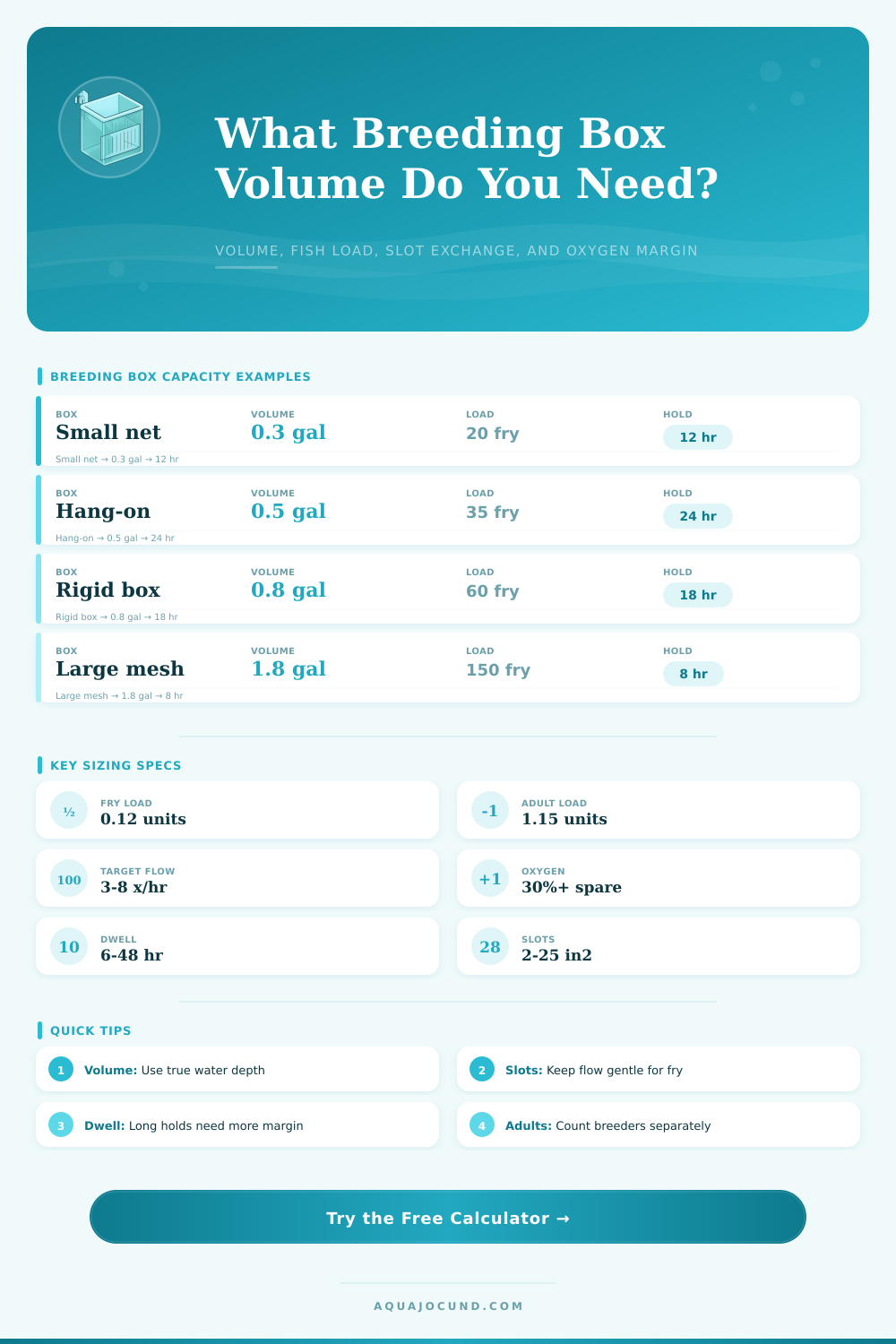
Breeding Box Sizing Result
| Box type | Exchange behavior | Stress density | Best calculation use |
|---|---|---|---|
| Net breeder | High passive flow through fabric | 6.5 load units/gal | Short fry separation with broad contact area |
| Fine mesh nursery | Moderate flow, slower through fine mesh | 5.8 load units/gal | Tiny fry where escape prevention matters |
| Hang-on rigid box | Slot or lift-driven flow path | 5.2 load units/gal | Measured dwell time and controlled turnover |
| In-tank rigid box | Slot dependent, can stagnate in corners | 4.6 load units/gal | Viewing adults, eggs, or larger juveniles |
| Divided breeder box | Reduced usable swim space per chamber | 4.0 load units/gal | Separating a pair or multiple broods |
| Isolation cup | Low exchange unless lifted or perforated | 3.1 load units/gal | Very short observation holds |
| Egg tumbler insert | High vertical water movement | 2.8 load units/gal | Eggs and wrigglers, not active fry load |
| Common box | Inside dimensions | Approx volume | Typical calculated use |
|---|---|---|---|
| Small clip-on net | 6 x 4 x 4 in / 15 x 10 x 10 cm | 0.42 gal / 1.6 L | 15-30 small fry for short dwell |
| Medium hang-on | 8 x 4 x 5 in / 20 x 10 x 13 cm | 0.69 gal / 2.6 L | 30-50 livebearer fry with lift flow |
| Large mesh breeder | 10 x 6 x 6 in / 25 x 15 x 15 cm | 1.56 gal / 5.9 L | 80-140 fry with broad mesh sides |
| Deep rigid nursery | 9 x 5 x 7 in / 23 x 13 x 18 cm | 1.36 gal / 5.2 L | Adults or larger juveniles briefly |
| Large grow-out basket | 14 x 8 x 8 in / 36 x 20 x 20 cm | 3.88 gal / 14.7 L | Heavy broods with strong exchange |
| Holding situation | Dwell time | Target exchange | Oxygen margin |
|---|---|---|---|
| Quick egg check or transfer | Under 6 hr | 2-3 box volumes/hr | 20% spare |
| Livebearer drop box | 6-18 hr | 3-5 box volumes/hr | 30% spare |
| Overnight fry protection | 18-36 hr | 5-8 box volumes/hr | 45% spare |
| Adult pair isolation | Under 12 hr | 6-10 box volumes/hr | 60% spare |
| Grow-out basket | Daily checks | 8+ box volumes/hr | 45% spare |
| Fish load group | Calculator load | Stress trigger | Adjustment note |
|---|---|---|---|
| New fry under 0.25 in | 0.06-0.09 units each | Crowding at surface film | Use conservative profile |
| Fry 0.25-0.5 in | 0.10-0.18 units each | Feeding waste builds quickly | Raise slot exchange |
| Juveniles 0.5-1 in | 0.20-0.45 units each | Corner piling and chasing | Increase true volume |
| Adult livebearer | 2-3 units each | Oxygen and aggression | Short dwell only |
| Adult cichlid pair | 4-7 units each | Stress from confinement | Use large mesh basket |
A common mistake of most aquarium keeper is to choose breeding boxs based off how they look from an adult perspective rather than that of a juvenile fry. When you have a guppy breeder box and your adult fish fit into your tank, you think, “hey this should work”. Without thinking about water volume/exchange rate, you simply clip it onto your tank. Then when those livebearer babies drown in their own waste or neon tetras suffocate in stagnant corner, you realize your mistake.
Three things typically determines whether your brooding efforts succeed or fail. These are the oxygen margin during feeding times, passive exchange through slots, and true water volume. Don’t think that a box gives you much more then it does. Manufacturers list external dimensions, but you need internal usable depth. You want to know space where the fish will live. Subtract an inch or two from the top depending on how high the box floats in the tank, because that part is just empty plastic.
Why Most Breeding Boxes Fail
Once you enter your actual dimensions into the calculator above it does the math and spares you having to guess if there’s enough breathing space for the fry. Because oxygen consumption and waste production rates varies so much between species, the calculator separates the load of tiny fry from adult breeders to manage those levels. The flow needs to be correct. Thirty guppy fry may last a whole day in a given net box, but one adult betta might get stressed out and wreck that little net box within several hours.
Whether a closed box is a good idea depends more on how well water moves through it rather than its shape. Even though rigid plastic may look like a solid box, small holes (slits) will cause waste to accumulate in lower corner… Forming dead zones where ammonia levels spike rapidy. An open net design provides no defense from bigger tank mates trying to poke their head in. But mesh sides allow for better passive exchange; water passes easily back and forth within the fabric. So you must trade off clean water exchange vs. You must consider the safety of predators. If you don’t understand the options, refer to the table on the page to see which box designs is best for your situation regarding water flow and stress density.
There’s such a thing as too much dwell time in your breeding setup. You might think it’s okay to leave fry overnight in a holding box, but without sufficient surface area where water can be replaced with fresh gas exchanged, there is a rapid decline in dissolved oxygen. This tool assesses the size of the box versus how long you plan to hold them. For example, if you want to put some eggs in an incubation cup and hold them for twenty four hours, the tool will tell you if the volume of the cup is too low. It will also tell you if there isn’t enough space on the slots to allow for oxygen. It even considers air help; for example, it knows a tight box is okay if there is an airstone nearby that makes no noise in the tank.
The stress density profiles also accounts for the behavior of the species. Delicate killifish larvae and sensitive cichlids don’t fare well confined to tight quarters as do hardy live bearers. It’s easy to assume all fry are alike and they can handle whatever you dish out, but that couldn’t be more wrong. Tuning the stress profile within the calculator considers not overloading a delicate species to the breaking point. Always keep a buffer zone between waste accumulation and dilution.
The other thing many hobbyists miss is the section where they slide the box on/off the tank. They just see if it fits around the rim and move on. But the little mesh sections or windows are most important part of this system. The lungs. If there isn’t sufficient air space, even a large box will still be full of stagnant water. There is a trade-off between having enough surface area for exchange and enough volume for swimming room. The key is balancing both to avoid making a costly mistake.
There’s a reason why a box isn’t called a tank. You have to know exactly how much room you have. You have to respect its limitations. How much water are you keeping? What’s the flow rate? If you don’t know this stuff going into your breeding setup, there will be unnecessary losses. The point is, knowing what real volume means for waste and O2 levels removes all guesswork and replaces it with planned actions. It changes your thought process from breeding being a lottery to it becoming a science. That makes all the difference in whether your fry thrive or not.