Male to Female Ratio Calculator
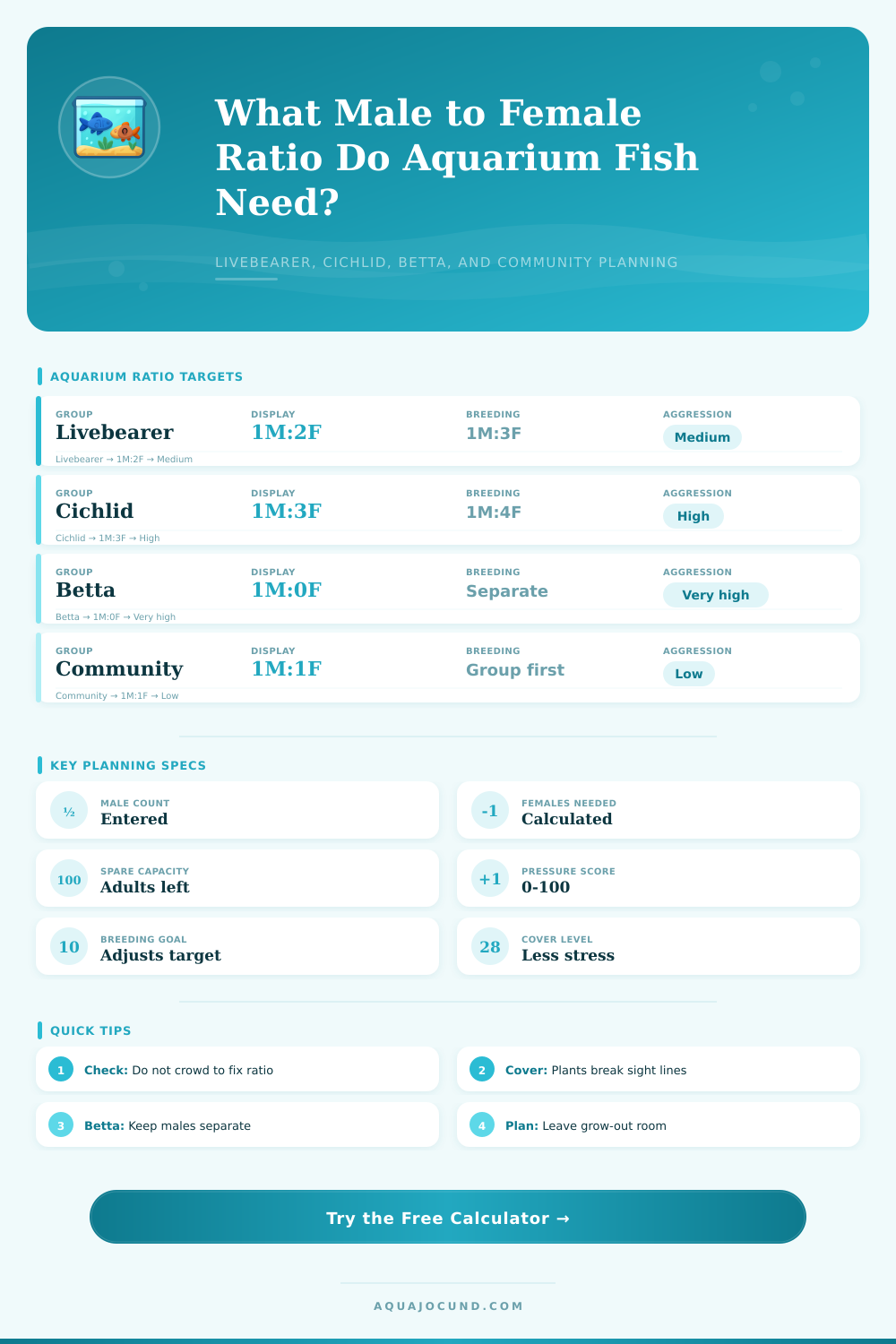
Plan aquarium fish sex ratios by species group, male count, current females, tank capacity, cover, aggression pressure, and breeding goal.
Calculation breakdown
| Fish group | Display target | Breeding target | Male limit note | Pressure cue |
|---|
| Tank example | Planning volume | Common ratio use | Typical adult group | Capacity note |
|---|---|---|---|---|
| 10 gal / 38 L livebearer nano | 10 gal / 38 L | 1M:2F or 1M:3F | 1 male with 2-4 females | Leave room for fry removal or grow-out. |
| 20 gal / 76 L platy group | 20 gal / 76 L | 1M:2F display | 2 males with 4-6 females | Extra females reduce repeated attention. |
| 29 gal / 110 L dwarf cichlid | 29 gal / 110 L | 1M:1F or 1M:2F | Pair or trio | Caves and territory layout matter. |
| 40 breeder / 151 L cichlid harem | 40 gal / 151 L | 1M:3F | 1-2 males with 3-8 females | Avoid adding females beyond filtration capacity. |
| 55 gal / 208 L mbuna plan | 55 gal / 208 L | 1M:3F or 1M:4F | Species-specific harems | Rock breaks and male count drive pressure. |
| Betta display tank | 5-20 gal / 19-76 L | 1M:0F | One male, no females | Female additions are not ratio fixes. |
| Score | Band | Ratio meaning | Adjustment to test |
|---|---|---|---|
| 0-24 | Low | Ratio and capacity are comfortable. | Keep observing the group during feeding. |
| 25-49 | Watch | Some pressure is likely but manageable. | Add cover or rebalance before breeding. |
| 50-74 | High | Male count, ratio gap, or crowding is driving stress. | Reduce males, add females only if capacity allows. |
| 75-100 | Critical | Ratio correction alone may not be enough. | Separate fish, redesign territories, or split groups. |
| Plan result | Female count status | Spare capacity | Breeding goal fit | Planning action |
|---|---|---|---|---|
| Balanced harem | At or above target | 2+ adults free | Display or breeding | Hold the ratio and monitor fry load. |
| Female shortfall | Below target | Enough room | Any goal | Add calculated females after quarantine. |
| Capacity blocked | Below target | Zero or negative | Usually poor | Reduce males or expand space before adding fish. |
| Betta male display | No females required | Tank-specific | Display only | Do not add females as companions. |
| Community pair plan | Close to 1:1 | Moderate | Display or light breeding | Prioritize group size and compatibility. |
If you’ve ever added a new male to your tank and he runs the girls until they’re hiding, then you know what it’s like to have stressed out fish. It’s a familiar dilemma for any fish keeper. The natural response is to add more females. “surely adding more will solve it!” But it doesn’t, at least not in real life. You either cannot do it because of filter restrictions or lack of tank volume. If you neglect tank volume, then aggression will result.
So how do you plan? You need to use strategy, not guesswork. It gives you some numbers to take away the worry and go from a “gut feeling” about it to hard targets. You don’t have to add up all variables yourself or keep track as you’re setting up the tank because the calculator does that for you. What’s valuable is it lets you consider behavior and capacity at the same time. Most people consider just gender ratio but forget overall capacity, and end up having too many fish. Even if you have correct sex ratio, being overstocked stresses fish out, so you’ve got to consider both sides of things.
How to Plan Your Tank Setup
These figures also take into account cover, which impacts the behaviour of the fish. If there’s no rockwork/plants in your tank then that will throw off balance (e.g., where do the female go for a break?). Sight lines is taken into account because aggression is visually driven. Reducing sight lines by heavily planting an area or using lots of rockwork decreases mental stress on the fish. Even with the same # of fish, this can alter dynamic.
How much should you stock? That depends on what you want to achieve in your tank(s). If you’re running a display tank, more is not better; it needs space and stability. If you’re breeding fish, more is generally better since you’re putting more pressure on the female (and need to maximize fertilization). So the calculator makes different recommendations based off this split as these two types of tanks have opposing objectives: one wants a stable environment whereas the other want to reproduce. You can’t optimize for both simultaneously.
Because cichlids are territorial, they pose special problems. Mbunas in particular will defend territories vigorously, usually by a male. According to the reference table, I should of keep more females than other peaceful community fish. More females will dilute the aggression and let each one take a break. While livebearers may be able to get by with less space, harassment from a dominant male eventually takes its toll. Not all fish follow a typical harem arrangement (e.g., Bettas don’t). You should keep them separate or in very specific, carefully monitored groups. If not, they’ll injure each other AND pollute your tank. Specialized species like Bettas don’t follow common rulebook, which is why the tool flags this difference.
The spare capacity metric is one that you shouldn’t overlook. In order for biological filtration to be effective, there has to be space for it. Adult fish will generate waste all day, every day. Fry will grow fastly. If you max out your stocking limit just to hit a perfect ratio, you are overstocking. Overstocking will lead to poor water quality which will kill more fish then aggression ever will. Leaving blank space in your plan isn’t wasted space, it’s insurance. It might feel limiting at first when planning but it leads to predictable outcomes. When the tank is balanced, it will remain active and quiet. What you’ll see is normal behavior instead of conflict and hiding. Using the mathematical approach tames variables while leaving fish free to live comfortabley.