Hiding Spot Count Per Fish Calculator
Estimate caves, plant cover, wood hides, territories, and line-of-sight breaks for a stocked aquarium.
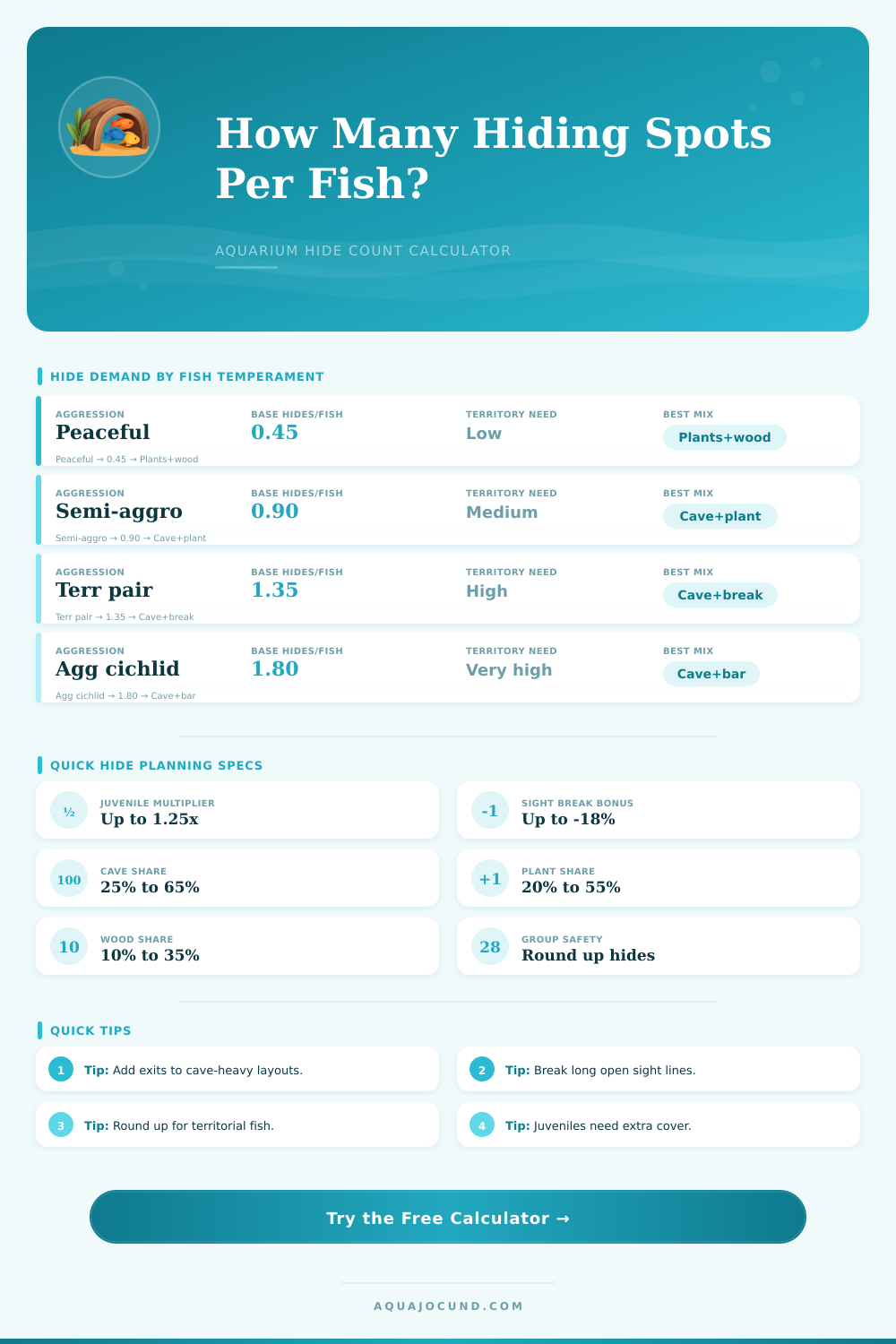
| Species behavior | Base hides per fish | Territory pressure | Useful cover style |
|---|---|---|---|
| Peaceful tetras, rasboras, livebearers | 0.45 to 0.60 | Low | Plants, leaf litter, shaded corners |
| Betta, gourami, dwarf cichlid | 0.75 to 1.15 | Medium | Plants plus one secure cave per focal fish |
| Apisto pairs, shell dwellers, reef pairs | 1.15 to 1.50 | High | Caves with separated entrances |
| Mbuna, large cichlids, crabby bottom fish | 1.55 to 2.00 | Very high | Rock stacks and broken sight lines |
| Tank | Dimensions | Footprint | Typical hide range |
|---|---|---|---|
| 10 gal | 20 x 10 in / 51 x 25 cm | 200 sq in / 1290 cm² | 3 to 8 hides |
| 20 long | 30 x 12 in / 76 x 30 cm | 360 sq in / 2320 cm² | 6 to 14 hides |
| 40 breeder | 36 x 18 in / 91 x 46 cm | 648 sq in / 4180 cm² | 8 to 22 hides |
| 55 gal | 48 x 13 in / 122 x 33 cm | 624 sq in / 4026 cm² | 12 to 32 hides |
| 75 gal | 48 x 18 in / 122 x 46 cm | 864 sq in / 5574 cm² | 14 to 40 hides |
| Hide type | Counts as | Best use | Spacing note |
|---|---|---|---|
| Rock cave or shell | 1 full hide | Territorial fish and bottom dwellers | Face openings away from rivals |
| Dense plant clump | 0.7 to 1 hide | Shoals, fry, shrimp, livebearers | Use tall clumps to block sight lines |
| Driftwood arch or root pocket | 1 hide | Loaches, plecos, shy community fish | Leave multiple exit paths |
| Leaf litter or floating cover | 0.5 hide | Juveniles and surface shy fish | Pair with hard hides below |
| Reef rock ledge | 1 to 1.3 hides | Marine pairs and rock pickers | Separate ledges by swim lanes |
| Break quality | Modifier | Visual cue | Calculator effect |
|---|---|---|---|
| Poor | +12% | Fish can see across most of the tank | Raises hide count |
| Fair | +4% | Some decor, but open center lane | Slightly raises hide count |
| Good | -8% | Decor divides the footprint into zones | Reduces duplicate hides |
| Excellent | -18% | Multiple tall breaks and alternate routes | Lowest calculated hide pressure |
When you add a new cichlid to an aquarium that’s pristine on paper but empty to the eyes of the fish, it can be the beginning of aquarium panic mode. The temperature are just right. The water is crystal clear. The filter run quietly in the background. Yet, your new addition sits tightly behind the heater in the corner for three days because the open swimming area is realy a psychological hazard zone. Not a habitat. That’s why having a sense of how many hiding places is needed are important. Shelter density matter way more then volume alone ever will.
How do you know if you have “enough”? The calculator above will do that math for you. It turns your worry about having enough cover into a clear answer regarding how many wood pockets, plant clusters, and caves you should of go out and buy. That’s where it starts to make sense: territorial size and aggression aren’t abstract ideas, they’re quantifiable space requirements.
Why Fish Need Enough Hiding Places
What does a tetra school in a tank want? Some visual barrier to make them feel safe when schooling. What about a dwarf cichlid or angelfish pair? They’ll want clear territorial boundaries (otherwise one will chase the other forever). And that’s exactly what the tool requests, your species’ aggression level, which moves the whole thing. For example, a dense wad of java fern can works well for peaceful fish. But semi-aggressive species requires separate territories with clear entry and exit points. They also need defended spaces. Guessing at the midpoint won’t get you far; getting the input values right is critical.
Now, what’s a hide to a non-reading-fish? It’s not just any piece of decoration. If there isn’t an entrance, it’s not a hide. It is just junk cluttering up your tank, blocking water flow and holding all your waste. This is where the reference table on the page comes into play, separating hard structures such as rock caves from soft cover such as leaf litter/clumped plants. Breaking line of sight work differently depending off the types of materials.
Rock caves offer complete protection for sleep or nesting. Taller clumping plants breaks a predator’s line of sight but don’t force fish to sit in a box. Wood hides creates varied shapes similar to natural root systems that help ground shy bottom dweller. Rather than just fill up empty space with whatever’s handy, the calculator break these down by quantity. You’ll have a precise idea of how much of each you’re aiming for.
There is one additional variable that sometimes goes unnoticed in your first stocking plan, juveniles. Juvenile fish is more prone to being picked on (even by other fish of their species). They tend to be smaller and therefore faster than bigger fish in the tank. Without the benefit of a size advantage to protect them from conflict, they must use the densest available cover and vertical complexity to hide from contention. The tool recognize this and factors it into its calculations. If you choose the juvenile growout stage, it multiply the density recommendation. This ensures all juveniles has enough hiding spots so none feel cornered into submission.
The silent killer in aquarium design is line of sight. If you have the right amount of hides but your long rectangular tank has wide open lanes where the fish can see their rivals all the way across the room, they will experience stress even if there’s no actual conflict. Placing decor carefully to break those visual corridors will reduces this pressure dramatically. Good sight breaks can lowers overall hide count because now the fish can’t see threats coming at them. Bad visibility conditions will increases the hide count. Everything that might be a potential rival is always visible, which causes higher tension. Because of this, you need more defensive shelters to deal with it.
So in short order, what’s happening here is creating a habitat where natural behaviors are encouraged instead of inhibited by crowding and bare ground. It’s about creating a landscape where your fish can explore their surroundings, not cower out of fear or stress and hide all day. By breaking up the long sight lines and balancing cave density with open swimming space, the aquarium becomes less of a stage for conflict and more of an ecosystem.
The logistics is handled by the math. What you’re left with is just biology…biological peace. And that calm surface water devoid of chaser and chased is realy what you’re paying for when you throw those additional rocks on there.