Vacation Feeder Days Calculator
Estimate how many days your feeder can cover from fish count, size, ration, hopper capacity, humidity loss, skipped-feed buffer, and waste risk.
Calculation breakdown
| Food type | Bulk density | Moisture sensitivity | Portion repeatability | Best planning use |
|---|
| Profile | Weight estimate | Typical ration | Feeder note |
|---|
| Tank example | Typical fish load | Example ration | Feeder food needed | Planning note |
|---|---|---|---|---|
| 5 gal / 19 L betta | 1 fish near 2.5 in / 6.4 cm | 0.05-0.10 g/day | Under 1 g for a week | Portion control matters more than hopper size. |
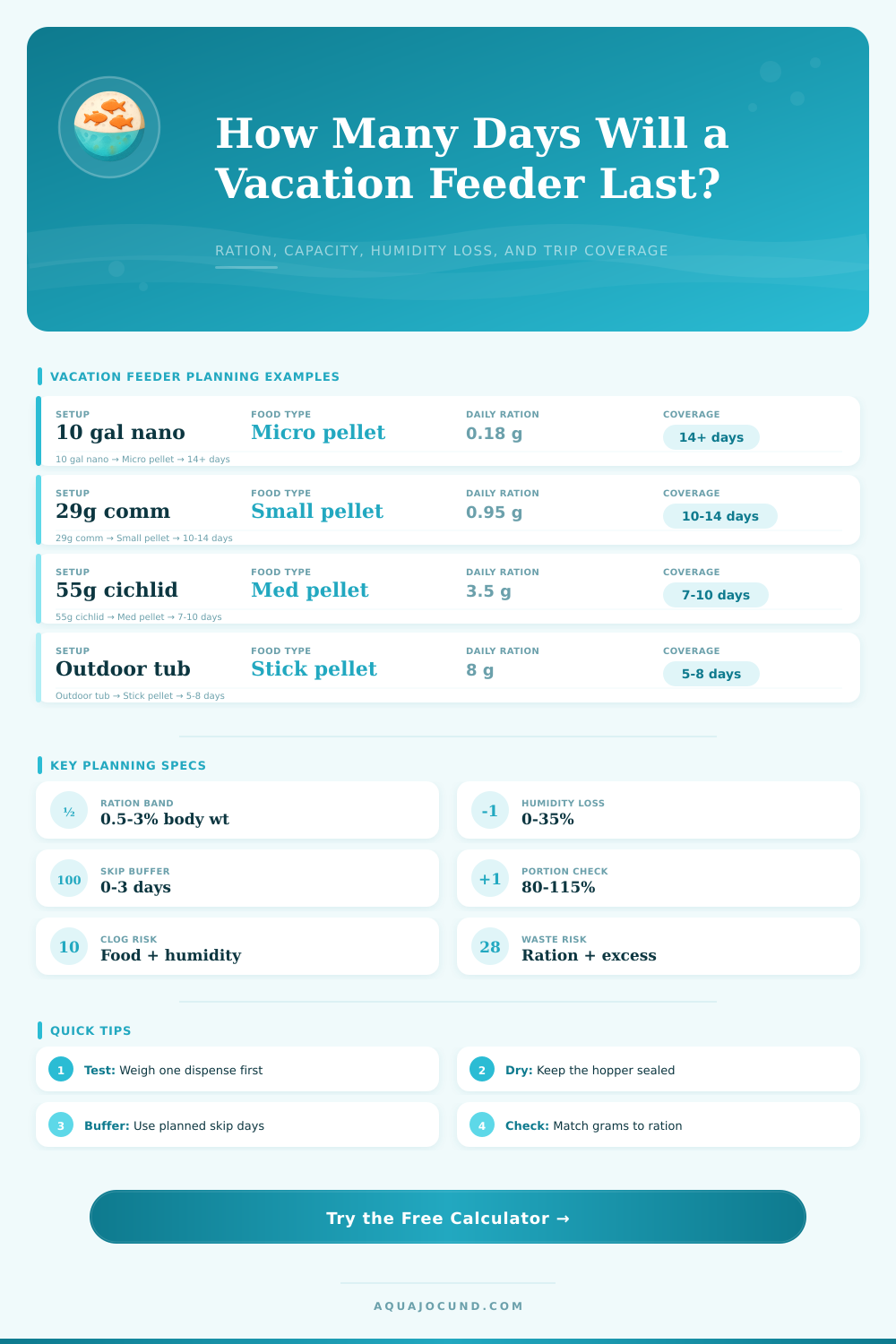
| 10 gal / 38 L nano | 8-12 small fish | 0.12-0.35 g/day | 1-3 g for a week | Micro pellets usually meter better than flake. |
| 20 gal / 76 L community | 15-25 small fish | 0.45-1.20 g/day | 4-9 g for a week | Use a skip day if portion setting runs high. |
| 40 gal / 151 L breeder | Medium mixed stock | 1.5-3.0 g/day | 11-22 g for a week | Check clumping risk in covered tanks. |
| 55 gal / 208 L cichlid | 8-14 stocky fish | 3-6 g/day | 22-45 g for a week | Match pellet size to the feeder opening. |
| Outdoor tub | Juvenile pond fish | 5-12 g/day | 35-85 g for a week | Humidity and splash exposure can shorten coverage. |
| Plan result | Coverage ratio | Portion ratio | Waste risk cue | Adjustment to test |
|---|---|---|---|---|
| Conservative match | 120% or more | 80-105% of ration | Low | Keep a small skipped-feed buffer. |
| Tight but usable | 100-119% | 85-115% of ration | Low to medium | Reduce humidity exposure or add capacity. |
| Overfeeding risk | 100% or more | Over 115% of ration | Medium to high | Lower dispense size or feed fewer active days. |
| Capacity shortfall | Under 100% | Any | Depends on portion | Increase usable food or shorten active feed days. |
| Clump-prone setup | Any | Any | Humidity driven | Switch to firmer pellets and test indoors. |
When you leave your fish alone, you get anxious about them. You’ve packed up. Double-checked the locks. You realized your fish won’t feed themselves. Freedom through an auto feeder comes at the price of more changing factors, factors that change. Mechanical failures, food densities, humidity… these can all upset your peace of mind.
Managing this anxiety require stopping guesswork and starting measurement. This tool is the answer. Panic becomes arithmetic. Vague hope transforms into a clear feeding schedule.
How to Feed Your Fish When You Go Away
What’s the catch? You can’t just fill up on any food. The catch is how long it lasts. Food exposed to humidity & air changes over time. Even with a covered hopper, it never realy seals completely. Moisture absorbed into dry food needs to be considered. So does clumping. If pellets clump up enough to jam dispensers, then a single stuck pellet might eventually release and cause massive waste dumps.
How long will the feeder last? Will it last for 10 days, or only 3 before it stops because of a clog? Knowing what your food will do when exposed to air and humidity is half the answer. The other half is knowing precisely how many pellets/cycles you are feeding. Most folks believe that “one feed” means “X amount of nutrition”. It’s not true. Food comes in all shapes and sizes. Crushed flakes are not the same as big sticks, and micro pellets flow at different rates.
Cheaper timers have bad markings so the dial may say 0.5gm but due to friction and gravity will be dropping three times as much. The calculator asks you to weigh a single dispense and enter that number. Doing that handful of cycles will provide you with real results instead of trusting what the manufacture says. Verifying that yourself is simple and helps prevent overfeeding which is worse than underfeeding if you’re away for a while.
There’s also an element of fish physiology behind it. A goldfish or stocky cichlid isn’t going to have the same metabolic requirements as a slender community fish. Profile choice is meant to adjust expected daily food according to its size and shape. Why does this matter? Because bigger equals more mass, which means they need more mass to support themselves when active. Feed too much volume for a small nano tank, and you’ll foul the water long before running out of food. By pairing livestock weight with expected consumption rate, the system helps make up for those variables.
When automation takes away our ability to intervene, it forces us to think about how less is often more. It’s smarter to plan for failure than perfection. Even an automatic feeder doesn’t work perfectly all the time: Some gears slip; some pellets get jammed up; some mechanisms don’t make it through a cycle. For those mechanical hiccups, build into your plan a skipped-feed buffer. Healthy adult fish can easily go a day without feed, but they can’t survive if their feeder runs dry because you didn’t calculate with any margin at all! You’ll want to subtract the number of planned rest days from the overall requirement so even a small malfunction won’t cause a crisis or raise stress levels too much.
On another note, what about the risk of waste? Algae blooms and ammonia spikes caused by overfeeding will destroy tank environment during your absence. To address this, the calculator measures your setup relative to established risk limits. If you’re feeding more than what’s considered safe for your livestock (based on the recommended band), it raises a red flag indicating higher waste potential. This offsets overly aggressive timer settings or human error. It reminds us that it isn’t just the length of time that matters, but how efficiently we do it. What good is a feeder capable of lasting through your entire vacation if it kills the fish while doing so?
The physics are the same whether you’re feeding your big cichlid tank or that betta bowl. Food falls downward due to gravity. Moisture wants to destroy it. Fish consume whatever they can reach. Presets can make things go faster. But custom input is more effective.
For example, the reference tables offer examples from commonly used set-ups. The reference tables show how different tank sizes and fish loads translate into grams of food needed. These benchmarks help you sanity-check your own numbers. That gives you standards against which to check your figures. Your figure shouldn’t say “ten gallons = 50 grams/week”. Something’s off there. Odds are good you’ll find yourself severely overfeeding.
Last but not least, test it before departing. Set it up on the feeder for a complete day in your house, then inspect the results. Are they even? Did any clump up? Is it dispensing the correct amount (or close enough)? This exercise will tell you things you won’t learn from the numbers. Maybe some of your pellets form into lumps in the hopper. Perhaps the timer isn’t quite syncing up properly. These are headaches to be fixed before departure if possible.
How to use the tool for successful vacation feeding Vacation feeding is all about setting reasonable expectations and sticking to limitations. It’s not about being perfect; it’s about building a consistent process that reduces the likelihood of failure. If you know what the inputs are and trust the calculations, you can go on vacation without obsessively checking your phone every few minutes for signs of doom. The water will remain clean, the fish will be fine, and you’ll get to relax while on holiday. A small amount of planning goes a long way towards ensuring both you and your livestock remains content.