🌊 Mixing Station Pump Turnover Calculator
Estimate barrel volume, pump flow after head loss, turnover per hour, salt dissolve timing, circulation direction, and heater mixing time for aquarium water-change stations.
| Pump class | Typical rated flow | Shutoff head | Mixing use |
|---|---|---|---|
| Nano utility | 120-250 gph | 3-5 ft | Small buckets and short hose paths |
| Compact mixing | 300-500 gph | 5-7 ft | 10-25 gal water-change bins |
| Submersible utility | 600-900 gph | 7-11 ft | 32-44 gal barrels with moderate lift |
| Mag-drive | 900-1200 gph | 10-14 ft | 55-75 gal drums and transfer lines |
| Pressure-rated | 1200-2000 gph | 15-22 ft | Long hose, manifold, and basement stations |
| Use case | Turnover target | Salt target | Practical mixing window |
|---|---|---|---|
| RO/DI storage | 3-6x per hour | 0 ppt | 15-60 min circulation refresh |
| Fresh mineral mix | 6-12x per hour | 0-2 g/L | 30 min to 2 hr |
| Brackish batch | 8-15x per hour | 5-18 ppt | 1-4 hr, verify salinity |
| Reef saltwater | 10-20x per hour | 33-36 ppt | 2-12 hr depending on salt |
| Large fish room | 6-12x per hour | Target species range | 8-24 hr for heat and clarity |
| Container | Typical dimensions | Batch volume | Flow for 12x/hr |
|---|---|---|---|
| 5 gal bucket | 12 in dia x 14 in | 5 gal / 19 L | 60 gph / 227 LPH |
| 20 gal bin | 24 x 16 x 13 in | 20 gal / 76 L | 240 gph / 908 LPH |
| 32 gal can | 22 in dia x 27 in | 32 gal / 121 L | 384 gph / 1454 LPH |
| 44 gal can | 24 in dia x 31 in | 44 gal / 167 L | 528 gph / 1998 LPH |
| 55 gal drum | 23 in dia x 34 in | 55 gal / 208 L | 660 gph / 2498 LPH |
| 100 gal tank | 48 x 24 x 20 in | 100 gal / 379 L | 1200 gph / 4542 LPH |
| Outlet direction | Mixing effect | Dead-zone risk | Best use |
|---|---|---|---|
| Bottom upward swirl | Lifts settled salt from the base | Low | Deep barrels and drums |
| Side circular gyre | Creates stable barrel rotation | Low | Trash cans and round reservoirs |
| Top-down stream | Strong surface movement | Medium | Shallow bins with visible bottom |
| Movable wand | Manual sweep clears corners | Variable | Rectangular bins and quick batches |
| Ring manifold | Multiple outlets distribute flow | Low | Large reservoirs |
| Single corner outlet | One strong stream, weak far corner | High | Temporary use only |
The box contain a brand spanking new submersible pump. It says on the box that it will handle eight hundred gallons per hour. That should of be plenty for your thirty-two gallon mixing barrel. So you set the pump in there and connect the hose and let ‘er rip. An hour goes by. Two hours go by. You test the mixture with a hydrometer. You find out the surface of the barrel have become dangerously salty, but the lower part of the barrel hasn’t changed much at all from freshwater. The pump didn’t break. Your math did.
Trusting what’s printed on the box while failing to account for physics of dissolved solids and the hose/lift combination makes this the classic mixing station trap. All you need to do is input your set-up information, and the calculator do all the rest. You don’t have to guess if your flow rate is sufficient to actualy dissolve the salt in time until your next water change.
Why Your Pump Is Not Working Right
This isn’t simply a matter of raw volume. Head loss matters. Circulation velocity matter. Mounting a pump vertically and pushing water upward into a display tank fights against gravity with each inch of vertical lift. Each additional foot of height rob your flow. Each hose elbow introduce resistance. A pump that’s rated for high performance at zero feet of head may only spit out a trickle when required to push water up six feet through a tiny hose. These losses are accounted for by the tool so you know what your pump actually does rather than what its manufacturer hopes it will do in a perfect laboratory setting.
Why does this matter? Salt takes time to dissolve into the water. Dissolving is also a function of water moving. Without sufficient turnover, the water will layer. The heavy salty stuff will settle and the fresh lighter water will float. What you’ll have is a gradient rather than a uniform mixture. This is not good for health of your fish or consistent with your reef parameter results.
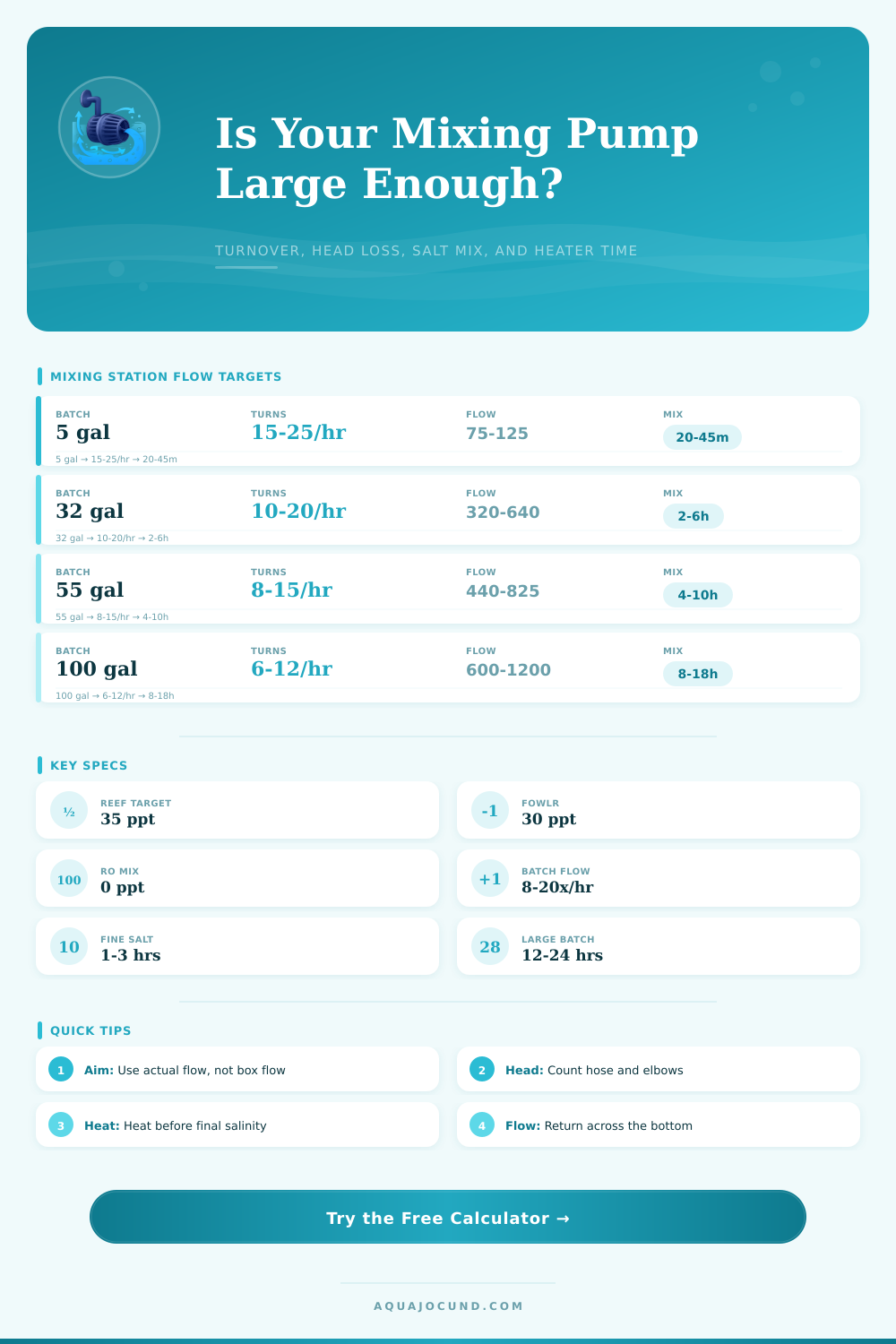
Most aquarists want a turnover rate of at least 10-20 turns per hour to mix the water. This means turning over the total volume of water in the barrel multiple times to scrub away any layers of density. The table on the page give clear guidance to those targets. It demonstrates why a bigger barrel need more flow to achieve the same level of mixing/agitation.
This all gets more complicated when you add heating. Warm water is not the same as cold water: it won’t mix the same way, doesn’t dissolve as much gas, and so on. Depending on the temperature of your room, you’re probably going to want some sort of heater in your mixing station. However, unless you have some form of circulation to ensure even distribution of that heat, having a heater won’t do anything because top layer will get warmer while bottom layer remains colder. Your heater’s wattage determine how fast it can heat things up, and the calculator guesses how long it should take for your installed wattage to raise the entire batch to temp. It takes into account both room draft and heat loss through the tank lid. Remember that managing flow is as important as managing salinity to keep the temperature even.
People often cut corners on hose size to save money. Backpressure from a half-inch hose with a high-flow pump will cause a dramatic drop in your effective flow rate. If you are mixing, going up to a three-quarter inch or larger can be the difference between a two- and four-hour mix. This is one of those small hardware changes that pays for itself in terms of time savings.
Consider, too, how you return the water. Placing the stream against surface will result in some splashing but it won’t do much to lift any settled salt off bottom. By angling the return so that it hits side wall or floor, you establish a current that sweeps the entire barrel, making sure no dead zones are left where undissolved crystals can hide.
It’s not all about convenience. The mix is about consistency, and inconsistent salinity can be a bigger stressor on livestock than we give it credit for. Osmotic stress from subtle changes in specific gravity weaken an animal’s immune system over time. Consistent salinity means consistent specific gravity. By having a correct turnover rate, you ensure each drop out of your spigot is the same as the previous one. You won’t have to wonder if the water changed today; just trust your equipment. Knowing exactly what you’re putting into your tank vs. Hoping for the best.
How long is that hose? Run your numbers through this tool and count your elbows and lift. You might find your pump is actually underperforming by half its rating. Maybe you have a half-rated pump. Now you know why your mix takes forever. Before the next water change, you can correct it with better plumbing or a bigger pump.
It’s all about clarity. Clear water. Clear salt. Clear conscience.