RO Storage Tank Sizing Calculator
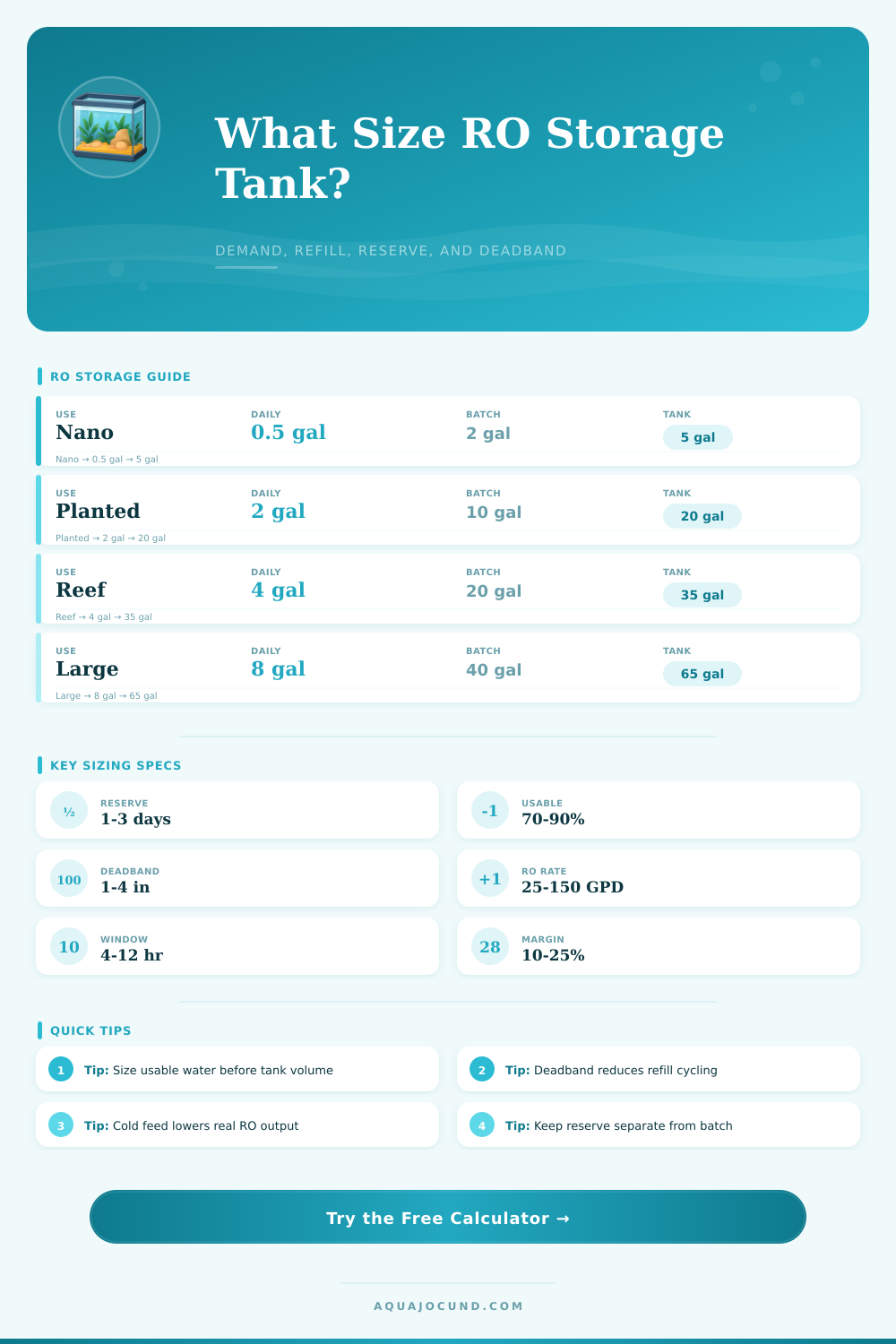
Size aquarium RO/DI storage from daily RO demand, water change batches, emergency reserve, production rate, refill window, usable tank percent, and float switch deadband.
💧Quick RO Storage Presets
⚙Storage Sizing Inputs
Calculation Breakdown
📊Comparison Grid
📘RO Production And Refill Window Table
| Membrane Rating | 4 Hour Window | 8 Hour Window | 12 Hour Window | Use Case |
|---|---|---|---|---|
| 25 GPD / 95 LPD | 4.2 gal / 16 L | 8.3 gal / 32 L | 12.5 gal / 47 L | Nano top-off |
| 50 GPD / 189 LPD | 8.3 gal / 32 L | 16.7 gal / 63 L | 25 gal / 95 L | Small water changes |
| 75 GPD / 284 LPD | 12.5 gal / 47 L | 25 gal / 95 L | 37.5 gal / 142 L | Common aquarium RO/DI |
| 150 GPD / 568 LPD | 25 gal / 95 L | 50 gal / 189 L | 75 gal / 284 L | Reef or fish room |
📋Usable Tank Percent Reference
| Usable Percent | What It Allows | 30 Gal Tank Gives | 50 Gal Tank Gives | Best Fit |
|---|---|---|---|---|
| 70% | Large headspace and pickup allowance | 21 gal / 79 L | 35 gal / 132 L | Mobile bins |
| 80% | Conservative float switch range | 24 gal / 91 L | 40 gal / 151 L | Most reservoirs |
| 85% | Balanced storage and safety | 25.5 gal / 97 L | 42.5 gal / 161 L | RO/DI stations |
| 90% | Tight headspace with reliable shutoff | 27 gal / 102 L | 45 gal / 170 L | Fixed tanks |
🐟Common Aquarium RO Storage Scenarios
| Aquarium Setup | Daily RO Demand | Water Change Batch | Reserve Target | Typical Tank |
|---|---|---|---|---|
| 5 to 10 gal nano | 0.2 to 0.6 gal / 1 to 2 L | 1 to 3 gal / 4 to 11 L | 1 to 2 days | 3 to 5 gal / 11 to 19 L |
| 29 gal planted tank | 1 to 2 gal / 4 to 8 L | 8 to 12 gal / 30 to 45 L | 2 days | 15 to 20 gal / 57 to 76 L |
| 55 to 75 gal reef | 2 to 5 gal / 8 to 19 L | 15 to 25 gal / 57 to 95 L | 2 to 3 days | 30 to 45 gal / 114 to 170 L |
| 125 gal display | 5 to 10 gal / 19 to 38 L | 30 to 50 gal / 114 to 189 L | 3 days | 55 to 75 gal / 208 to 284 L |
📏Float Switch Deadband Reference
| Container Footprint | 1 Inch Deadband | 2 Inch Deadband | 4 Inch Deadband | Cycle Note |
|---|---|---|---|---|
| 12 x 12 in / 30 x 30 cm | 0.6 gal / 2.4 L | 1.2 gal / 4.7 L | 2.5 gal / 9.4 L | Small ATO bin |
| 18 x 24 in / 46 x 61 cm | 1.9 gal / 7.1 L | 3.7 gal / 14 L | 7.5 gal / 28 L | Medium reservoir |
| 24 x 36 in / 61 x 91 cm | 3.7 gal / 14 L | 7.5 gal / 28 L | 15 gal / 57 L | Large storage tank |
| 23 in round / 58 cm | 1.8 gal / 6.8 L | 3.6 gal / 14 L | 7.2 gal / 27 L | Common barrel |
Many aquarists purchase a reverse osmosis system, then deal with storage afterward. That’s a mistake. If your RO system are down for repairs, you may be forced to use stored water if you didn’t save any extra during your last filling. Without enough storage, you’re vulnerable if the tap runs dry or the system need a break. Without storage you’re hosed.
The calculator does all the number crunching for you. Just enter your fill rate and time between refills. It will tell you how much water you have available in your containers so there is no guessing about what’s at the bottom of that bin.
How to Choose Your RO Water Storage Tank
So how do you size your storage? It’s more than selecting a large bucket. There is a difference between nominal capacity and actualy capacity (the amount you can withdraw before experiencing a air lock or needing to prime the pump). Rarely does a 30 gallon tank contain 30 gallons of useable RO output. You must have room for the intake tube to remain submerged. You also need space for the float switch to function. Finally, leave some buffer for mistakes. Don’t forget, your tank is subject to physics, get it wrong and you’ll be looking down into a full container but no water will flow.
First, set your actual requirement. In addition to the regular, big batches required for biweekly water changes in planted or fish-only setups, there’s also the constant, slow trickle of automatic top-offs typical in most reef tanks. Those two types of consumption require different sizes. The first requires a sudden lump sum, whereas the second steadily draws down reserves. You need enough for both at once. If you size it based off average daily consumption, you’ll be out of water just as you’re about to make some saltwater.
The other important limitation most folks forget about is the refill window. You may have a seventy-five gallons per day membrane which looks great on paper but when you can’t let it run after work, well, it won’t produce much water at all! To maximize efficiency most systems will be set up with some sort of float switch or timer where they are cycled off after 8 or 12 hours max. Not only does this save waste water but it also prevent the membranes from overheating. That’s why the tool factors in how long it would take to fill up your reserve from empty under those conditions. If it runs more then your refill window allows, then you need to upgrade to a larger tank (or just increase the size of the system to cover the gap).
Deadband also refers to float switches. Most hobbyists overlook its importance. Deadband is the vertical distance between when the float switch turns on and when it shuts off. If you have a little deadband you will get short cycling. This will wear out pumps and solenoids too soon. If you have a large deadband you will use up some of your stored volume but it’ll give the system breathing room. So you want to find a happy medium based on the size of your containers. Wider bins can create a lot of volume change without much height difference.
Having emergency reserves makes you feel good in the event of an equipment failure or power outage. Having one to three days of extra water in reserve means you won’t have to run around at the last minute if something goes wrong. It gives you a tiny bit of breathing room. It provides a little backstop before crisis mode sets in. This is included in your overall need and factored into the output of the calculator… so you don’t accidentally engineer a system with no wiggle room.
You get what you pay for: Long term success also depends on material choices. Bins should be food grade polyethylene, which resists algae growth and can be easily cleaned. Stay away from bins that were previously used as fuel or chemical containers. You don’t want legacy contaminants leaching out of old plastic into your pure water.
Finally, what you want to achieve with this whole system is something that just works quietly in the background. It is something you hardly know is there. If you size everything correctly, the RO station will be a quiet companion to keeping your aquarium(s) running, not an ever-present distraction.
How much water do you need? Before purchasing the tank, consider how much water you’ll use overall. Determine your total water volume based off what’s usable and then purchase a container capable of holding it. This makes the routine easy and ensures your reserve is safe. You should of planned for this earlier.