💧 DI Resin Exhaustion Gallons Calculator
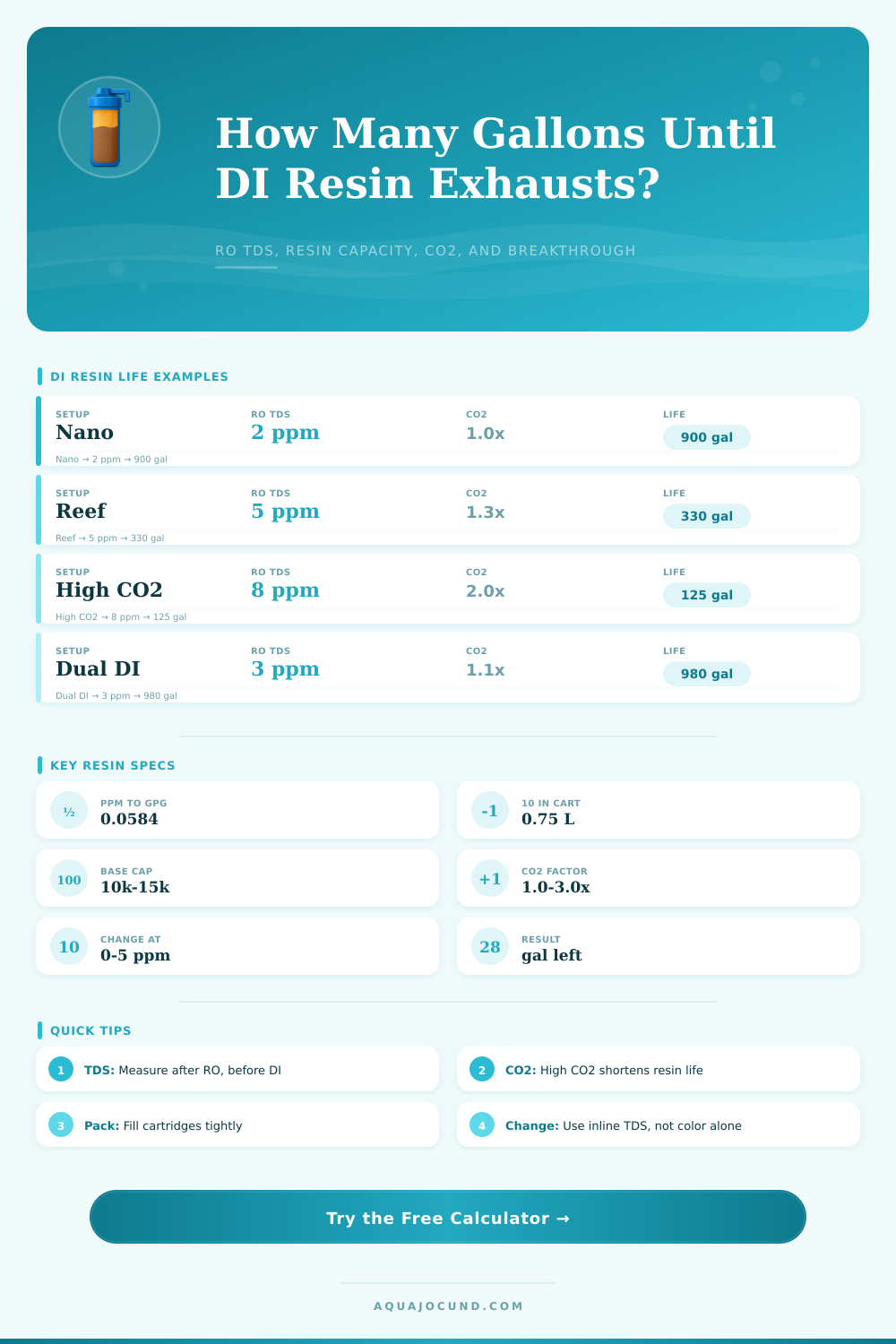
Estimate RO/DI mixed-bed resin life from canister volume, resin capacity, RO product TDS, CO2 load, target breakthrough, gallons already produced, and gallons remaining.
🧪Resin capacity and RO product water
Use your resin data sheet if available. The calculator converts grains to ppm-gallons.
Lower this for loose packing, channeling, air gaps, or a partly filled refillable cartridge.
Measure after the RO membrane and before the DI stage, not at the tap and not after DI.
Calculation Breakdown
⚙DI resin comparison grid
📋DI resin reference tables
| Resin profile | Planning capacity | Best use | Calculation note |
|---|---|---|---|
| Conservative mixed bed | 8,000 grains/ft³ | Unknown resin or older refill | Useful when no data sheet is available. |
| Regenerated mixed bed | 9,000 grains/ft³ | Service DI tanks or reused media | Lower reserve than fresh disposable resin. |
| New mixed bed | 10,000 grains/ft³ | General RO/DI polishing | Common planning baseline for mixed-bed DI. |
| Fresh color-change bed | 12,000 grains/ft³ | Aquarium refill cartridges | Use inline TDS for final change timing. |
| Premium nuclear-grade bed | 15,000 grains/ft³ | Low-TDS reef polishing | Best entered from a resin specification sheet. |
| High-capacity anion blend | 18,000 grains/ft³ | Specialty polishing stage | May not match a standard mixed-bed cartridge. |
| Cartridge or vessel | Typical resin volume | Approx ft³ | Planning note |
|---|---|---|---|
| Half 10 inch refill | 1.6 cups / 0.38 L | 0.013 ft³ | Useful for small systems or split test beds. |
| Standard 10 inch refill | 3.2 cups / 0.75 L | 0.027 ft³ | Common vertical refillable RO/DI cartridge. |
| Large 10 inch refill | 4.0 cups / 0.95 L | 0.033 ft³ | Fits some wider or tightly packed refill shells. |
| Dual 10 inch DI | 6.4 cups / 1.51 L | 0.053 ft³ | Two full canisters in series for longer run time. |
| Small service tank | 16 cups / 3.79 L | 0.134 ft³ | Portable DI vessel, not a small inline cartridge. |
| RO product TDS | Grains per gallon | Resin pressure | What to check |
|---|---|---|---|
| 0.5 to 2 ppm | 0.03 to 0.12 gpg | Low | Confirm the TDS meter is reading before DI, not after DI. |
| 2 to 5 ppm | 0.12 to 0.29 gpg | Moderate | Typical for good membrane rejection on many municipal supplies. |
| 5 to 10 ppm | 0.29 to 0.58 gpg | High | Membrane rejection, pressure, and temperature begin to matter more. |
| 10 to 20 ppm | 0.58 to 1.17 gpg | Very high | Check membrane age, restrictor match, pressure, and prefilters. |
| 20+ ppm | 1.17+ gpg | Severe | DI resin may exhaust quickly unless the RO stage improves. |
| Aquarium use | Common DI batch pattern | Breakthrough target | Tracking method |
|---|---|---|---|
| Nano shrimp | 2 to 5 gal at a time | 0 to 1 ppm | Log every batch because small use hides slow exhaustion. |
| Planted RO mixing | 5 to 20 gal per week | 1 to 2 ppm | Compare DI output with remineralized target water. |
| Reef ATO and salt mix | 10 to 50 gal per week | 0 to 1 ppm | Watch both resin color and final inline TDS. |
| Fish room storage | 40 to 150 gal batches | 1 to 3 ppm | Record totalizer gallons or barrel fills per cartridge. |
💡DI resin exhaustion tips
If you notice water softness slipping in your shrimp keeping or if you notice pH drifting in your reef tank, think about whether you need to replace deionization (DI) cartridge. It’s the quiet guy just hanging out in the plumbing, waiting to go belly up before you even realize there is an issue with it, making the whole system seem like its losing grip. Most aquarists replace them because they “feel” they’re ready or they’re supposed to be some color, but both are way past the point. By that time, the water hasn’t been good for days and the resin is shot. Knowing how much capacity is left lets you plan ahead so that changing the cartridge becomes more of a planned habit then a panicked reaction.
But those who don’t know how to read their TDS meters are getting misled by them. TDS meters report dissolved solids but they won’t differentiate between dissolved CO2 and hard minerals. Standard conductivity measures cannot detects your carbon dioxide, but it will use up resin capacity at the same rate as any other mineral, such as magnesium or calcium. That’s where everyone misses it. If you’re drawing water off of your city or from a well that has higher levels of organic materials in the water, your resin bed is fighting a two-front war against acid water. That’s why the hidden load of carbon dioxide are taken into account when estimating total demand. The calculations use multipliers based on actual chemical pressure instead of ideal lab conditions.
How to Know When to Change Your DI Cartridge
This goes back to the fact that it’s all about the cartridges. What does that mean? Well, physical world is at play here. How well did you pack that refillable container? Did you tap it gently after pouring in some new beads? You just created channels and air pockets through which water will flow freely from the outside walls of the shell to the inside, bypassing the beads entirely. Even though the shell appears full, your effective volume has plummeted. Capacity isn’t everything. How tightly do you pack matter more. Is it really better to have a big vessel with tons of void space in it or a smaller one but tightly packed? Of course not, so the tool compensates for that by allowing you to specify what fill percentage you are working with, forcing you to think about whether you truly packed that last load of resin effectivly.
And then there’s reserve capacity. Unlike a light bulb that switches off, the resin fades as it saturates. The beads slow down ion swapping when they’re saturated. When your TDS meter say 1ppm, they may already be at 80% exhaustion and unable to keep pace with varying water flows. Having a reserve threshold built into your calculations allows you to replace the resin long before its performance suffers instead of after failure. That’s what creates the buffer between someone who’s worried about parameters and someone who has full confidence in their system.
Some resins have a better baseline than others. Premium nuclear grade blends contain more grains per cubic foot, but they cost more and may not perform as well under heavy flow rates. The standard mixed bed is a good old workhorse that’ll run out predictably at the 10,000-grain point. The whole equation hinges on what profile of resin you’re working with. If it’s a color-change bed where you’re relying on sight to know everything is okay, keep in mind the color change comes long before exhaustion. So your effective gallon count are less than theoretical max.
Don’t be lulled into believing that more resin = more good. Oversize cartridges run the risk of leaving some dead spots (bad flow distribution), whereas undersize ones turn over so fast they don’t effectively exchange ions. To find the sweet spot, size your resin volume to match your incoming water quality and how much water you actualy use in a week. Before you measure TDS of your RO product, do it at the input to the DI stage, not output. That is the real load being carried by your beads.
It all boils down to gallons produced. That allows you to handle an invisible chemical process as a schedule you can live with. Instead of wondering about the purity of the water, you know exactly when to grab the next cartridge, you should of planned it earlier. As the resin works quietly in the background, it keeps a log of how much it produces so that it does not have to ask for help.