🌿 Bleach Dip Ratio Plant Calculator
Calculate aquarium plant dip water, household bleach amount, final sodium hypochlorite percentage, neutralizer dose, sensitivity timing, and rinse volume.
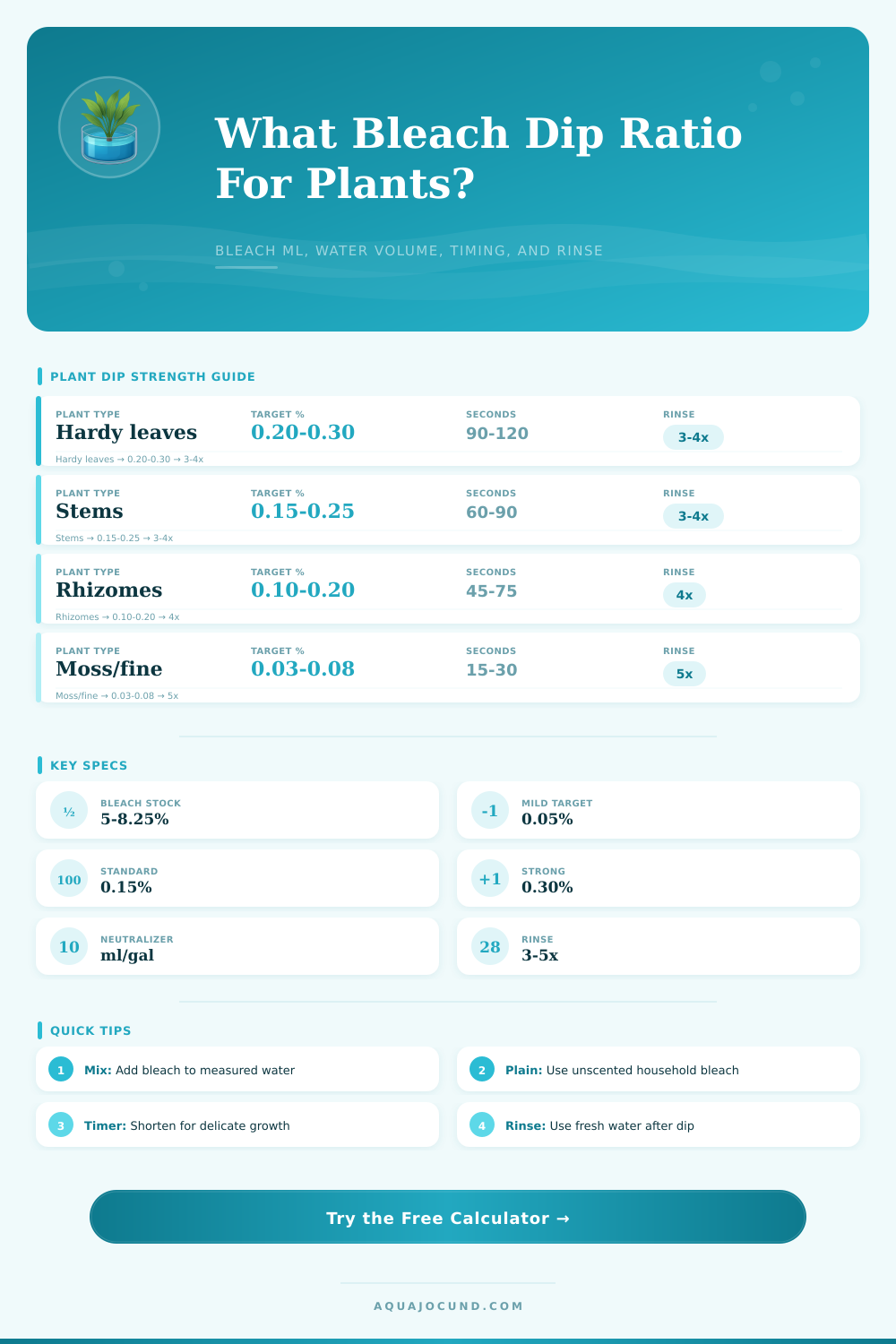
| Plant profile | Example plants | Target band | Timing window | Rinse multiplier |
|---|---|---|---|---|
| Hardy broad leaf | Anubias leaves, Java fern leaves | 0.15-0.30% | 75-120 sec | 3-4x |
| Rhizome epiphyte | Anubias rhizome, Bucephalandra, Java fern | 0.10-0.20% | 45-75 sec | 4x |
| Rosette crown plant | Amazon sword, Cryptocoryne, bulb crowns | 0.08-0.18% | 45-75 sec | 4x |
| Stem plant bundle | Ludwigia, Rotala, Bacopa, Hygrophila | 0.08-0.18% | 45-90 sec | 4x |
| Ribbon or grass plant | Vallisneria, Sagittaria, dwarf chain sword | 0.05-0.12% | 30-60 sec | 4-5x |
| Fine leaf plant | Cabomba, Myriophyllum, hornwort portions | 0.03-0.08% | 15-35 sec | 5x |
| Moss or liverwort | Java moss, Christmas moss, Riccia | 0.02-0.06% | 10-25 sec | 5-6x |
| Floating plant | Salvinia, frogbit, red root floater | 0.02-0.05% | 10-20 sec | 5-6x |
| Bleach label | Stock % NaOCl | Bleach for 1 L at 0.10% | Bleach for 1 L at 0.15% | Approx bleach:water |
|---|---|---|---|---|
| Older regular household | 5.25% | 19.6 ml | 29.4 ml | 1:34 at 0.15% |
| Regular household | 6.00% | 16.9 ml | 25.6 ml | 1:39 at 0.15% |
| Concentrated household | 7.50% | 13.5 ml | 20.4 ml | 1:49 at 0.15% |
| Concentrated household | 8.25% | 12.3 ml | 18.5 ml | 1:54 at 0.15% |
| High-strength sodium hypochlorite | 10.00% | 10.1 ml | 15.2 ml | 1:66 at 0.15% |
| Container | Measured water | Metric equivalent | 6% bleach for 0.15% | Fresh rinse at 4x |
|---|---|---|---|---|
| Small cup | 0.5 qt | 0.47 L | 12 ml | 1.9 L |
| Plant bowl | 1 qt | 0.95 L | 24 ml | 3.9 L |
| Nano tray | 2 qt | 1.89 L | 48 ml | 7.8 L |
| Standard bucket | 1 gal | 3.79 L | 97 ml | 15.5 L |
| Large plant tray | 2 gal | 7.57 L | 194 ml | 31.1 L |
| Target setting | Final NaOCl % | Use case | Neutralizer plan | Rinse plan |
|---|---|---|---|---|
| Gentle | 0.05% | Moss, floaters, fine leaves | 2-3x label dose in rinse bucket | 5-6x dip volume |
| Mild | 0.10% | Grass plants, thinner stems, rosettes | 2x label dose in rinse bucket | 4-5x dip volume |
| Standard | 0.15% | Rhizomes, hardy stems, broad leaves | 2x label dose in rinse bucket | 3-4x dip volume |
| Firm | 0.20% | Hardy leaves with exposed surfaces | 2x label dose in rinse bucket | 4x dip volume |
| Strong | 0.30% | Short hardy-leaf dip only | 3-5x label dose in rinse bucket | 4-6x dip volume |
How to make new plants safe if you have no hot water? No problem. Bleach dips sterilize things with no toxic pesticides and hot water. It’s a targeted attack against bacteria, snails, and other pests, while trying to keep the plant tissue alive. That means getting the timing of the sterilizing dip just right, plus the concentration, and then understanding how to neutralize them all simultaneously.
If you’re winging it, that’s a lot of guessing. And the math for mixing the solutions is pretty simple, but easy to screw up. The percentage of sodium hypochlorite in household bleach ranges a lot, from five percent to maybe eight percent. It depends on where and when you buy the stuff. It might be too weak to kill anything. It might be strong enough to burn the leaves in seconds if you make the wrong assumption.
How to Use Bleach for Plants Safely
That’s where a committed calculator comes into play. This time around, you can simply put in the percentage from whatever is printed on the bottle and it calculates exactly how many milliliters will get you to X amount of concentration in Y amount of water. That eliminates all of the guessing per dip. Just as importantly, tool offers presets for different plant types that automatically adjust the recommended timing and rinse multipliers.
Some plants (e.g., Java Fern, Anubias) is quite resilient and can handles higher doses for longer periods of time without being damaged. Other types (e.g., delicate mosses) will start getting bleached and go whitish after only 20 seconds or so. In this case, the preset options for various plant groups within the tool help. They adjust the suggested rinse multiplier and time window to match. This way, you treat your Christmas Moss chunk carefully, but a bunch of stem plants stays submerged long enough to do its thing.
The other important element most forget about is timing. The tendency is to think “longer=safer,” but that doesn’t apply when it comes to bleaches (oxidizers). Although they may kill any pests present, prolonged soaking will harm cell walls and break down chlorophyll which can cause rotting. Typical dip times range between 45-90 seconds, depending on the type of plant being treated. Use a timer; trying to watch a clock and simultaneously hold plants in a bucket is unproductive and imprecise. Set your phone’s timer for the exact amount of time needed based off your solution’s concentration; this helps you focus on your work instead of watching the seconds tick by.
That’s where you really do the work…the rinsing stage. Remember, bleach isn’t magic…it doesn’t just dissapears after being pulled out of the water. It continues working on the surface of those plants until neutralized or fully diluted. If there is any chlorine left on your plants it will slowly start killing them over the coming days and appear as if they are rotting. They aren’t…that’s chemical stress from chlorine.
If you use some type of dechlorinator in your buckets while rinsing, it will greatly speed up the process. Use twice or even triple the amount called for on the label of whatever neutralizer you’re using to make sure all traces of oxidants are broken down before contact with your tank water. The more fresh water you have around, the more dilution it provides so it breaks down whatever tiny bit might be leftover.
The shape of the container itself can also be thought about to improve accuracy. Even two containers that appear roughly the same size (e.g., a round bucket vs. A rectangular tray) may contain different amounts of water. By measuring the dimensions (length x width x depth), you’re able to calculate the exact volume instead of just eye-balling how close it is to being full. Knowing exactly how much bleach is in your water volume = knowing exactly what’s going on. That leads to direct improvement in safety.
It becomes a predictable, controllable part of your routine maintenance, making what was once an intimidating chemical process seem easyer. Preparation replaces instinct. Knowing you have your ducks in a row… The right concentrations, proper timing, a neutralization plan, eliminates the fear factor. You should of had this ready before you start. Now you can go after newly introduced plants knowing they’re being removed before the threat becomes obvious.
This protects your investment. After all, you want your new acquisition to thrive, not succumb to chemical shock. A thorough measuring changes what might be a liability into an effective barrier to your aquatic ecosystem.