🌿 Alum Dip Concentration Calculator
Mix an aquarium plant alum dip by bath volume, target strength, powder density, stock solution, exposure time, plant sensitivity, and rinse dilution.
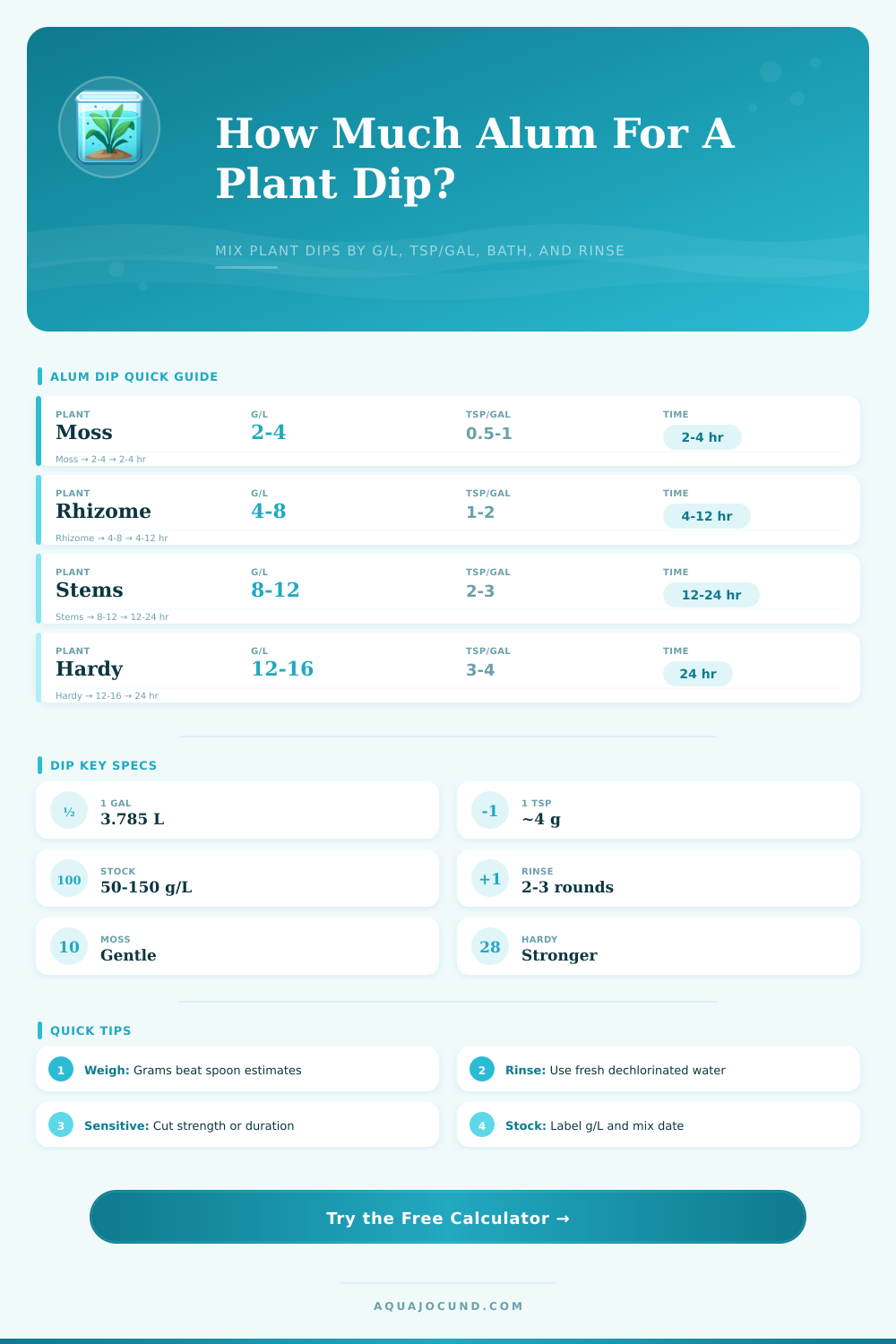
| Plant Group | Typical g/L Range | Duration Window | Calculator Adjustment |
|---|---|---|---|
| Mosses and delicate tissue | 2 to 4 g/L | 2 to 4 hours | Low exposure score, larger rinse priority |
| Anubias, Buce, Java fern | 4 to 8 g/L | 4 to 12 hours | Moderate concentration and duration |
| Most stem and rosette plants | 8 to 12 g/L | 8 to 24 hours | Standard plant-dip reference band |
| Hardy swords, crypts, floaters | 12 to 16 g/L | 12 to 24 hours | Higher tolerance, still rinse thoroughly |
| Unknown or mixed batch | 4 to 8 g/L | 4 to 8 hours | Conservative cap for mixed plant loads |
| Target Strength | Approx tsp/gal | Dry Alum For 1 Gal | 100 g/L Stock For 1 Gal |
|---|---|---|---|
| 2 g/L gentle | 0.5 tsp/gal | 7.6 g | 76 mL |
| 4 g/L light | 1 tsp/gal | 15.1 g | 151 mL |
| 8 g/L standard | 2 tsp/gal | 30.3 g | 303 mL |
| 12 g/L strong | 3 tsp/gal | 45.4 g | 454 mL |
| 16 g/L hardy | 4 tsp/gal | 60.6 g | 606 mL |
| Bath Container | Volume | At 4 g/L | At 8 g/L |
|---|---|---|---|
| Small specimen cup | 0.5 L / 0.13 gal | 2 g dry alum | 4 g dry alum |
| Metric plant tray | 1 L / 0.26 gal | 4 g dry alum | 8 g dry alum |
| One gallon bowl | 3.8 L / 1 gal | 15 g dry alum | 30 g dry alum |
| Five gallon bucket | 18.9 L / 5 gal | 76 g dry alum | 151 g dry alum |
| Ten gallon holding tub | 37.9 L / 10 gal | 151 g dry alum | 303 g dry alum |
| Carryover On Plants | Fresh Rinse | One Rinse Remaining | Two Rinses Remaining |
|---|---|---|---|
| 20 mL dip liquid | 1 L rinse | 1.96% | 0.04% |
| 40 mL dip liquid | 1 gal rinse | 1.04% | 0.01% |
| 75 mL dip liquid | 1 gal rinse | 1.94% | 0.04% |
| 100 mL dip liquid | 2 gal rinse | 1.30% | 0.02% |
Aluminum sulfate is white and is sold either as clear crystalline solid or as white powdered solid. It do a good job of killing hitchhikers in the tank. Use it carefully. Killing plants is something you don’t want to do when eliminating hitch hikers. The calculator shows how much to use so that it is both effective and safe for plant.
Why do we need to know this? We need to keep our plants alive. A spoon can work for a beginner, too: “I need one teaspoon for every gallon! That’s easy, I’ll just add some and see what happens.” Wrong. Just because two spoons appears equal in size doesn’t mean their weight is the same. One may be full of fine powder while the other are mostly coarser crystals.
How To Use Aluminum Sulfate Safely
To compensate for that difference in weight (density), the calculator ask which type of product you are using. Otherwise, your bath might be twice as potent or only half as strong. With scale, there’s no guesswork; a visual measurement becomes an exact measurement of chemical.
Another factor that will cause the error is sensitivity of the plants. Some plant are tougher than others. While a Java fern can tolerate abuse, delicate moss balls melts away in minutes. Because the strength of the tissue has to match concentration and duration, the tool requests you categorize your plant material. An overnight dip may be ok for hardy stem plants in higher concentrations while more tender epiphytes requires a gentler touch. If you treat those delicate bits of moss like a robust sword plant, they will ended up with brown ends and melting leaves. Better to err on under dipping rather than overdipping. These grouping allow the calculator to adjust its recommendations so the exposure doesn’t go beyond safe levels.
Prepared solutions make repeated dips easier. Constantly mixing powder with water each time takes too long, not to mention risk of error from lumpy messes. A concentrated stock solution makes it easy to add large amounts quickly. Simply measure amount of water you will use for the final bath and add the liquid accordingly (keeping in mind the concentration of your stock). To do this, you’ll need to know the dilution strength of the stock. The calculator converts this to tell you exactly how many milliliters of your stored liquid equal your desired dose. You will have less prep time and fewer spills.
Rinsing is realy the cleaning part. It’s common for many aquarists to only pay attention to the dipping and not the residue that stays behind. When you remove plants from the bath they will have a layer of that chemical solution on their leaves, put those right back in your tank and you’re putting some of that stressor back on your livestock. The tool demonstrates the dilution effect… How later rounds of rinses decrease amount of residual concentration left on plant leaves. A couple or three changes with fresh water make a huge difference in residual carryover. This little step prevents post-dip shock.
It has some reference tables that are actualy part of the page so that you don’t have to leave the page, which is great if you want to check quickly about common scenarios. Like a large bucket set up vs. A single gallon bath. So when you get ready to mix, you can get an idea in your head about the size of what you’re dealing with. If you put a little bit of alum into a small cup or a lot into a five-gallon bucket…you see it at a glance and can keep from underdosing big amounts by mistake.
The key is to heed the chemistry. As a harsh disruptor of mucus membranes and deterrent to soft-bodied pests, Alum does its job. That’s by design. However, it is not something you want on your moss. On those nasty snails? Yes please. But use the calculator to input your numbers. And then rely on your eyeballs even more. If a plant starts looking distressed during the regimen, remove it sooner than later. No formula will consider each specific species’ resilience and any other factors such as general health. Rinse well; go easy; and give ’em time to bounce back. Better to have a mild dip that’s effective then one that’s severe but lethal.