LED Channel Percentage Mix Calculator
Blend white, blue, red, green, and UV channel watts into a peak mix, ramp-adjusted schedule, PAR share estimate, and color-bias readout.
| Channel | Typical aquarium role | PAR weight used | Mix caution |
|---|---|---|---|
| White | Broad daylight base and visual brightness | 0.95 | Too much can wash out reef fluorescence |
| Blue | Coral fluorescence, deep-water look, useful PAR | 1.05 | Can hide plant color if whites are low |
| Red | Plant color, warm tone, visual contrast | 0.82 | High red may make algae-prone tanks harder to tune |
| Green | Human-eye fill and natural color rendering | 0.58 | Adds brightness more than measured PAR punch |
| UV/violet | Violet edge, fluorescence, high-energy blue-side light | 0.72 | Use controlled levels and avoid staring at emitters |
| Setup | White / blue | Red / green / UV | Color bias |
|---|---|---|---|
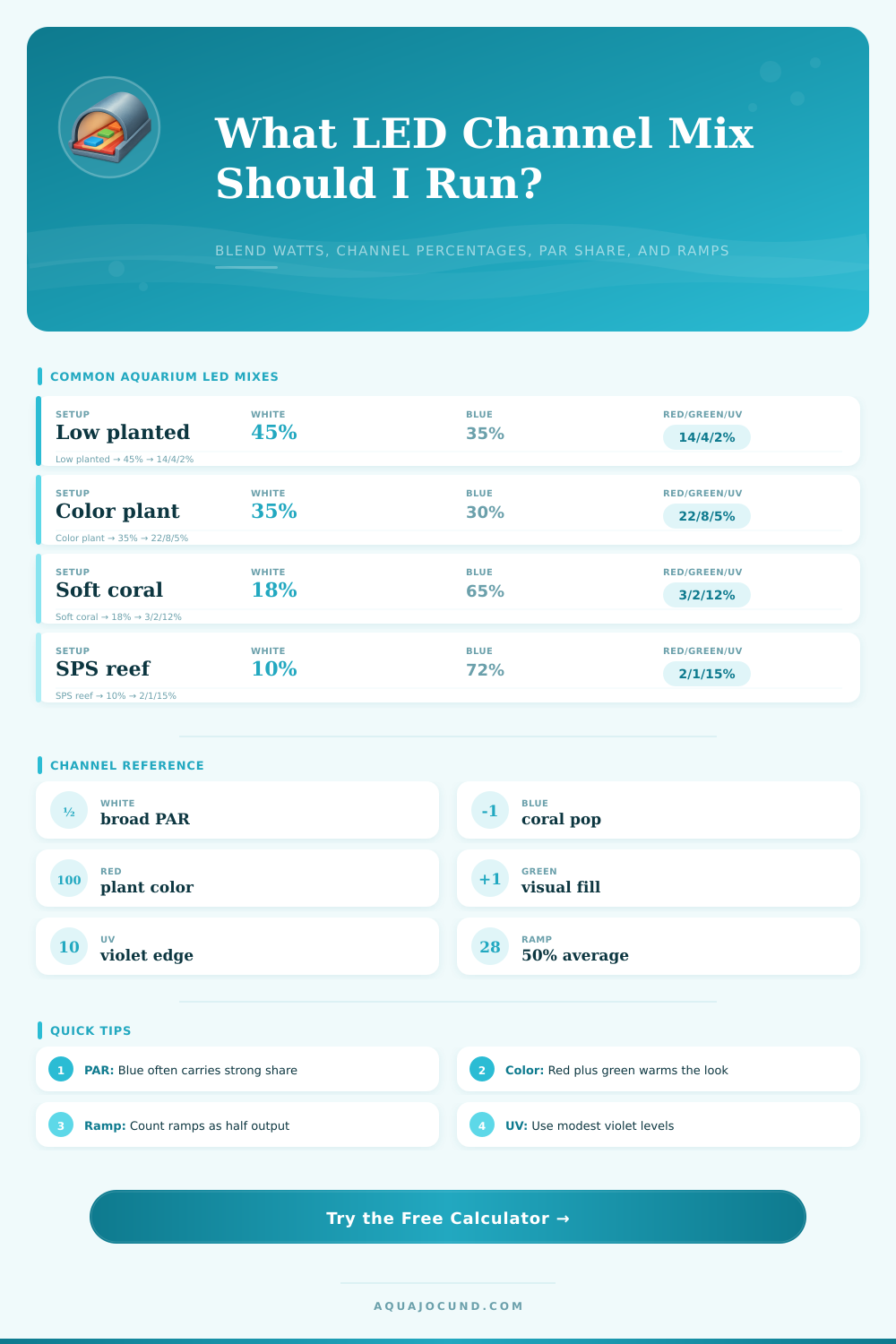
| Low-tech planted | 45% / 35% | 14/4/2% | Neutral daylight |
| Color plant CO2 | 35% / 30% | 22/8/5% | Warm color boost |
| Blackwater display | 25% / 28% | 12% / 6% / 0% | Warm dim viewing |
| Soft coral reef | 18% / 65% | 3/2/12% | Blue reef look |
| SPS reef | 10% / 72% | 2/1/15% | Strong actinic bias |
| Schedule item | Formula | Effect | Use in calculator |
|---|---|---|---|
| Peak active watts | Channel watts x channel % | Instant output at full mix | Summed across all channels |
| Ramp equivalent | Total ramp minutes / 120 | Linear ramp averages half output | Added to full photoperiod |
| Daily watt-hours | Peak watts x effective hours | Schedule-weighted light load | Shows blended daily output |
| PAR share | Weighted channel PAR / total weighted PAR | Separates visual brightness from PAR contribution | Reported by channel family |
| Tank style | Typical target PAR | Useful mix direction | Ramp cue |
|---|---|---|---|
| Shade planted nano | 15-30 PAR | White-led base with mild blue | 30-60 min total ramp |
| Mixed planted community | 30-60 PAR | Balanced white, blue, and controlled red | 60-120 min total ramp |
| CO2 carpet or Dutch | 70-120 PAR | Higher white and red with enough blue fill | 90-180 min total ramp |
| Soft coral reef | 60-120 PAR | Blue-forward with modest UV/violet | 120-240 min total ramp |
| SPS reef zone | 180-350 PAR | Strong blue plus UV with controlled white | 180-300 min total ramp |
Turn on a strong LED array suspended above a planted tank for the first time and you’ll swear the water’s glowing from within. It is a satisfying moment, until you realize your red stem plant appear more purple than normal. Your corals’ fluorescent colors seem to dissapears into the background. Chances are good you’re not lacking light, but rather using the wrong channels to do the work.
Remember: Aquarium lighting isn’t all about brightness. Every component influence the taste of what lives beneath the glass. To get that combination correct, you need to balance biological requirements, visual appeal, and photon output. Once you input information about your fixtures, the calculator above run the numbers for you. That means no more guesswork, only a structured plan.
How to Balance Aquarium Light Colors
The base layer is white light, which is just as it sounds, the light that provides daylight simulation. It lets you see inside the tank. If there’s insufficient white light, your aquarium will appear as some sort of abstract art work. It is not a living ecosystem at all.
Where it gets interesting: Blue light stimulate coral fluorescence (they’ll glow), but more importantly, it also drives photosynthesis very effectively. What happens with excessive blue light without sufficient white/red? The light will be perceived as harsh. Coloration may also be hidden in plants.
Remember, these channels don’t each contribute equally to PAR (photosynthetically active radiation). For example, blue LEDs frequently carry a greater percentage of the PAR load on a single watt than green ones. So your fixture may seem dim but it still drive strong growth. Most hobbyists err here when they judge by what their eyes tells them only.
The spice (green and red) comes from the channels. Warmth is brought by red light. It heightens the colors of plants. Greens appear vibrant and reds pop. Green light is inefficient at driving PAR. However, it fills out the spectrum for human vision, making the tank appear naturaly rather than over-saturated or washed out.
Adding a little bit of UV or violet light add a high-energy edge to the light which can enhance fluorescence in some species. Careful dosing is needed here. Add too much UV or violet light and you run the risk of stressing your livestock and promoting unwanted algae blooms.
The chart on the page do a good job of laying this out. It shows how different tank styles focus their input on one channel versus another. An SPS reef setup for instance lean hard into blue and UV. A low-tech planted tank rely more on balanced reds and whites.
There’s also another variable which impacts how much light you’re actualy getting per day, ramping. If you have programmed your sunrises/sunsets with transitions, during these minutes, you’re not running at maximum power. The lights gradually go up and down. So if you have a two hour ramp time, that doesn’t mean two hours at max intensity. This adds less to the overall photon budget. Know the difference so you don’t accidentally cause photoinhibition in sensitive species. Also avoid algae issues in heavy plant beds.
Match your real effective daily light integral to the amount of light your livestock can tolerate. Don’t get fooled by just looking at the peak wattage number on the box. If you’re not sure where to start, pick a tank style preset first. After that, watch it and then tweak the individual channels accordingly.
Bump up the red (or white) by a bit if your plants appear leggy. Boost the violet (or blue) percentage if your corals are pale. Observe the results over weeks, not days. Corals and plants slowly adjust their photoreceptors. A sudden change in spectrum (just like a sudden decrease in light intensity) can be stressful.
Aim for a stable environment that looks good to you AND helps your tank inhabitants grow. It’s a mix of art and science, and now that you have the tools to measure the science, all you need to do is perfect your eye for the art.
Dialing in the spectrum will transform your tank from a lit box to a living landscape once you stop chasing raw brightness. You should of tried it sooner.