Aquarium Mesh Lid Frame Length Calculator
Size screen-frame rails, corner connector deductions, spline channel clearance, brace bars, waste allowance, and a practical cut list for rimmed or rimless aquarium mesh lids.
Mesh Lid Cut Results
| Cut Part | Qty | Each Length | Total Length | Build Note |
|---|
| Profile | Typical Corner Bite | Channel Inset | Best Use |
|---|---|---|---|
| Aluminum window screen frame | 0.22-0.31 in | 0.31-0.44 in | Most rimmed freshwater and reef tanks |
| Low-profile aquarium rail | 0.15-0.25 in | 0.22-0.35 in | Rimless tanks and narrow ledges |
| Heavy-duty patio screen frame | 0.31-0.50 in | 0.44-0.63 in | Large lids, cats nearby, or high mesh tension |
| Custom printed corner system | 0.20-0.60 in | 0.25-0.50 in | Overflows, cords, feeders, and odd cutouts |
| Tank | Nominal Footprint | Likely Lid Target | Brace Plan |
|---|---|---|---|
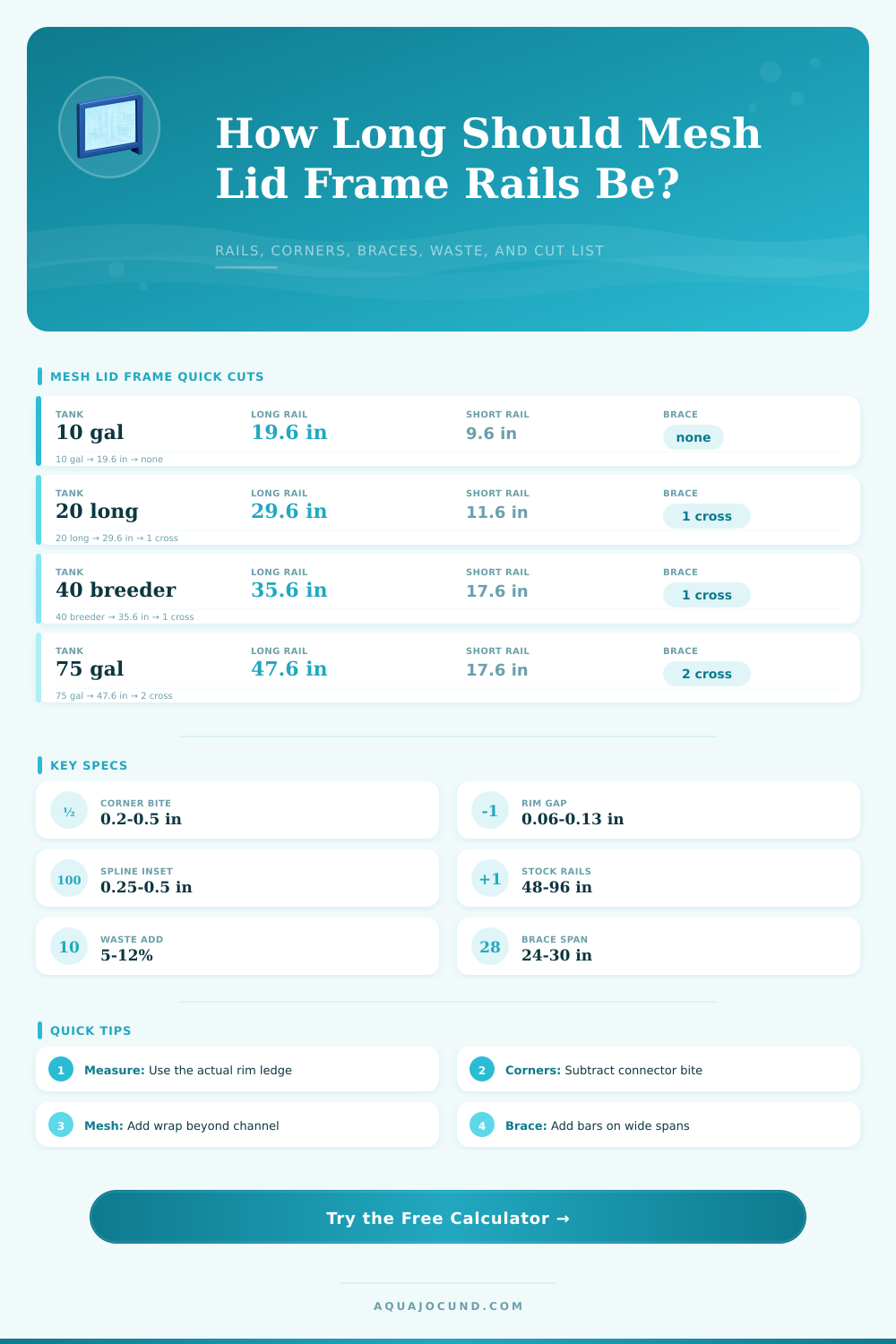
| 5.5 gallon | 16.25 x 8.38 in | 16.0 x 8.1 in | No brace |
| 10 gallon | 20.25 x 10.5 in | 20.0 x 10.2 in | No brace or light brace |
| 20 long | 30.25 x 12.5 in | 30.0 x 12.2 in | One width brace |
| 40 breeder | 36.19 x 18.25 in | 35.9 x 17.9 in | One width brace |
| 75 gallon | 48.5 x 18.5 in | 48.1 x 18.1 in | Two width braces |
| 125 gallon | 72.5 x 18.5 in | 72.0 x 18.1 in | Split lid or 3 braces |
| Allowance | Small Lids | Large Lids | Why It Matters |
|---|---|---|---|
| Finished side clearance | 0.03-0.06 in | 0.06-0.13 in | Prevents a tight lid from scraping rim trim |
| Corner connector bite | 0.15-0.25 in | 0.25-0.50 in | Sets the actual rail cut length |
| Spline channel inset | 0.22-0.38 in | 0.38-0.63 in | Controls the net mesh rectangle |
| Mesh wrap beyond channel | 1.0-1.5 in | 1.5-2.5 in | Gives enough screen to pull while rolling |
To do so the project starts in hardware store and finishes with a frame that doesn’t fit flat onto your tank. You grab some off-the-shelf screen door rail and measure its standard length against your tank’s standard size. You try to build the lid, only to realize the corners won’t come together, or maybe the mesh are too tight. And it’s always something to do with geometry of how aluminum profiles connects, never the glass itself.
So that’s what this calculator’s for; it forces you to take into account those physical details that you so easily can forget when rushing to get the project done and removes the need to guess. The thing is, every frame system subtracts some length on the rail where it join another one so you need to figure out how much corner allowance to give. In standard aluminum screen frames, connectors cuts about a quarter inch or slightly more off both ends of the bar, so you have two long bars and then two short ones that is losing material before ever hitting the saw blade.
Why Use This Calculator
Cut them to fit exact inside length of the opening in your tank’s rim, and you’re gonna be left with a frame too big to assemble. Once you’ve chosen what profile type you want, this subtraction happen automatically on the tool, it matters! Slim low-profile rails has shallower channels, while heavy-duty patio frames is deep. Getting this calculation correct means no crooked lid. Otherwise, you’ll leave a gap big enough for an agile betta to slip through.
However, there’s another aspect of the project that many people overlook; the mesh/wrap allowance. Depending on depth of spline channel inset into the frame, the mesh will be positioned either far inside or outside of the outer perimeter of the rail. To hold the mesh down correctly, you want some excess material past this groove. If you don’t have sufficient allowance for wrap, then the rolling tool won’t stay on the spline all the way up to corner, resulting in an unsupported edge which begins to ripple when water move across it. This effect is more pronounced with longer spans, like those on large tanks such as a seventy-five gallon, where a lot of tension exist between rails.
The calculator increases the mesh blank size based off how much extra material you plan to roll over. This ensures you purchase enough material instead of trying to connect two tiny scrap piece halfway up the tank in front of your brand new lid.
Another differentiator between the experienced builder and the first-timer: how much do you allow for waste? Saws has kerf, meaning they chew up some width when cutting through aluminum. Since no one cuts perfectly their first time around, ordering just enough stock rail to avoid running out midway through assembly is risky. You will likely end up making a second run to the store because you made a mistake or took an aggressive cut, leaving a rail two millimeters too long. A little buffer goes a long way to save your butt.
Because mesh will tend to bow outwards either on its own (when wet) or if bumped from underneath, lids on long tanks require bracing. That’s why a crossbar running down the center of the width of most tanks is usually all that’s required (even though you can get away without one for mid-size community tank). Larger display aquariums or even wide ones such as breeders may require two crossbars in order to ensure rigidity of the lid. In those cases, this handy tool calculates the intermediate length taking into account the bite of connectors used to hold everything together, keeping your cut list clean and accurate.
After all, a well-built lid isn’t so much about brute force as it is about precision fit. Those little deductions realy make the difference between a lid that binds versus one that slides into place with quiet satisfaction. You should of used this tool earlier to avoid mistakes.