ATO Reservoir Days Calculator
Estimate usable reservoir volume, daily top-off demand, emergency reserve, salinity runway, and the next refill date.
| Reservoir type | Cover loss | Dead volume hint | Best use |
|---|
| System example | Common ATO size | Typical daily demand | Expected interval |
|---|---|---|---|
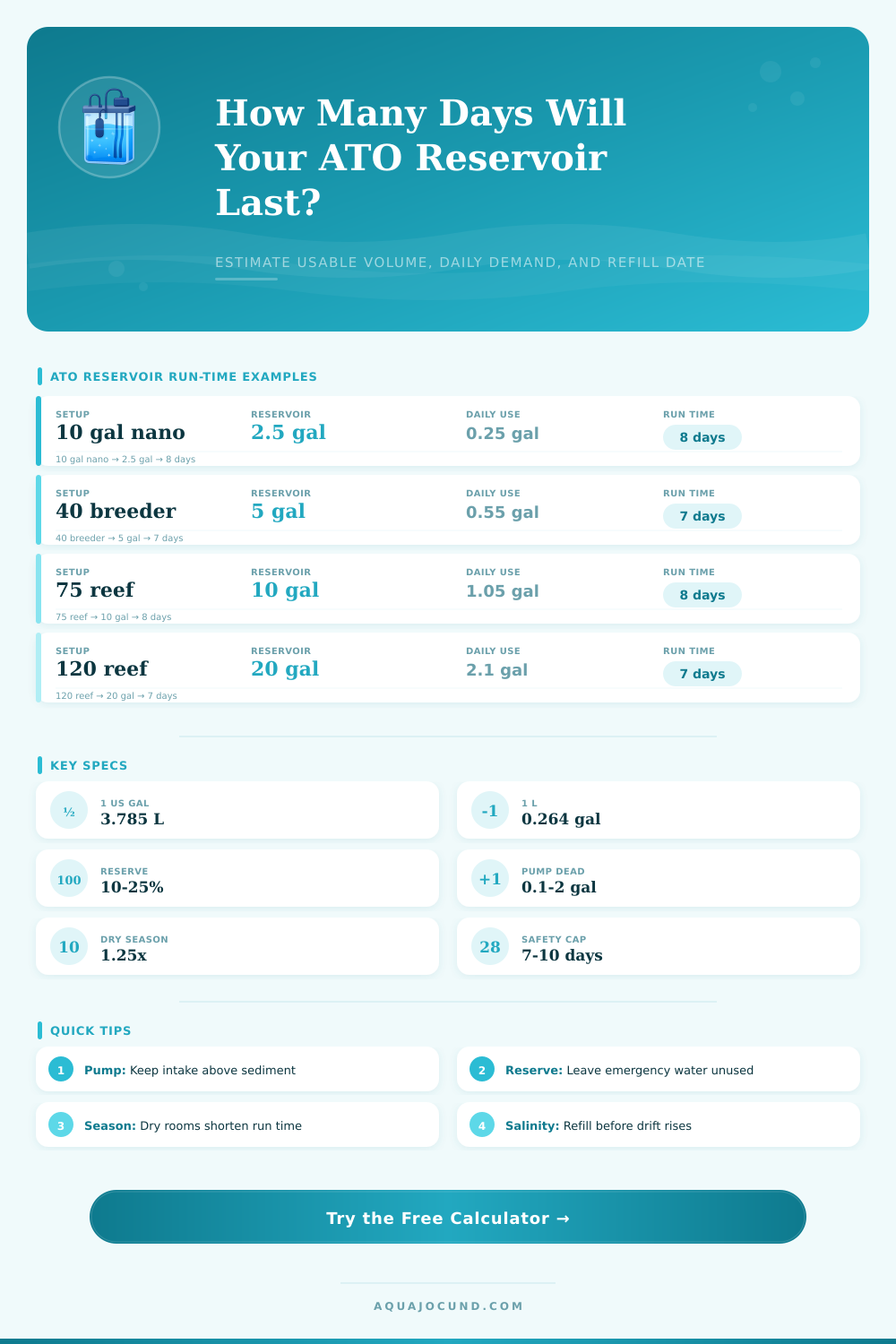
| 5 gal pico | 0.8-1.5 gal / 3-6 L | 0.05-0.12 gal / 0.2-0.5 L | 5-14 days |
| 10 gal nano reef | 2-3 gal / 8-11 L | 0.15-0.30 gal / 0.6-1.1 L | 6-12 days |
| 40 breeder reef | 5 gal / 19 L | 0.45-0.75 gal / 1.7-2.8 L | 5-9 days |
| 75 gal reef with sump | 10 gal / 38 L | 0.8-1.4 gal / 3-5 L | 6-10 days |
| 120 gal SPS system | 18-25 gal / 68-95 L | 1.7-2.8 gal / 6-11 L | 6-12 days |
| Frag tank, open top | 12-20 gal / 45-76 L | 1.2-2.4 gal / 5-9 L | 5-11 days |
| Season setting | Factor | When to use | ATO impact |
|---|---|---|---|
| Humid or covered room | 0.82x | Tight lids, humid fish room, low air movement | Longer reservoir interval |
| Normal room | 1.00x | Measured evaporation already matches current conditions | Baseline interval |
| Warm lights or light fan | 1.15x | Open canopy, surface agitation, moderate cooling fan | About 13% fewer days |
| Dry winter room | 1.28x | Heated indoor air, low humidity, uncovered sump | About 22% fewer days |
| Open top with strong fan | 1.45x | Active evaporative cooling or very dry air | About 31% fewer days |
| Stability target | Limit | Meaning | Planning note |
|---|---|---|---|
| SPS reef | 0.5-1.0% | Small salinity rise before refill alarm | Size reservoir for frequent reliable refills |
| Mixed reef | 1.0-1.5% | Moderate short-term stability target | Useful default for weekly checks |
| FOWLR or hardy marine | 1.5-2.5% | Wider but still controlled concentration rise | Do not use as a normal operating swing |
| Freshwater planted | 2.0-4.0% | TDS concentration check rather than salinity target | Still top off before pumps run low |
What’s your experience with a reef tank? Unless it’s making noise, in most cases a reef tank is better off silent. Set it up, dial in the parameters, hope it stays stable (then its feed time). Oh shoot, forgot to check the water level, now the auto top-off reservoir are empty. Oops, I went on a week long vacation and didn’t check the water level. Why? Because the reservoir was viewed as something unknowable, not something to be planned for because it have a finite capacity.
Water evaporates different depending on the season, lighting levels, and room humidity. In a hot dry winter, it may go dry in 5 days; in a cool damp summer, ten days. Knowing that help maintain salinity stability and avoid late-night “oh crap” refill emergencies.
How to Plan Your Reef Tank Water
How? Don’t worry about estimating any of this. Just put in your own parameters and let the calculator do the math for the remaining usable volume based off physical limits. Now determine the amount of water you actualy have available by honestly measuring your reservoir volume. This includes any pump dead volume, which is water in the tank below the pump’s intake point that will never be drawn out due to the suction of either sediment or air.
In addition, remember to account for an emergency reserve. While this isn’t strictly necessary from a mechanical standpoint, having a bit of water remaining in case the pump surges and the water level suddenly becomes very low can help avoid drawing air into the pump or causing it to form bubbles.
This one is not in your average planning guides: salinity stability. As the reservoir dries up, so does the water level. But the water keep evaporating. That means salt concentration in your main tank increases quickly. A salinity spike can be stressful on those sensitive SPS corals or even make their tissues recede. You can input a tolerance limit for how many days you are safe if your auto top-off fails completely. It is not about when the reservoir goes empty, but how many days your livestock can survive without you knowing and stepping in.
Everything changes seasonally. Active cooling and/or air circulation require more refill water then does a covered, humid set-up. Multipliers in the reference table makes that clear: A dry winter setting can slash your runway by nearly a quarter compared to a covered summer setup. That’s why so many keepers refill every three days in January, even though they did fine with two weeks back in August. They should of just remember that.
While the built-in presets serves as a good starting place (i.e. If you have a large sump system or a nanocube), they’re just ballpark numbers. Your best number to plug into this tool is your actual daily evaporation rate which you can measure yourself. Fill up your reservoir, mark where water line starts, leave the pump running overnight, and note how far down the water level drop the next day. You’ll know exactly how much water evaporated.
This one piece of data brings the math out of the realm of theory and into reality. It factors in your climate conditions, the exact size of your sump, and the tightness of your lid. These are all things that cannot be accounted for by any generic equation.
It alters the way you deal with the components. It’s no longer a reactive thing… Oh crap, the water level is really low, I need to do something now. Instead, you can plan around solid figures. Refill dates is scheduled according to those numbers. You don’t fret over an empty bucket anymore; you understand it contains three more days of reserve. What once was a stressful situation becomes part of the routine, maintaining the tank.
And it’s not just doing what is necessary to prevent the tank from running dry, but also providing a stable environment for your livestock so they can thrive without unexpected parameter shifts. When you’ve got the numbers dialed in, then its back to being quiet again… and staying that way.