Light Duration Energy Use Calculator
Estimate aquarium light kWh, ramp-adjusted photoperiod, heat load, and algae-risk duration from fixture watts and channel schedule.
Energy Use Results
| Fixture type | Typical channel watts | Heat factor | Common use |
|---|---|---|---|
| Low-profile LED strip | 8-30 W | 0.88 | Nano, low-light, shallow tanks |
| RGB planted LED | 20-75 W | 0.90 | Color-tuned planted aquariums |
| High-output LED bar | 40-150 W | 0.92 | Deep planted displays |
| Reef LED panel | 60-220 W | 0.94 | Coral display lighting |
| T5 fluorescent fixture | 24-80 W | 0.96 | Even spread over long tanks |
| Metal halide pendant | 150-400 W | 0.98 | High-intensity point source |
| LED and T5 hybrid | 80-300 W | 0.95 | Reef or Dutch-style coverage |
| Band | Effective hours | Algae pressure | Schedule cue |
|---|---|---|---|
| Short | Under 5.5 h | Low duration pressure | Useful for recovery or new setups |
| Balanced | 6-8 h | Moderate and usually manageable | Common planted display target |
| Extended | 8-10 h | Rising risk if nutrients or CO2 lag | Use only with stable maintenance |
| Long | 10+ h | High duration pressure | Reduce duration before raising output |
| Tank | Typical fixture | Schedule | Energy range |
|---|---|---|---|
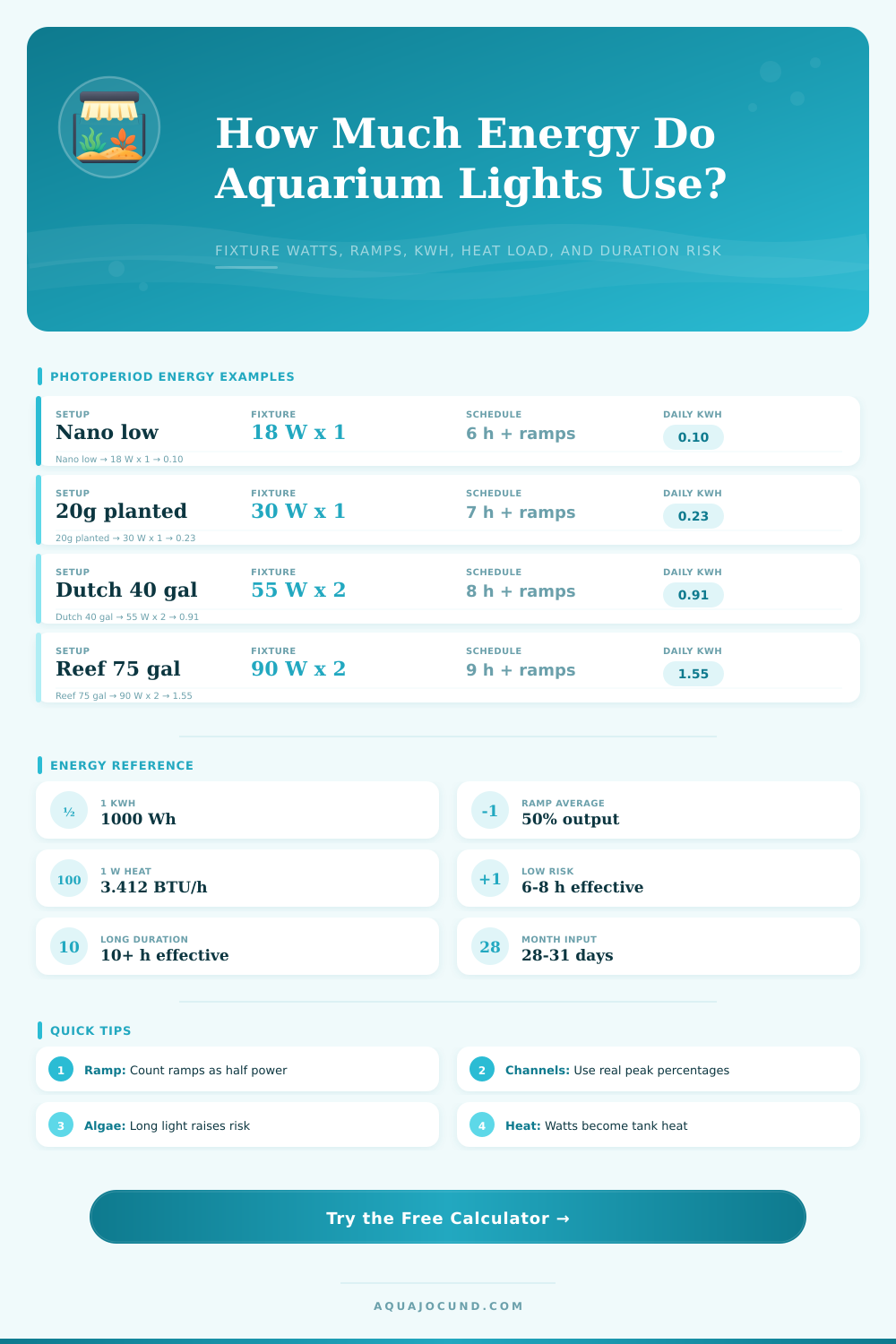
| 5 gal nano / 19 L | 8-18 W LED | 5-7 h plus short ramps | 0.04-0.14 kWh/day |
| 20 gal long / 76 L | 24-45 W LED | 6-8 h plus 30-60 min ramps | 0.15-0.38 kWh/day |
| 40 breeder / 151 L | 50-120 W LED or T5 | 7-9 h plus ramps | 0.40-1.10 kWh/day |
| 75 gal / 284 L | 120-220 W reef or planted LEDs | 8-10 h with ramps | 1.00-2.20 kWh/day |
| 125 gal / 473 L | 180-360 W mixed lighting | 7-10 h with ramps | 1.50-3.60 kWh/day |
| Item | Formula | Why it matters | Unit |
|---|---|---|---|
| Main watt draw | Channels x watts/channel x peak % | Real draw at programmed peak | W |
| Ramp equivalent | (Ramp up + ramp down) / 120 | Linear ramps average half output | h |
| Daily energy | (Main W x effective h + moon W x moon h) / 1000 | Total light energy per day | kWh |
| Heat load | Average W x heat factor x capture % | Estimated tank-side heat contribution | W or BTU/h |
Getting the correct spectral mix of light for your corals needs and achieving the right PAR values is one thing, but then turning those lights on for 14 hours a day because “more light means more growth” will invite a cyanobacteria invasion. That’s simply the tax you’ll pay for that mistake in energy costs.
Time kills tanks faster than anything else, and most aquarium keepers ignores it while they obsess over color spectrum of their LEDs. After plugging your schedule and fixture specs into the calculator (above), it do the rest of the math. You don’t have to guess at sunrise ramps or convert watts into kilowatt-hours…you’re saved that headache.
Why Light Timing Matters for Your Aquarium
You might think those forty-five minutes don’t matter during a ramp up, but they do. When the fixture is on a linear ramp, it’s running at half-power for entire period of time. So an hour-long gentle rise to full brightness will add around half-an-hour of true peak illumination to your tank. The actual metric of importance for corals and plants isn’t the clock time on your timer, it’s the effective photoperiod. Two forty-five minute ramps plus a seven-hour full photoperiod adds up to seven hours; but you’re closer to eight hours of effective exposure. Why? The ramps add some amount of energy too, which is important to think about when looking at algae balance.
Six to eight hours of effective exposure is usually what a balanced planted tank need to thrive. If you go over ten effective hours, your nutrient demand spikes. Your water column won’t be able to keep up with all that sudden carbon fixation and dissolved organics hangs around. Green dust algae will settle onto any available surface. People make this mistake, they blame the light intensity rather then its duration.
Another unseen variable which the tool calculates on your behalf is heat load. Each watt your light draws will eventually become heat in your room, and a significant portion of that enters the water column directly. A large percentage of that heat go right into the water column. If you have a small tank and you’re not getting any airflow or surface agitation, an eighteen-watt strip could be raising your water temperature by a degree or two. This will show up as BTUs and allow you to determine whether or not your lighting is working against your chiller during summer months. It may not seem like much but it matters when you are trying to keep parameters stable for sensitive livestocks.
For example, a high tech CO2 injected tank is very different than a low-tech shaded tank. While a low tech may run for only 4 hours a day, a high tech may has to go under a 9 hour period of intense light in order to take up carbon efficienty; this means it’s going to draw more current on your electric bill and will barely budge the needle. Both are fine setups, but one takes much higher amounts of energy input and management then the other.
To see how your tank compares to similar tanks, the tool has a reference table that shows them. If you’re running a seventy-five gallon reef tank, knowing that what you’re putting into the tank is typical helps. Knowing if there’s some problem with your driver efficiency is also helpful.
You can adjust schedules by looking first at changing the effective hours (not necessarily the peak percentage). For example, if algae shows up after a schedule adjustment, look at total equivalent hours first. You may be giving your tank too many lights on in total. Dimming it down 10% won’t do anything if you’re already putting out too many hours of light. In contrast, sometimes reducing the photoperiod by an hour will solve things better than lowering the fixture output. There is a biological limit to how much coral/plants can process using light before that energy turns into waste product, which is why it works.
In conclusion, providing lighting for your aquarium means as much about restraint as it does supply. You desire just enough light to sustain life but not so much that your energy bill increases exponentially or encourages unwanted algae growth. When you hit that balance point, the numbers level off. Plants will grow better, your tank will appear cleaner, and you won’t have to wonder why your utility bill keeps increasing month after month.
Take some time to properly map out your schedule the first time and it would of saved you from doing it over again.