Light Intensity by Distance Calculator
Estimate aquarium PAR or lux at plant height from fixture output, reference distance, beam angle, mounting height, and water clarity.
Use the maker PAR map or a meter reading at the reference distance.
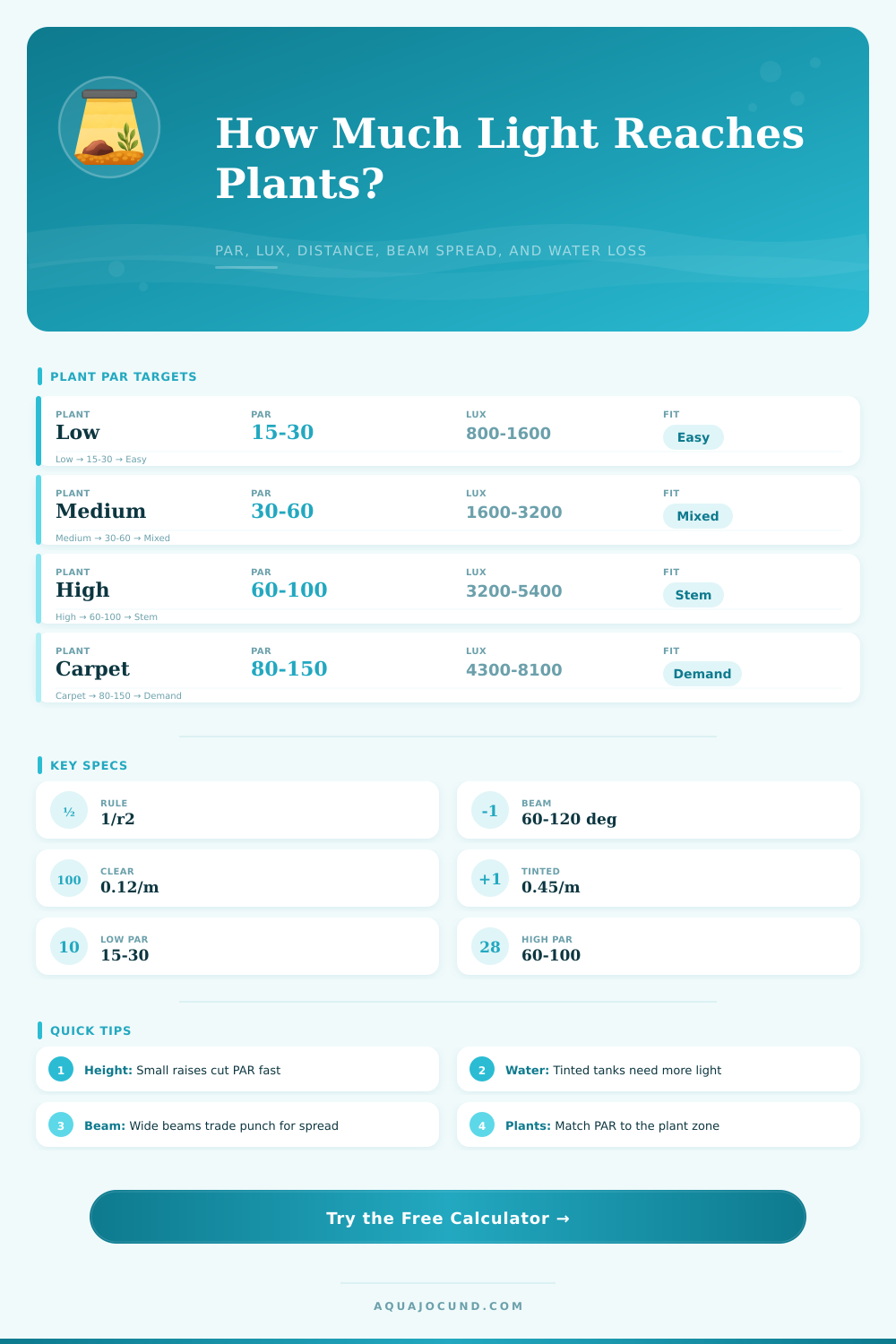
| Category | PAR target | Approx lux | Typical plants |
|---|---|---|---|
| Shade epiphytes | 8 to 20 PAR | 430 to 1080 lux | Anubias, Buce, Java fern |
| Low light | 15 to 30 PAR | 800 to 1600 lux | Crypts, moss, easy stems |
| Medium light | 30 to 60 PAR | 1600 to 3200 lux | Mixed planted aquariums |
| High light | 60 to 100 PAR | 3200 to 5400 lux | Color stems and CO2 tanks |
| Carpeting plants | 80 to 150 PAR | 4300 to 8100 lux | Monte Carlo, HC, hairgrass |
| Water condition | Coefficient | 30 cm loss | Best use |
|---|---|---|---|
| Very clear marine | 0.08 per meter | About 2% | Clear reef or refugium water |
| Clear planted | 0.12 per meter | About 4% | Freshwater after maintenance |
| Typical community | 0.22 per meter | About 6% | Normal freshwater display |
| Light tannins or haze | 0.45 per meter | About 13% | Wood, botanicals, light cloud |
| Blackwater or heavy tannins | 0.85 per meter | About 23% | Tea colored aquariums |
| Green water or particulates | 1.20 per meter | About 30% | Bloom, dust, or suspended waste |
| Beam angle | Spread style | Intensity feel | Common fixture use |
|---|---|---|---|
| 40 degrees | Narrow cone | Strong center, fast edge drop | Deep tanks and pendants |
| 60 degrees | Focused | Good punch with modest spread | High output bars |
| 90 degrees | Balanced | Common planted tank spread | Most aquarium LEDs |
| 120 degrees | Wide | Broad coverage, lower center PAR | Shallow tanks and panels |
| Tank | Footprint | Plant plane | Planning note |
|---|---|---|---|
| 10 gallon | 20 x 10 in / 51 x 25 cm | 10 to 12 in / 25 to 30 cm | Low fixtures often work close to the lid |
| 20 long | 30 x 12 in / 76 x 30 cm | 9 to 11 in / 23 to 28 cm | Great spread, less depth loss |
| 29 gallon | 30 x 12 in / 76 x 30 cm | 14 to 16 in / 36 to 41 cm | Needs more output than a 20 long |
| 40 breeder | 36 x 18 in / 91 x 46 cm | 12 to 14 in / 30 to 36 cm | Wide beam helps front to back coverage |
| 55 gallon | 48 x 13 in / 122 x 33 cm | 16 to 18 in / 41 to 46 cm | Depth makes mounting height important |
| 75 gallon | 48 x 18 in / 122 x 46 cm | 17 to 19 in / 43 to 48 cm | Often benefits from two light rows |
The common wisdom among most aquarium keepers is that the brighter a light look, the better. So you purchase a fancy new light and hang it as high as possible under your hood; after all, the higher the light, the more even the spread of energy, right? Makes perfect sense… if you are human. We humans detest glaring, blinding light, so we position our lights above us to reduce discomfort. Plants aren’t like us.
What matters to them is amount of photons reaching their foliage, not the ambient brightness of the room. A basic knowledge of how light intensity decline over distance can be the difference between a flourishing carpet vs. An algae ridden nightmare. Those are some hard numbers, and all of them will work against you, but only according to rules of physics: Light behave according to the inverse square law: doubling the distance reduces the light strength to one-fourth.
Why Light Height Matters for Plants
That’s where almost every estimate go off the rails. For instance, that fancy new LED bar is rated at 100 PAR at 12″ (which is presumably sufficient for high-demanding stem plants). Many people mounts it six inches above the water. This puts your plants four inches below surface, which is a typical aquarium depth. This creates an additional ten inches of water and air between source and the subject. Your new fixture is suddenly rated a quarter of original intensity based off the inverse square law.
If you enter the actual distances for mounting height and plant depth, the calculator does the math for you and saves you having to guess which coefficient work for your configuration. It also factors in beam angle. This determines if light strikes the middle of substrate precisely or spreads across a wider area with weaker light.
Remember, there’s no such thing as empty space in water. Water filters light, absorbing and scattering it, which becomes increasingly dense by each inch of depth. Even clear water will lose perhaps 4% of its power within thirty centimeters. Increase the nitrates a bit, toss in some driftwood tannins, and suddenly that loss will jump dramatically. The table below show that a blackwater environment will absorb almost a quarter of the light before it ever reaches the mid-water column. You’re not just battling distance, you need stronger lighting solutions when using tinted tanks.
Lux is another metric many get confused with PAR. While lux is a measurement of brightness of light perceived by human eye (with heavy emphasis on green), plants don’t have eyes. Instead, they take into account Photosynthetically Active Radiation, or PAR: essentially how many usable photons falls within the red and blue spectrums regardless of what they prefer to see. An RGB light with lots of purple may show poorly on a lux meter but provide good photosynthetic action due to its high efficiency at moving chlorophyll.
By presetting its spectrum, the tool translates this information for you so you don’t fall prey to purchasing a light that’s dimly lit but does an effective job fueling growth. Hardware specs aren’t everything, and neither is plant category. Sure, some plants can go almost anywhere (e.g., Anubias, java fern). Others needs full lighting to grow well (e.g., carpeting species like dwarf hairgrass or monte carlo). This mismatch set people up for frustration.
Want to carpet? Don’t expect those leaves to stay green if they’re not under constant, intense lighting. Got those high-light stems? You won’t get good results putting them in a shallow nano tank with a narrow beam. The center will cook while the edges starve. The other will starve.
The calculator provide a reality check before purchase by checking your estimate against typical PAR targets for each plant category. Another tradeoff is beam width. Wide beams penetrates further but are weaker; narrow beams focus energy but miss the dark corners. Often you want a wider beam for longer tanks (e.g., 55 gallon vs. A 40 breeder) because it reaches from end-to-end without having hot spots in the middle. Shallow bowls look great with short, wide lights, whereas deep tanks will see those same lights fall flat.
At its core, however, aquascaping is about matching your light delivery with what plants need (and less about maximizing your number). The single most variable thing in any tank configuration is how far away your fixture sits above substrate. Even small shifts in this distance can transform a potentially successful environment into a stressful one. Before moving any standoffs or drilling any holes, use the tool to imagine these shifts.
Light doesn’t negotiate; it hits the leaf or it doesn’t. You should of planned for it and save yourself weeks of trial and error.