🌱 Aquasoil Bags Needed Calculator
Estimate rounded aquasoil bag count from tank footprint, sloped bed depth, bag liters, dry-to-wet settling, cap layer, planting intensity, and extra reserve.
✅ Aquasoil Bag Estimate
| Bag size | Best use | Liters per bag | Coverage at 2 in depth |
|---|---|---|---|
| 1 L pouch | Small cap repairs | 1 L | About 122 sq in / 787 sq cm |
| 3 L nano bag | Desktop and shrimp tanks | 3 L | About 366 sq in / 2361 sq cm |
| 5 L small bag | 5 to 10 gallon layouts | 5 L | About 610 sq in / 3935 sq cm |
| 8 L medium bag | Mid-size planted tanks | 8 L | About 976 sq in / 6296 sq cm |
| 9 L standard bag | Most aquascape builds | 9 L | About 1098 sq in / 7083 sq cm |
| 20 L bulk bag | Large displays and deep banks | 20 L | About 2441 sq in / 15748 sq cm |
| Tank | Footprint | Typical soil bed | Typical bags needed |
|---|---|---|---|
| 5 gallon | 16 x 8 in / 41 x 20 cm | 1 to 2.5 in slope | 1 x 3 L or 1 x 5 L |
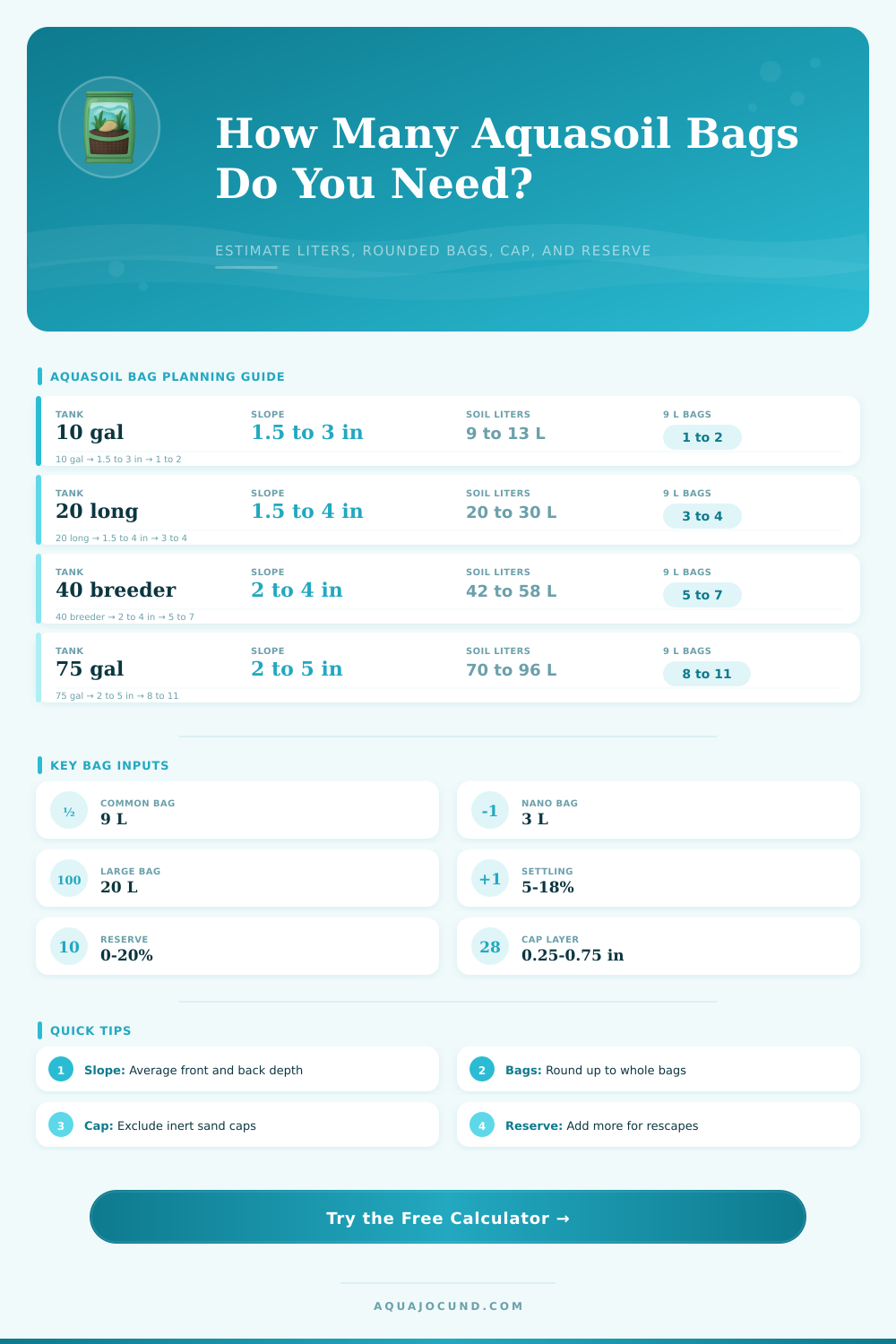
| 10 gallon | 20 x 10 in / 51 x 25 cm | 1.5 to 3 in slope | 1 to 2 x 9 L |
| 15 cube | 15 x 15 in / 38 x 38 cm | 1.5 to 3.5 in mound | 2 x 9 L |
| 20 long | 30 x 12 in / 76 x 30 cm | 1.5 to 4 in slope | 3 to 4 x 9 L |
| 29 gallon | 30 x 12 in / 76 x 30 cm | 2 to 4 in planted bed | 3 to 5 x 9 L |
| 40 breeder | 36 x 18 in / 91 x 46 cm | 2 to 4 in nature style | 5 to 7 x 9 L |
| 75 gallon | 48 x 18 in / 122 x 46 cm | 2 to 5 in terrace | 8 to 11 x 9 L |
| 120 gallon | 48 x 24 in / 122 x 61 cm | 2 to 5 in display bank | 10 to 14 x 9 L |
| Selection | Factor | Typical use | Calculator effect |
|---|---|---|---|
| Mostly even bed | x 1.00 | Simple planted layout | Uses average front/back depth directly |
| Gentle back slope | x 1.04 | Open foreground with taller rear plants | Adds small shaping allowance |
| Iwagumi stone bank | x 1.08 | Stones set into deeper soil | Adds soil packed around hardscape |
| Dutch stem bed | x 1.06 | Dense rows and even plant depth | Adds root-zone allowance |
| Island mound | x 1.14 | Central or offset high mound | Adds mound shaping volume |
| Valley or path layout | x 0.88 | Open sand path cuts through soil | Reduces aquasoil coverage |
| Terraced deep pockets | x 1.16 | Retaining walls and steep backs | Adds deep-pocket reserve |
| Adjustment | Typical range | Use when | Bag planning note |
|---|---|---|---|
| Dry-to-wet settling | 5 to 18% | Soil compresses after flooding | Add before rounding to full bags |
| Powder cap | 0.25 to 0.75 in | Carpets or fine foregrounds | Count if it comes from aquasoil bags |
| Inert cap | 0.5 to 1.5 in | Sand cap or cosmetic path | Measure separately, exclude from bags |
| Planting intensity | 0 to 16% | Heavy planting removes and shifts soil | Dense carpets need more loose reserve |
| Extra reserve | 0 to 20% | Future touch-ups or rescapes | Useful when bag sizes force close rounding |
You’re new to the hobby. This is first time you’ve purchased aquasoil. You pick up a regular nine liter bag from the shelf. It seem like enough since that is what they had. Until it’s in your tank. Until you open that bag and dump it into a twenty gallon long tank, and now it’s barely a dusting across the bottom, not even really a bed. There are just sparse sections here and there, root exposure, and a creeping dread that you’ll be returning to LFS in no time.
Buying substrate is one of those “cheap now but pay more later” expenses of the hobby. Not only will you end up paying more (in money) down the road, but your plants won’t thrive either. Unless you use calculator on this page. It does the math for you so you don’t have to wing it.
How to Calculate How Much Soil You Need
It uses exact dimensions of your own tanks. It adjusts based off how steep a bed you’d like to create. It also accounts for the fact that soil settle when it comes into contact with water.
Aquasoil depth is another thing most folks consider as if there’s only one value. In reality, except perhaps for stem plants grown dutch-style, it never are. When doing a nature- or Iwagumi-style layout, the bed will be sloped, possibly one and a half inches in the front to four or five in the rear. That’s two values that can’t simply be multiplied together! The calculator does that average for you but then uses a multiplier depending on how you want to lay out the tank.
If you’re making a lot of different elevations, like terracing the layout with deeper pockets, you’ll need far more substrate than you would with a nice gradual slope because you’re filling voids around rocks to create those distinct elevation changes. Getting that concept is what keeps you from undershooting when you build something complicated in rockwork.
Next up is settling factor, which is the reason why so many first-time aquascapers burn themselves. When dry granules get wet they compress significantly. What appears to be enough to completely cover everything on the bottom at the store may drop by half an inch once it’s wet. To account for this settling factor, the calculator include a variable called “settling percentage.” This can run from as little as 5% to as much as 18%. As you move toward high end, you use more compacted substrate or create a deeper back bank. Go with higher if you’ll be using something finer or building up quite deeply.
You’d rather have some extra soil than go poking around two weeks into the set-up trying to fill in exposed areas by reaching your hand in there and disrupting what’s already grow. But don’t forget the surface layer too. Many substrate growers like to add an inert “cap” layer, such as cosmetic powder or sand. This prevents roots from touching the acidic soil and keeps your tank looking clear.
Does your cap layer count towards your bag total? No, if it’s pure silica sand. Yes, if it’s aquasoil powder. The tool lets you tell these two types apart, so you will only budget for the number of bags you actualy intend to use. Telling the difference between inert and non-inert layers is important. You want to know how much nutrition your substrate provides, right?
They say “the devil’s in the details.” I’d add that “people underestimate the devil of details.” When you’re planting something like dwarf hairgrass or Monte Carlo, things you want to carpet, every single little stem you push into the substrate create a ton of volume. Think about tweezers pulling a piece of carpet into place, the whole area bulges outward. That’s what happens with plants.
The calculator assumes a bit more because of the density you choose (a couple percent). It isn’t much, but it ensures the bed won’t look empty within minutes of being planted. It is a good idea to keep some extra for later touch ups or rescaping. Soils gets used up. An extra liter or two will ensure that you have enough to fill those spots where it got thin.
What is the main point? When it comes down to it, you’re purchasing substrate to create the scene you’re imagining. If you aren’t buying the bags you’ll be leaving in your closet for years.
The table below is just one example provided by the calculator, but you don’t even have to plug in precise values if you don’t want to. It gives you some quick benchmarks for most popular tank sizes so you can see the difference between a forty-breeder display versus a ten-gallon nano. That can give you a good idea of your starting point, and you can tweak based on how much settling and slope you want.
After all, getting the substrate down properly makes everything else easier in the aquascape process. You can quit fretting over any bare spots and begin thinking more about plant placement, which is why we’re all here anyway.