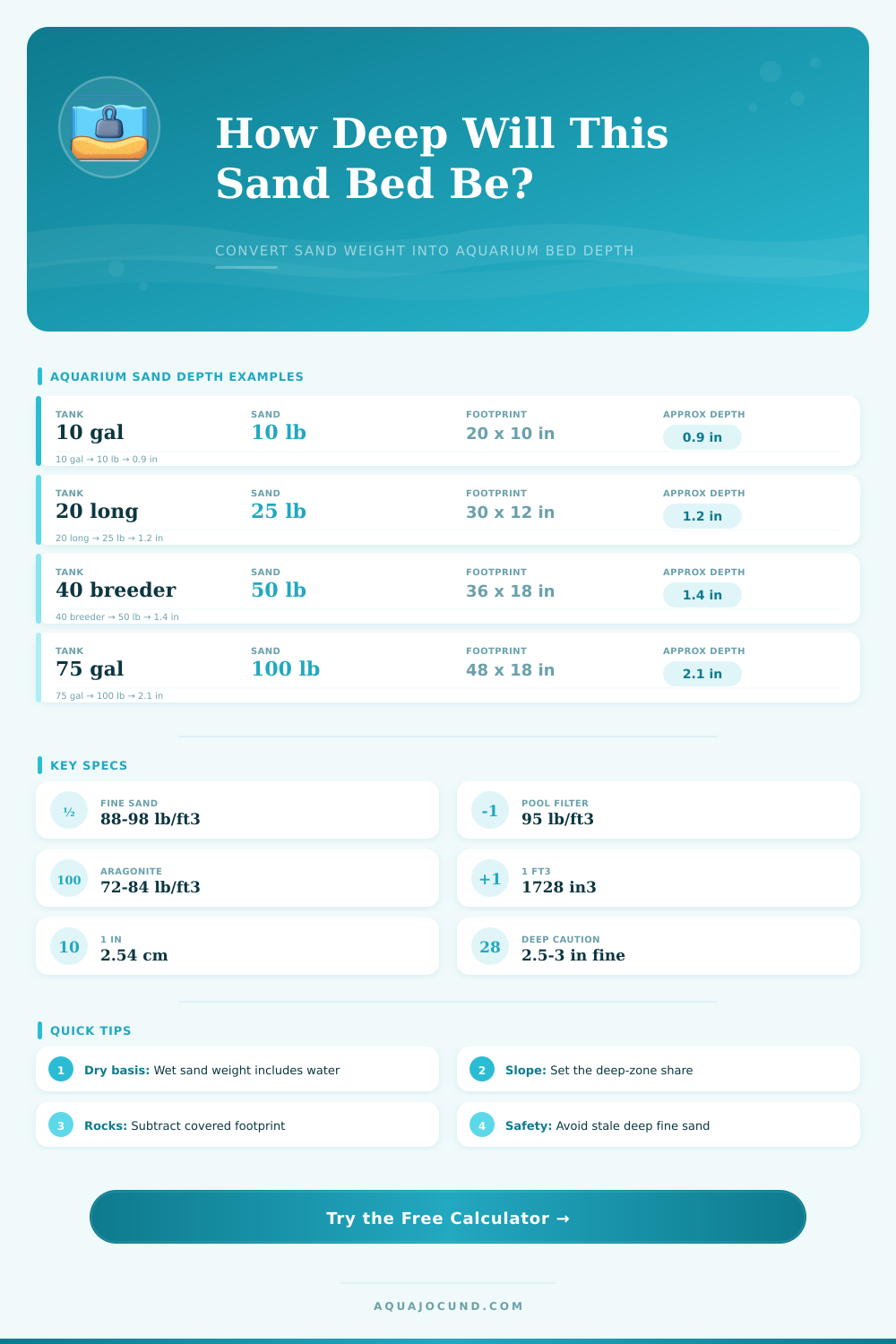
🏖 Sand Bed Depth From Weight Calculator
Convert a known sand weight into average aquarium bed depth, shallow and deep zone depths, adjusted footprint, installed volume, and anaerobic depth caution.
| Substrate | Typical bulk density | Grain behavior | Depth caution |
|---|---|---|---|
| Pool filter sand | 90-100 lb/ft3 | Even quartz grains, predictable settling | Watch fine pockets beyond about 3 in |
| Fine silica aquarium sand | 88-98 lb/ft3 | Packs tighter and traps less flow | Use shallow zones if livestock will not stir it |
| Washed play sand | 82-92 lb/ft3 | Mixed grain sizes and variable moisture | Rinse and drain before using weight estimates |
| Black blasting sand | 95-110 lb/ft3 | Dense angular grains | Keep deep pockets open or planted |
| Fine aragonite sand | 72-84 lb/ft3 | Lighter carbonate grains | Cloudiness and compaction vary by grade |
| Plant sand and soil blend | 58-76 lb/ft3 | Porous mix with organic fines | Use the conservative caution setting |
| Tank | Footprint | 20 lb pool sand | 50 lb pool sand |
|---|---|---|---|
| 10 gallon | 20 x 10 in / 51 x 25 cm | 1.8 in / 4.6 cm | 4.5 in / 11.4 cm |
| 20 long | 30 x 12 in / 76 x 30 cm | 1.0 in / 2.5 cm | 2.5 in / 6.4 cm |
| 29 gallon | 30 x 12 in / 76 x 30 cm | 1.0 in / 2.5 cm | 2.5 in / 6.4 cm |
| 40 breeder | 36 x 18 in / 91 x 46 cm | 0.6 in / 1.5 cm | 1.4 in / 3.6 cm |
| 55 gallon | 48 x 13 in / 122 x 33 cm | 0.6 in / 1.5 cm | 1.5 in / 3.8 cm |
| 75 gallon | 48 x 18 in / 122 x 46 cm | 0.4 in / 1.0 cm | 1.1 in / 2.8 cm |
| Target profile | Shallow zone | Deep zone | Calculator use |
|---|---|---|---|
| Thin cosmetic cap | 0.4-0.8 in / 1-2 cm | 1.0-1.5 in / 2.5-4 cm | Use low deep-zone share and check glass coverage |
| Cory or loach sand | 0.8-1.2 in / 2-3 cm | 1.5-2.0 in / 4-5 cm | Keep broad areas shallow for easy cleaning |
| Planted slope | 1.0-1.5 in / 2.5-4 cm | 2.0-3.0 in / 5-8 cm | Set the deep zone to the back third |
| Deep sand bed | 1.5-2.0 in / 4-5 cm | 3.0-4.5 in / 8-11 cm | Use intentional deep-bed husbandry and caution |
| Adjustment | Why it changes depth | Typical setting | Effect in this calculator |
|---|---|---|---|
| Moisture | Water adds weight without adding dry sand volume | Damp after rinsing | Reduces dry solid weight before volume is computed |
| Compaction | Settling and pressing remove pore space | Settled after filling | Multiplies installed volume downward or upward |
| Displacement | Rocks and planters cover bottom area | 5-20% | Reduces open footprint, raising local depth |
| Deep zone share | A slope concentrates volume into part of the tank | 20-40% | Solves shallow depth after the deep target is reserved |
So you read the bag and it says it’s good for your tank. That is perfect. So you get yourself a nice 25 pounds of some brand name stuff and go dumping it into the tank. Smooth it around and now you’re looking at the bottom and thinking “I’m not even close to covering the glass” if you are lucky, or “Oh crap…I made this deep pit, now everything I put in there are going to sink.”
Everyone has done it. Everyone who doesn’t think about density before they start scooping. It’s not weight that’s the issue. Volume is the issue. And volume is dependent off how tightly packed the grains are, how much water is already clinging to them, and what else might be in your tank taking up space.
Why Sand Depth Is Hard to Guess
Sand is often thought of as a uniform material. Most hobbyists assume a pound of pool filter sand behave exactly like a pound of aragonite or a bag of washed play sand from hardware store. Nope. This is the first misconception to eradicate. Sand consists of individual particles with air pockets between them. So what they’re packing into a volume determine the bulk density of all that stuff. Aragonite isn’t packed like pool filter sand which runs dense and consistent at approximately ninety-five pounds per cubic foot. Because it is made of carbonate grains, they don’t pack together as tightly. If you plug an incorrect number into your brain regarding density, you’ll over-estimate depth by a third or more.
To solve this problem, I’ve created a tool on this page that does the conversion work for you. It won’t require you to memorize each specific gravity. Just select the type of material and it’ll take care of the rest.
The quiet assassin is moisture: When you weigh your sand after rinsing it off, you’re adding weight without increasing amount of dry substrate. Yes, a wet bag feels heavier but it’s not heavy with any more solid matter. So a pound of wet sand has a lot less actualy grains than a pound of bone-dry sand. Overlooking this means overestimating your depth each and every time. This is a little detail that really matters if you’re aiming for a particular slope for corydoras burrowing area or other planted tank needs.
Displacement comes into play next. Sand just covers the exposed bottom areas. That means if you’ve got a planter pot, a piece of driftwood root, a big rock island, etc., that’s not going to be covered by sand. You can enter a displacement percentage to subtract that coverage when figuring out available footprint for sand. It keeps the math from spilling limited sand onto an area it will never cover. It also increases the depth locally within the open areas; exactly the info you need before placing your hardscape.
“Then we feed that into the output which not only shows us the average depth but also divides that into shallow and deep zone targets. And that’s when the real design kicks in. In most situations, you don’t want a flat bed. What you want is a slope. The calculator looks at how much of the total area you’d like to be shallow versus the deep back corner. It then figures out whether or not you have enough sand for both the shallow front lip and deep back corner. It will tell you if you’re short. It will warn you off if you’re trying to go too deep with too fine sand. That warning is there because if you disturb layers less than two or three inches beneath the surface, they can becomes stagnant and develop sulfur pockets that release toxic hydrogen sulfide.”
What you stock also determines your profile choice. Thin caps (half an inch to an inch) is good for shrimp and tiny tetras. Two inches or so in the rear end works well for plant roots. The substrate should of be deep enough for corydoras (they love it), but not so loose that silt gets stirred up. Generally speaking, those profiles span the range of the reference table; however, the actual shape will depend on the size of your tank and where you place hardscapes.
Adjusting the compaction setting allow you to make up for desired pack tightness. Sand will settle over time with water flow. If pre-compacted, then you’ll have a more accurate day-one measurement.
At its core, depth isn’t just for looks; it serves a purpose. A pretty bed might be the death of your fish if it traps waste. It is too shallow. Plants has no biological buffer. Enter the calculator. The weight in the bag meets the bottom of the glass ecosystem. Where a guess becomes a plan.
Still gotta scoop, wash, and set up. But now you’ll know precisely how much sand you’re going to work with BEFORE you drop it in the tank. That certainty makes all the difference.