Substrate Weight Needed Calculator
Estimate aquarium sand, gravel, aquasoil, or coral weight from footprint area, sloped depth, density, compaction, hardscape displacement, and bag size.
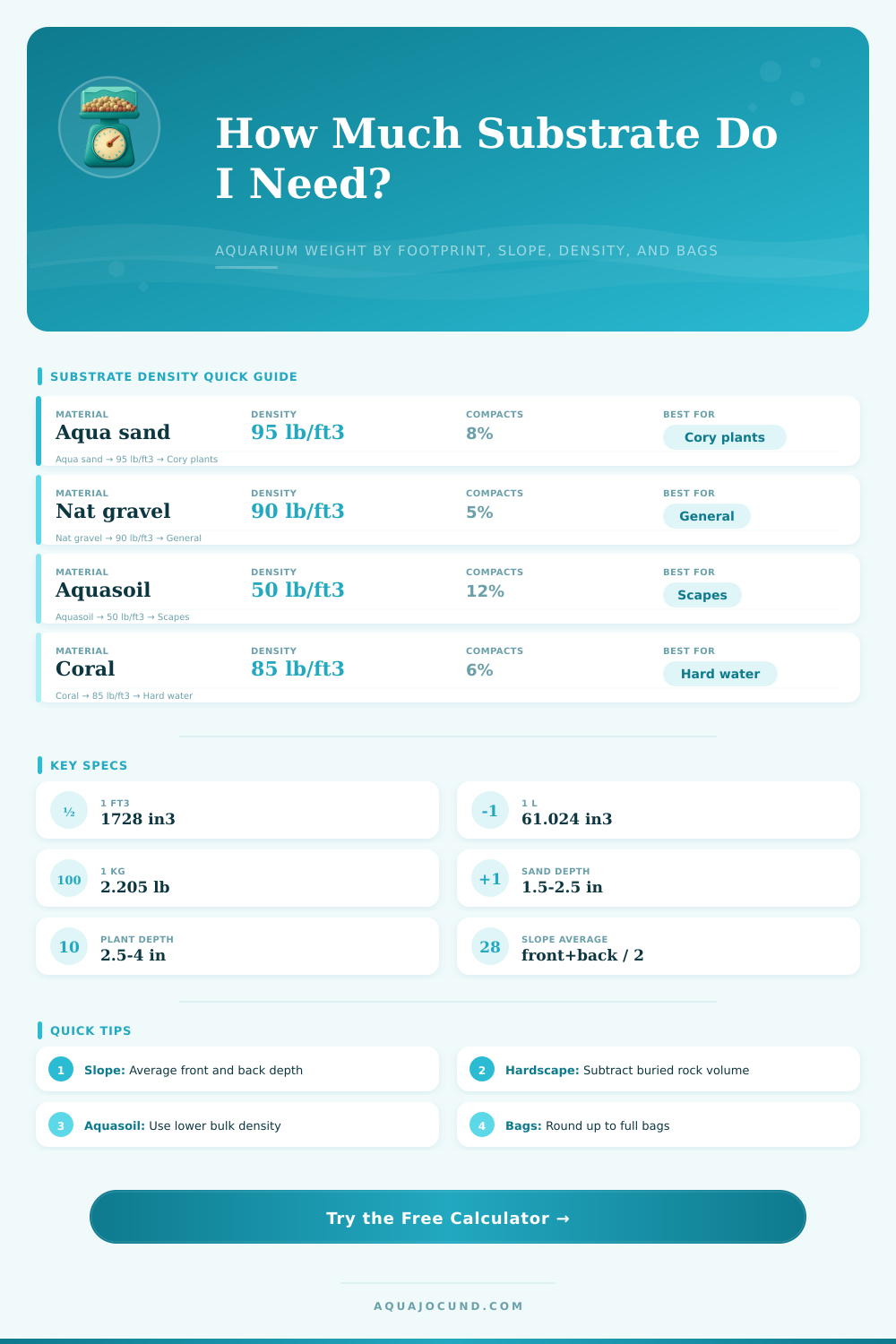
| Material | Typical Bulk Density | kg/L Equivalent | Default Settling |
|---|---|---|---|
| Aqua sand | 95 lb/ft³ | 1.52 kg/L | 8% |
| Pool filter sand | 93 lb/ft³ | 1.49 kg/L | 7% |
| Washed play sand | 100 lb/ft³ | 1.60 kg/L | 10% |
| Natural aquarium gravel | 90 lb/ft³ | 1.44 kg/L | 5% |
| Pea gravel | 105 lb/ft³ | 1.68 kg/L | 5% |
| Planted aquasoil | 50 lb/ft³ | 0.80 kg/L | 12% |
| Porous clay gravel | 70 lb/ft³ | 1.12 kg/L | 8% |
| Coral or aragonite | 85 lb/ft³ | 1.36 kg/L | 6% |
| Lava rock granules | 45 lb/ft³ | 0.72 kg/L | 10% |
| Tank | Footprint | Area | Approx Sand for 2 in |
|---|---|---|---|
| 10 gallon | 20 x 10 in / 51 x 25 cm | 200 sq in / 1290 sq cm | 24 lb / 11 kg |
| 20 long | 30 x 12 in / 76 x 30 cm | 360 sq in / 2323 sq cm | 43 lb / 20 kg |
| 29 gallon | 30 x 12 in / 76 x 30 cm | 360 sq in / 2323 sq cm | 43 lb / 20 kg |
| 40 breeder | 36 x 18 in / 91 x 46 cm | 648 sq in / 4181 sq cm | 78 lb / 35 kg |
| 55 gallon | 48 x 13 in / 122 x 33 cm | 624 sq in / 4026 sq cm | 75 lb / 34 kg |
| 75 gallon | 48 x 18 in / 122 x 46 cm | 864 sq in / 5574 sq cm | 104 lb / 47 kg |
| 125 gallon | 72 x 18 in / 183 x 46 cm | 1296 sq in / 8361 sq cm | 156 lb / 71 kg |
| Layout | Front Depth | Back Depth | Average Used |
|---|---|---|---|
| Thin cosmetic layer | 0.75-1 in / 2-2.5 cm | 1-1.5 in / 2.5-4 cm | 0.9-1.25 in / 2.3-3.2 cm |
| General display | 1.25-1.75 in / 3-4.5 cm | 2-2.5 in / 5-6.5 cm | 1.6-2.1 in / 4-5.5 cm |
| Rooted planted | 2-2.5 in / 5-6.5 cm | 3-4 in / 7.5-10 cm | 2.5-3.25 in / 6.5-8.3 cm |
| High rear slope | 1.5-2 in / 4-5 cm | 4-6 in / 10-15 cm | 2.75-4 in / 7-10 cm |
| Bag Size | Best Use | Rounding Note | Metric Equivalent |
|---|---|---|---|
| 5 lb | Nano details and caps | Fine for small adjustments | 2.3 kg |
| 10 lb | Small aquariums | Often one to three bags | 4.5 kg |
| 20 lb | Common sand and gravel | Good default for most tanks | 9.1 kg |
| 40 lb | Large sand bags | Fewer bags, less fine control | 18.1 kg |
| 9 L | Aquasoil bags | Use metric bag size mode | Varies by density |
There’s an empty tank in front of you, and it’s time to create your own world within its walls. The lights wait. The glass shines like new.
The bottom layer, the substrate, is the one thing that counts more then anything. What will be on the bottom? How thick will the layer be? Will it support the life you plan to live in this habitat? They seems like simple questions. But if you buy too little, you’ll have bald spots that suffocate roots. If you buy too much, you’ll have a heavy mass to move during set-up that you can barely budge once it is in place.
How to Calculate Substrate for Your Tank
It is not just about covering the ground. It’s about measuring depth, weight, and volume precisely enough so there won’t be a freak out mid-set up. If you’re most hobbyists, you guessed your depth by eyeballing a ruler next to the tank. You might think, “Two inches everywhere, therefore I’ll need the standard number of bags,” but you are incorrecty assuming that this is how it’s done in practice.
In reality, most tanks aren’t flat plain areas; more often than not you’ll want some sort of slope to achieve your visual depth. To that end, maybe try aiming for 3 inches in the rear sloping to 1 inch in the front so your foreground plants don’t appears to be floating in mid-air? What about averaging all of that depth rather than considering the entire floor as a single depth block?
And what about all that hardscape?! All of those nice bits of stone and driftwood you had intended to showcase is going to push substrate (and water) out of the way. Don’t forget about that hidden volume. You’ll end up with a bunch of empty bag on your porch because those rocks have already taken up the space you reserved for gravel.
What’s interesting is the density of the materials. Aquasoil feels like soil and is relatively lightweight. However, since you need much more aquasoil than sand to fill the same space, it ends up being heavier. Gravel exists somewhere in the middle. Until now, I’ve had to memorize that one cubic foot of volcanic rock has a different weight than one cubic foot of aragonite.
That’s why there’s a tool on this page that will do the work for you: convert from volume to weight (or vice versa). It uses the bulk density of whatever material you choose, and based off the footprint of your tank, it calculates the amount. For example, if you’re planning a planted tank, you may want to go for a higher compaction rate substrate. Because these soils can really compact over time as they leach their nutrients and break down, you end up starting off with a lot less than you thought after the first week or two. You always buy enough to fit your tank at first. By the third month, you’ve got a shallow layer.
Plan for some kind of overage. Ten percent usually covers both the settling and the bag spillage when you try pouring those bad boys into the tank on uneven floors. It’s a lot better than just rounding up, because, as it turns out, the size of the bag make a difference: A 20-pound bag isn’t enough for 45 pounds of sand, nor is one 50-pound bag (that’s difficult to lug by yourself anyway). You end up buying too little or having to drag home an entire bag when all you want is half. By rounding up to full bags, you will always know exactly which ones to drop into the virtual cart.
The other cool thing? If you’re mixing ingredients, such as topping infertile soil with a barrier of inert gravel, you can adjust for custom densities. This type of layering means you has no idea how much weight goes into every unique part until you lift a couple of heavy sacks.
Consider the big picture. Don’t buy too much sand only to have to top it up in another half a year. The shallower you make the front of the slope the more forgiving it will be to small grazing shrimp. Instead, make the rear bank deeper so large, heavy-rooted plants like Amazon sword species has enough room to establish themselves. Prioritizing those ratios beforehand would of saved both your wallet and your time.
It transforms a random mess into a calculated plan. Input your numbers, select your materials, hit calculate, watch the numbers fall in place, and go back to enjoying the real reason you bought an aquarium… To enjoy the life within it, the plants, the fish, and the light reflecting off the water surface.