🧪 All-In-One Dose By Volume Calculator
Scale liquid aquarium fertilizer by product strength, tank volume, nutrient priority, limiting nutrient, maximum safe daily dose, and weekly dosing rhythm.
| Profile | NO3 | PO4 | K | Fe | Best Use |
|---|---|---|---|---|---|
| EI macro | 3.13 ppm | 0.35 ppm | 2.05 ppm | 0.025 ppm | High light planted tanks with regular water changes |
| Lean daily | 1.25 ppm | 0.12 ppm | 1.60 ppm | 0.015 ppm | Daily dosing where nitrate is kept moderate |
| Low tech | 0.80 ppm | 0.08 ppm | 1.10 ppm | 0.010 ppm | Low demand tanks with slower plant growth |
| High N | 4.50 ppm | 0.35 ppm | 2.20 ppm | 0.018 ppm | Systems that consistently test nitrate-poor |
| High P | 2.00 ppm | 0.75 ppm | 1.80 ppm | 0.020 ppm | Phosphate-limited planted aquariums |
| High K | 1.20 ppm | 0.15 ppm | 4.00 ppm | 0.015 ppm | Potassium-priority dosing with low nitrate push |
| Trace rich | 0.60 ppm | 0.05 ppm | 0.80 ppm | 0.060 ppm | Iron and trace supplementation as the limiter |
| PPS style | 1.50 ppm | 0.15 ppm | 1.50 ppm | 0.015 ppm | Small, frequent, ratio-balanced dosing |
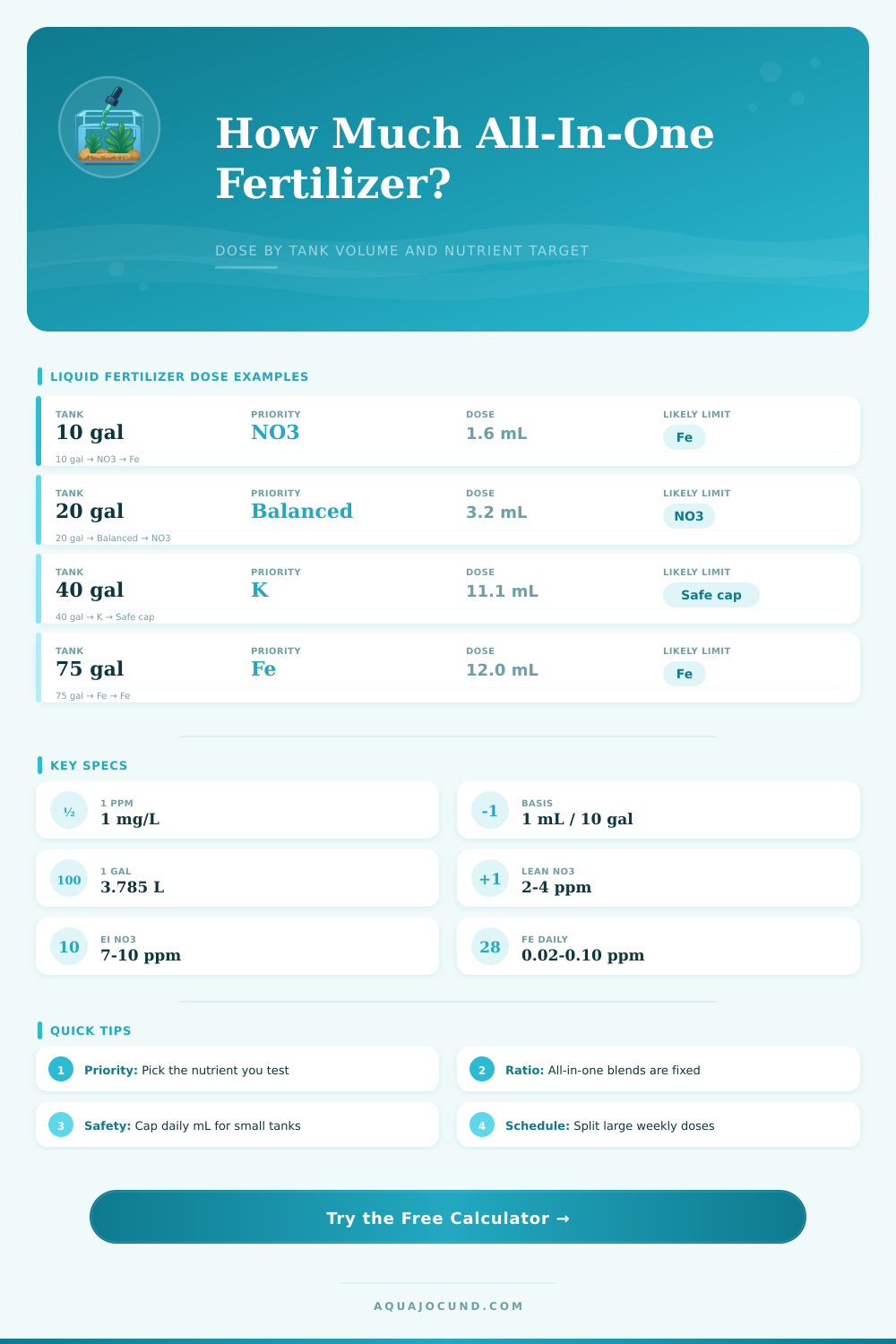
| Nominal Tank | Common Dimensions | Dosed Volume | EI Macro Dose For 5 ppm NO3 | Safe Cap At 5 mL / 10 gal |
|---|---|---|---|---|
| 5.5 gal | 16 in x 8 in x 10 in / 41 x 20 x 25 cm | 5 gal / 19 L | 0.8 mL | 2.5 mL |
| 10 gal | 20 in x 10 in x 12 in / 51 x 25 x 30 cm | 9 gal / 34 L | 1.4 mL | 4.5 mL |
| 20 long | 30 in x 12 in x 12 in / 76 x 30 x 30 cm | 18 gal / 68 L | 2.9 mL | 9.0 mL |
| 29 gal | 30 in x 12 in x 18 in / 76 x 30 x 46 cm | 26 gal / 98 L | 4.2 mL | 13.0 mL |
| 40 breeder | 36 in x 18 in x 16 in / 91 x 46 x 41 cm | 36 gal / 136 L | 5.8 mL | 18.0 mL |
| 75 gal | 48 in x 18 in x 21 in / 122 x 46 x 53 cm | 68 gal / 257 L | 10.9 mL | 34.0 mL |
| Priority Mode | Dose Chosen From | Limiting Nutrient Means | Use When |
|---|---|---|---|
| Balanced | Smallest target-reaching mL among NO3, PO4, K, and Fe | The first nutrient that reaches its target at the fixed product ratio | You want to avoid overshooting any selected target |
| Nitrate first | mL required to hit the NO3 target | Other nutrients may land below or above their targets | Nitrate test results are the main dosing control |
| Phosphate first | mL required to hit the PO4 target | PO4 controls the all-in-one amount | Phosphate bottoms out before nitrate or potassium |
| Potassium first | mL required to hit the K target | K controls the all-in-one amount | Source water and livestock load already add nitrate |
| Iron first | mL required to hit the Fe target | Iron controls the trace-safe dose | The blend is trace-rich or used mostly as a micro dose |
| Day | Dose | NO3 | PO4 | K | Fe |
|---|---|---|---|---|---|
| Calculate first | -- | -- | -- | -- | -- |
I’ve heard many aquarium hobbyist (especially those with planted tanks) say they grows their plants faster by using more fertilizers. It makes sense because plants use nutrients as building blocks for their tissues, so adding more should increase growth rates. However, it is not quite that linear.
You aren’t just providing food for the roots; you are also maintaining a chemical balance. Each milliliter added alter the ratio between iron, potassium, phosphate, and nitrate. All of these influence long-term stability. If these ratios becomes too skewed, algae will take over the gap and ruin your aquascape before you know it.
Why You Should Use a Fertilizer Calculator
After entering your desired nutrients (targets) and tank volume, the calculator does the rest, no more converting units or messing with coefficients yourself. You’re forced to face just how potent the product actualy is without wishy-washy directions on plastic bottles.
Liquid fertilizers typically specify how much of what’s inside they want you to use for a given amount of water, which is typically ten gallons. That starting point is very important. It is basis for all future calculations. Dosing half as much in a 40 gallon tank when you think it’s a 20 is doubling concentration of each ion in the water column.
Where folks get tripped up is understanding what the limiting nutrient is. For example, all nutrients in an all-in-one are fixed at whatever ratio the maker made them. So if you want to add more nitrates, you also has to add more phosphates and potassium. You can’t do just one without doing others. That’s kind of the whole point of having an all-in-one.
As you add more of it, the tool tells you which of these targets gets hit first. Your max safe volume (with this blend) is based off whichever nutrient is the limiting one. So if iron gets capped at safety before you reach your target for nitrate, then you stop there. Anything beyond that means risking metal buildup or growing unwanted bacterial blooms. Neither of these will make your stem plant look their best.
Besides nominal sizes, there’s another reason why many people ignore importance of tank geometry: It makes things even more complex. The “standard” ten-gallon tank has no basis in hydrology; it’s nothing more than a marketing term. Water fills only part of the glass. Even less is displaced by hardscapes, and some volume may be occupied by substrate. All these factor affect how much water actualy exists in the tank. Get the dose right with respect to the actual volume of water in the tank instead of the one shown on its retail tag.
For instance, if you have two gallons of gravel, those two gallon are not circulating. They might be absorbed by beneficial bacteria, which locks them out of circulation, or they might otherwise be taken up by plants. Chronic under-dosing… And there’s no better word for ignoring this gap, results in pale leaves and stunted growth even when fed regularly. These look like hungry plants.
Dosing out over time will also affect plant uptake of what you give them. Unlike us, they don’t have stomachs to put some away for tomorrow. Rather, they takes it up in pulses, usually in time with metabolism and light cycles. Dumping all of this week’s dose on Sunday night doesn’t hold concentrations as well as dosing every 3rd day.
The output shown on the schedule gives you exactly when to spread the total volume across whatever days you want. It creates a pulse rate that avoids shocking livestock while keeping nutrient availability consistent with plant metabolic demands. Water changes also reset this system weekly. They remove the build-up of nutrients while replacing those that were depleted. Frequent large water changes flush away precisely what you just put into the tank.
The calculator factors in that dilution to arrive at your total amount per week. It connects the water leaving via maintenance with what’s remaining in the tank.
While it will take some time to get the balance correct, knowing how it all works will make that learning curve more shorter and less painful. Yes, eventually you will stop reading charts and start reading your tank. You’ll notice changes in livestock behavior, plant color and growth rates more accurate than you could from a chart. The chart is now your foundation, your starting point (the beginning of building intuition). Until then let it do the work for you because it keeps you from making expensive mistakes. It translates abstract chemistry into concrete actions, keeping your water quality up while having thriving plants.
Aquascaping is an art and precision trumps volume every time. You should of seen how much better it works.