🌿 Macro Daily Dose Calculator
Size planted aquarium nitrate, phosphate, potassium, and magnesium dosing from real tank volume, dosing days, source water, dry salts, and stock bottle strength.
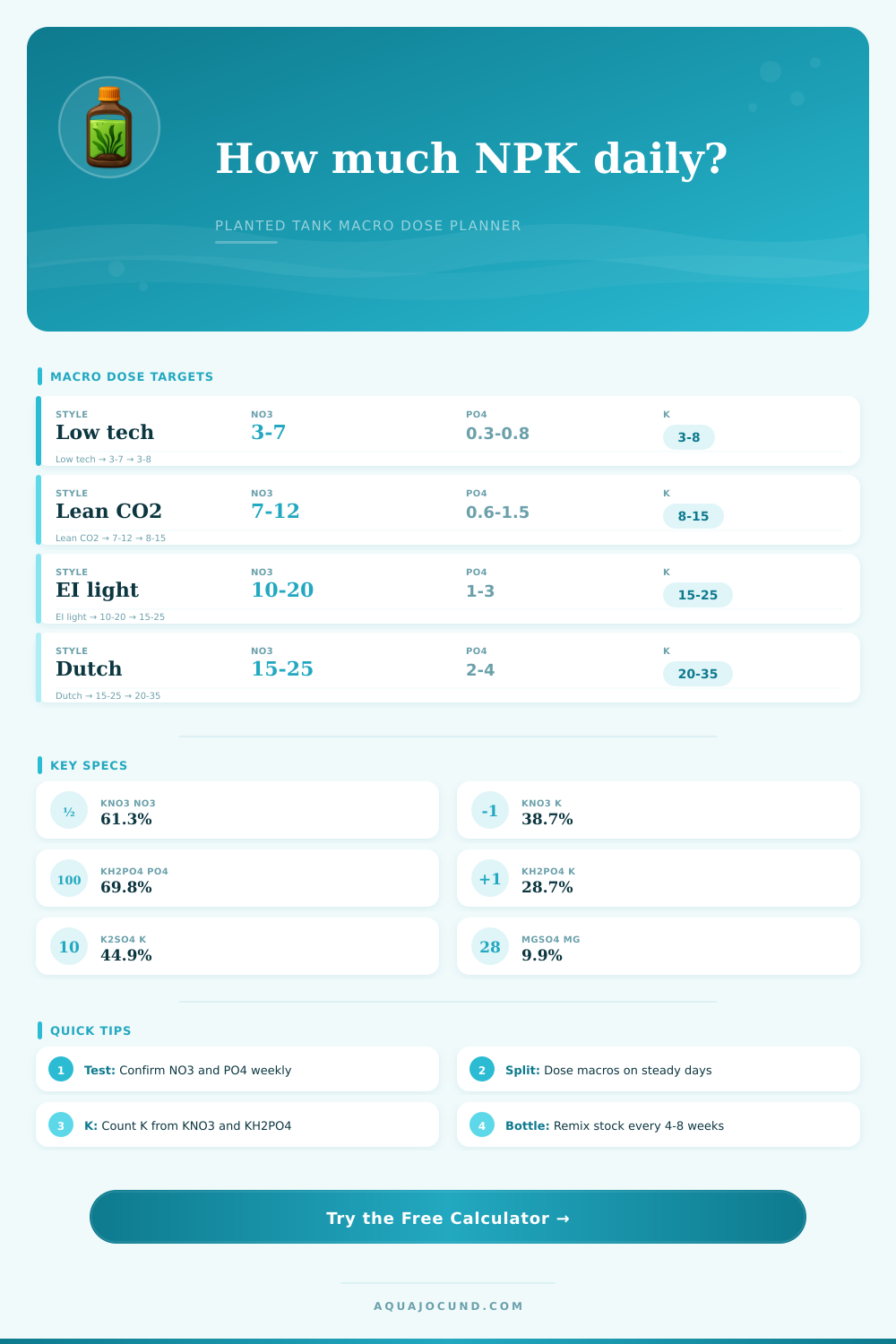
| Style | Typical NO3 per week | Typical PO4 per week | Typical K per week | Use case |
|---|---|---|---|---|
| Low tech | 3 to 7 ppm | 0.3 to 0.8 ppm | 3 to 8 ppm | Anubias, Java fern, crypts, moss, slow growth, no injected CO2. |
| Shrimp lean | 2 to 6 ppm | 0.2 to 0.7 ppm | 3 to 8 ppm | Moss, Bucephalandra, Caridina or Neocaridina tanks where stability matters. |
| Lean CO2 | 7 to 12 ppm | 0.6 to 1.5 ppm | 8 to 15 ppm | Aquascapes using CO2 but intentionally modest water-column nutrients. |
| Standard | 10 to 18 ppm | 1 to 2.5 ppm | 12 to 22 ppm | Mixed community tanks with stem plants, floaters, and rooted rosettes. |
| EI high light | 15 to 25 ppm | 2 to 4 ppm | 20 to 35 ppm | High light, pressurized CO2, frequent trimming, large weekly reset. |
| Plant farm | 20 to 35 ppm | 3 to 6 ppm | 25 to 45 ppm | Grow-out systems where nutrient excess is managed by water changes. |
| Salt | Main nutrient | Secondary contribution | Formula note | Best use |
|---|---|---|---|---|
| KNO3 | 61.3% NO3 | 38.7% K | 1 g adds 613 mg NO3 | Primary nitrate salt for most planted tanks. |
| KH2PO4 | 69.8% PO4 | 28.7% K | 1 g adds 698 mg PO4 | Primary phosphate salt with useful potassium carryover. |
| K2SO4 | 44.9% K | Sulfate | 1 g adds 449 mg K | Potassium top-up after KNO3 and KH2PO4 are counted. |
| MgSO4.7H2O | 9.9% Mg | Sulfate | 1 g adds 99 mg Mg | Magnesium correction for RO, soft tap, or high calcium water. |
| Ca(NO3)2.4H2O | 52.5% NO3 | 17.0% Ca | Adds hardness while supplying nitrate | Useful when potassium is already high or calcium is low. |
| KCl | 52.4% K | Chloride | More concentrated K source than K2SO4 | Small K corrections where chloride remains modest. |
| Tank | Usable water | Lean weekly target | EI weekly target | Macro rhythm |
|---|---|---|---|---|
| 5 gal nano | 16 to 18 L | NO3 4, PO4 0.4, K 5 | NO3 10, PO4 1.2, K 12 | Small stock doses prevent teaspoon errors. |
| 10 gal shrimp | 32 to 36 L | NO3 5, PO4 0.5, K 7 | NO3 12, PO4 1.5, K 15 | Keep changes gradual and test nitrate. |
| 20 long | 60 to 68 L | NO3 8, PO4 1.0, K 12 | NO3 18, PO4 3.0, K 25 | Three macro days fits common EI routines. |
| 40 breeder | 125 to 140 L | NO3 10, PO4 1.2, K 15 | NO3 22, PO4 4.0, K 30 | CO2 stability matters as much as fertilizer. |
| 75 gal display | 240 to 265 L | NO3 12, PO4 1.5, K 18 | NO3 25, PO4 4.5, K 35 | Larger stock bottles reduce mixing frequency. |
| 125 gal display | 420 to 455 L | NO3 12, PO4 1.5, K 20 | NO3 25, PO4 5.0, K 40 | Use a pump or marked dosing cup for consistency. |
| Check | Why it changes the dose | Calculator treatment | When to adjust |
|---|---|---|---|
| Nitrate in tap | Water changes can add measurable NO3 before dosing. | Subtracts weekly water-change NO3 contribution from the target. | If tap NO3 changes seasonally, update the source value. |
| Phosphate in tap | Some supplies carry PO4 from corrosion control or runoff. | Subtracts water-change PO4 before calculating KH2PO4. | If algae appears with high PO4 and low plant growth, retest. |
| Potassium carryover | KNO3 and KH2PO4 both add potassium. | Counts carried K before sizing K2SO4, KCl, or KHCO3. | If K top-up is zero, nitrate and phosphate salts already met K. |
| Magnesium gap | RO, rainwater, and soft tap can be low in Mg. | Subtracts Mg from source water change and sizes Mg salt. | Adjust if GH booster already supplies magnesium. |
| Water change reset | Large resets prevent long-term nutrient stacking. | Reports a steady-state estimate after uptake and weekly reset. | Use larger reset or lower targets if residual climbs too high. |
Discussions about planted tanks often start with fertilizers. Plenty of guesses and a bottle of something. “I heard this works for other people so I bought it.” Dose…daily…hope no algae grows. Hope the stems grow.
But each tank differs. Each aquascape takes up some water. That’s not realy the total volume in the tank. The chemistry of your water has its own baseline level of nutrients, and your plants are more than just stems. They have their own requirements depending on the light they receive. Treating a twenty-gallon community tank exactly like a high-energy export farm typically end in brown water or nuisance growth.
How to Do the Math Right
Just enter your true volume and targets into the calculator above to do the math for you. No need for guessing. Getting the volume correct is also the first step. Most aquarists go with manufacturer’s rating, which already incorporates glass thickness and the headspace at the top, but doesn’t account for substrate displacement. This means you have to factor in water displacement caused by rocks, wood, decorations, and substrate. A ten to fifteen percent water displacement is about average; this make a real difference when calculating concentrations.
Overestimating your water volume will result in underdosing. The plants won’t complain much initially, but they’ll eventually slow down and become deprived of nitrogen or whatever else is missing. Underestimating your water volume will lead to overdosing and the creation of an environment helpful to algae that thrive on high phosphate levels. It is a small detail but it is a matter of fact.
Next up is the source water. Blank doesn’t come out of the tap very often. Potassium or magnesium might be coming into some sources by nature. Nitrate will come from farming run off in many places. The tool subtracts what you are already getting from your tap water before sizing the dry salts. Then it sizes the dry salts based off that. It prevents adding nutrients on top of nutrients. So if your tap provides five ppm of nitrate and you want another 10, all you need to provide is five.
That’s why many newbies wind up with cloudy tanks. They don’t account for their source water. They keep piling on the problem without realizing they are feeding it.
Next up: How do you want to plant? An aggressive grow-out tank featuring stems and plenty of light plus injected CO2 will require much more nitrogen than a simple Crypt-and-fern tank. This is where the reference chart on that page comes in, illustrating the scale of nutrient requirements for everything from minimalist moss tanks to full-on grow-out setups. Estimative Index methods are going to “flood” the tank and depend on regular (weekly) water changes to reset the board. Leaner setups favor keeping phosphate down to help sensitive biofilters and protect shrimp. Neither is right nor wrong, just align it to your plant load and maintenance regimen.
Once you grasp what these salts do, it’s simple math: Nitrogen + potassium comes from potassium nitrate. Phosphorus + more potassium comes from monopotassium phosphate. Calculate how much they contribute, then add a separate source of potassium if you’re still under. Since magnesium tends not to appear in sufficient quantities in most fertilizer products, it typically gets its own salt as well. This calculator will explain exactly how many grams of each dry salt to use when dissolving into your stock bottle. Then it calculates the concentration so you know how many milliliters to use when dosing.
Don’t assume stock bottles are a lifetime supply. Higher concentration solutions will change and salts may settle out. Make up fresh every month or two to guarantee an accurate and stable solution. Always shake prior to use to mix in whatever may has settled. Daily dosing doesn’t need to be precise, consistency matters more. Following a regular schedule keeps things steady, and plants like that better than receiving large doses on random days.
And then there’s testing. Keep in mind these are averages based off how much nutrients is taken up. Because every aquarium differs (for example), in plant amounts, light duration, or CO2 levels, nutrient depletion will also occur different. What happens if you underfeed? Nitrate reaches zero midway through the week. What happens if you overfeed? Phosphate stays elevated while algae blooms. Slowly adjust target(s) accordingly. Adjust one variable at a time.
It isn’t about growing it but growing it sustainably without compromising livestock health/water clarity. If you’re new to dosing, start conservative. Adding a little more fertilizer is better than adding too much and fixing an algae bloom from nutrient overload. After getting to know your tank’s reaction, you can gradually increase dose numbers. The math provides the starting line; observation will keep you in the race. A simple test kit and your own eyes remains the best tools for adjusting based off the math.