🧪 Dry Fert To PPM Calculator
Convert aquarium dry fertilizer grams, teaspoons, or stock solution doses into nitrate, phosphate, potassium, calcium, magnesium, iron, sulfate, GH, and target-dose math.
| Fertilizer | Main ppm added | Typical tsp weight | Best aquarium use |
|---|---|---|---|
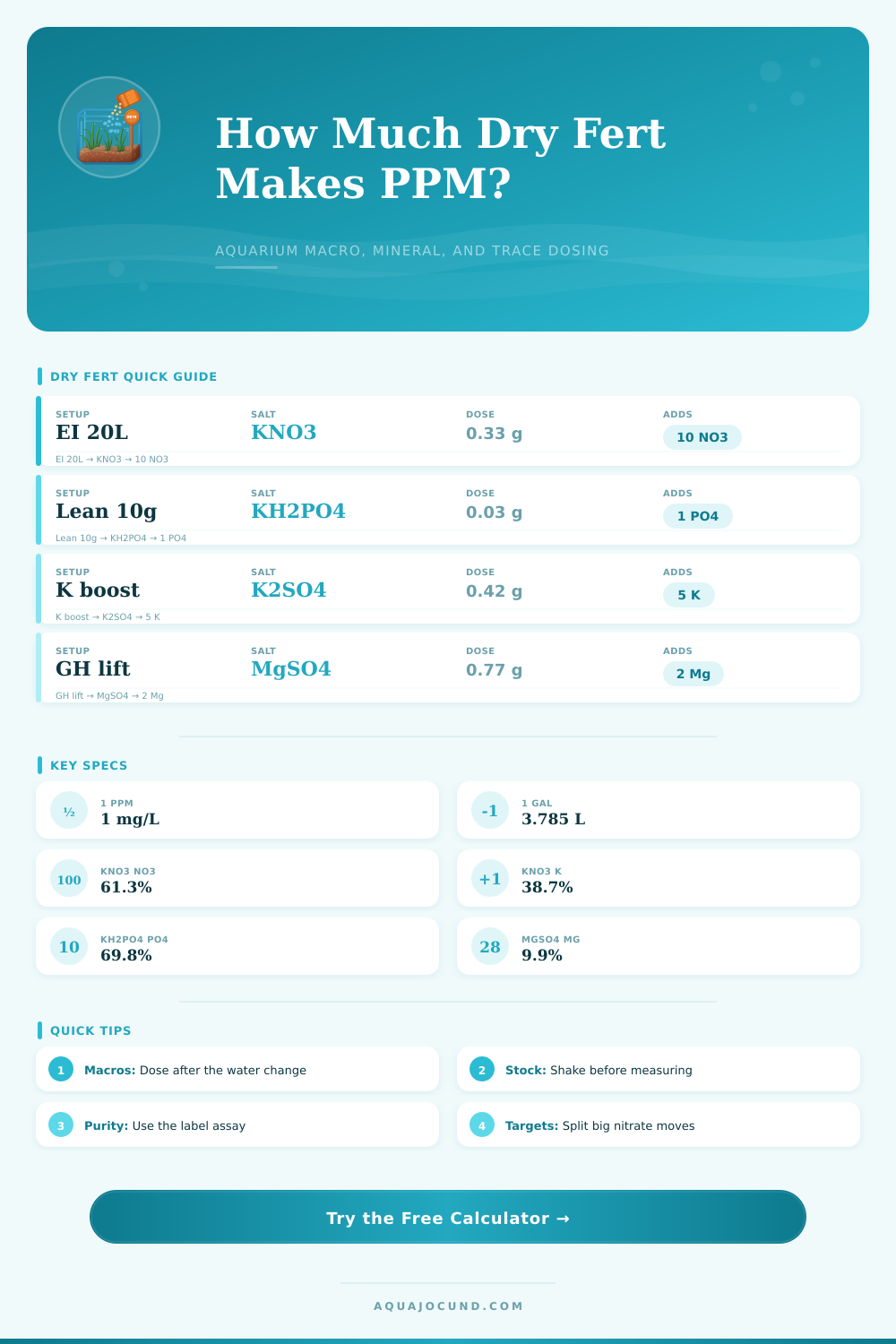
| Macro KNO3 | 61.3% NO3, 38.7% K | About 5.6 g/tsp | Nitrate plus potassium for planted tanks |
| Macro KH2PO4 | 69.8% PO4, 28.7% K | About 6.1 g/tsp | Small phosphate corrections and EI dosing |
| Macro K2SO4 | 44.9% K, 55.1% SO4 | About 6.4 g/tsp | Potassium boost without nitrate or phosphate |
| Mineral MgSO4.7H2O | 9.9% Mg, 39.0% SO4 | About 5.2 g/tsp | Magnesium and GH support |
| Mineral CaCl2.2H2O | 27.3% Ca, 48.2% chloride | About 4.4 g/tsp | Calcium raise with fast solubility |
| Trace CSM+B mix | Often 7% Fe plus micros | About 4.0 g/tsp | Trace dosing when iron is the control nutrient |
| Tank style | NO3 dose | PO4 dose | K dose |
|---|---|---|---|
| Low tech shrimp or moss tank | 1 to 5 ppm per dose | 0.1 to 0.5 ppm per dose | 1 to 5 ppm per dose |
| Lean aquascape with active soil | 2 to 7 ppm per dose | 0.2 to 1 ppm per dose | 3 to 8 ppm per dose |
| EI high light planted aquarium | 7 to 15 ppm per dose | 1 to 3 ppm per dose | 5 to 15 ppm per dose |
| Fish-heavy planted display | 0 to 5 ppm per dose | 0 to 1 ppm per dose | 3 to 10 ppm per dose |
| Remineralized RO planted tank | 5 to 10 ppm per dose | 0.5 to 2 ppm per dose | 5 to 12 ppm per dose |
| Stock recipe | Strength | 10 mL into 20 gal | Practical note |
|---|---|---|---|
| 50 g KNO3 in 500 mL | 100 mg/mL dry salt | About 8.0 ppm NO3 | Common macro bottle strength |
| 10 g KH2PO4 in 500 mL | 20 mg/mL dry salt | About 1.8 ppm PO4 | Easy to measure small phosphate doses |
| 40 g K2SO4 in 500 mL | 80 mg/mL dry salt | About 4.7 ppm K | Potassium-only support |
| 20 g trace mix in 500 mL | 40 mg/mL dry mix | About 0.04 ppm Fe | Keep trace bottles cool and dark |
| Aquarium | Water volume | 10 ppm NO3 from KNO3 | 1 ppm PO4 from KH2PO4 |
|---|---|---|---|
| 5 gal nano | 18.9 L | 0.31 g KNO3 | 0.03 g KH2PO4 |
| 10 gal shrimp tank | 37.9 L | 0.62 g KNO3 | 0.05 g KH2PO4 |
| 20 long planted | 75.7 L | 1.25 g KNO3 | 0.11 g KH2PO4 |
| 40 breeder display | 151.4 L | 2.49 g KNO3 | 0.22 g KH2PO4 |
| 75 gal aquascape | 283.9 L | 4.67 g KNO3 | 0.41 g KH2PO4 |
With a teaspoon of white powder in hand, you’re standing over your aquarium wondering: Is that pinch too much to feed my plants? Enough to kill my shrimp? Potassium nitrate… I know what that’s supposed to be. But how many milligrams will end up as nitrate in the water? And there lies the gap… From bag to bowl. Where most planted tank fail.
And yes, you read right: that generic recipe you pulled off Google assumes perfect conditions that never exist in your house. You follow the recipe thinking you’re dosing right. Use this calculator. Plug in your variables (salt type, volume), and it does the rest. No more guessing at coefficients, no more fretting over whether to use grains or ppm. Abstract chemistry becomes real-world numbers you can measure. Saves you time.
How to Feed Your Aquarium Plants Correctly
The point is that aquarium salts aren’t elemental; they’re mixes. Potassium nitrate contain both nitrate and potassium, but they do not contribute equally to the final concentration, nor does a gram of monopotassium phosphate deliver the same amount of phosphate as a gram of magnesium sulfate deliver magnesium. For example, if your goal was to increase nitrates without increasing potassium, simply adding additional KNO3 isn’t going to work. Why? Because you don’t know how much of each element there is per gram of salt.
On the page I’ve included a reference table which makes it clear what the percentage composition are for commonly used fertilizers such as KH2PO4 and KNO3. You’ll notice that a gram of KNO3 provides much less potassium than a gram of mono-potassium phosphate provide phosphate. This is important because over-dosing any single nutrient at the expense of another will create an imbalance, something algae loves. Algae doesn’t give a crap about your aesthetic vision but it knows that there’s excess food floating around just waiting to be consumed.
Dry powders are the common starting point for most hobbyists… They’re stable and inexpensive. But you need a decent scale to weigh out milligrams. And since things like magnesium sulfate absorbs moisture, their weight will vary based off humidity. This is why we use stock solutions when our dosing requirements increase. By mixing a fixed volume of water with a known amount of salt, you can dose by liquid volume rather than mass. To handle this transition, the tool allows you to enter the bottle size and the stock concentration. Tell it how much liquid you put in the tank, and then how much dry salt you put in the bottle. It will work out actual amount of nutrients that were added, eliminating the error margin of scooping an inconsistent pile of powder once per week.
There’s also a hidden variable: Water Volume. Yes, manufacturers rate tanks for maximum volume capacity, but no one fills a fish tank up to the top. Substrate, rocks, driftwood, and sump water all displace liquid. Rocks, substrate, and driftwood also displace water. When fully aquascaped, a twenty-gallon long may contain just seventeen gallons of water. That means your dosing concentrations is less than what you expect because you’re dosing for twenty gallons. But what happens when it contains nineteen but you dose for seventeen? You run the risk of overshooting your target. The calculator fills this gap between labeled capacity and actual chemistry. It allows you to either measure directly and put in volume or estimate based on dimension.
How much should I feed? That depends greatly on how dense your plants are and what light they recieve. High-tech planted tanks with a lot of light require lots of food (to keep pace with growth) while low-tech plants in a tank with lots of moss can survive on very little food. Feed them too little and the plants will grow slowly and become weak; they’ll look like algae because they are suffering from nutrient starvation. Overfeed and you’ll either create an algal bloom or cause toxicity (the opposite problem). Determining the happy medium is all about understanding how many times per week you change water.
When you do a water change, remember that half your nutrients go down the drain. So you have to replace half of those nutrients you’ve removed PLUS the ones the plants has used during the week. This tool helps determine this weekly load. This way, you can actively try to maintain balance rather than simply reacting when things start looking bad.
The last part of the equation is purity. Not all aquarium salts are pharmaceutical grade. Certain salts used as fertilizer come from agriculture and may have impurities/chemicals added that will cloud your water or add unwanted ions. The assay purity adjustment lets you account for what’s really dissolving (not what’s in the jar). It is a small change to make in an input field, but it prevents errors from building up over months of dosing.
When you realize how the powder works inside the math, there’s no more fear about adding nutrients. There’s no more guesswork, just management of your ecosystem with precision… Which converts those white crystals from potential risk to certain growth.