🌿 Fertilizer Stock Solution Dilution Calculator
Mix planted aquarium macro, micro, and remineralizing stock solutions from tank volume, dose size, target ppm, dry salt chemistry, solubility, and weekly dosing schedule.
| Product | Main use | Useful nutrient fractions | Solubility note |
|---|---|---|---|
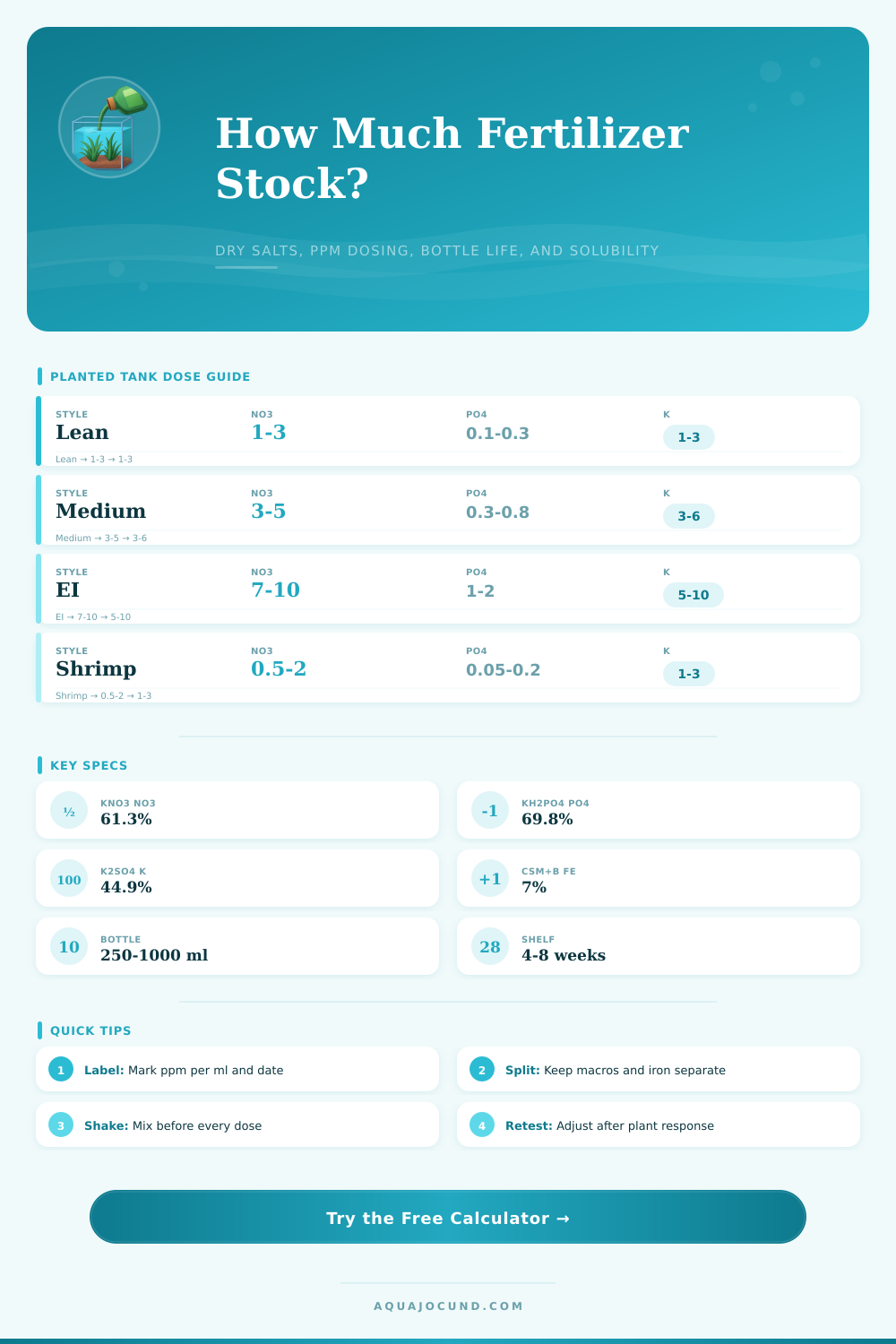
| Potassium nitrate | NO3 macro | NO3 61.3%, N 13.9%, K 38.7% | Very soluble, common EI nitrate stock |
| Monopotassium phosphate | PO4 macro | PO4 69.8%, P 22.8%, K 28.7% | Usually easy to dissolve at normal bottle strengths |
| Potassium sulfate | K macro | K 44.9%, SO4 55.1% | Lower solubility, check concentrated bottles |
| Magnesium sulfate heptahydrate | GH / Mg | Mg 9.86%, SO4 39.0% | Good solubility for magnesium booster stock |
| CSM+B trace mix | Trace | Fe about 7%, Mn about 2%, B about 1.18% | Use preservative or smaller batches for trace stock |
| Dosing style | NO3 per dose | PO4 per dose | Iron per dose |
|---|---|---|---|
| Lean low-tech | 1 to 3 ppm | 0.10 to 0.30 ppm | 0.02 to 0.05 ppm |
| Moderate planted | 3 to 5 ppm | 0.30 to 0.80 ppm | 0.05 to 0.10 ppm |
| EI or high-light CO2 | 7 to 10 ppm | 1.0 to 2.0 ppm | 0.10 to 0.20 ppm |
| Shrimp-safe lean | 0.5 to 2 ppm | 0.05 to 0.20 ppm | 0.01 to 0.05 ppm |
| Bottle | 10 ml doses | 20 ml doses | Best fit |
|---|---|---|---|
| 250 ml | 25 doses | 12.5 doses | Nano tanks, iron, trace, short shelf life |
| 500 ml | 50 doses | 25 doses | Most 10 to 55 gallon planted aquariums |
| 1000 ml | 100 doses | 50 doses | Large tanks, macro salts, multiple aquariums |
| 2000 ml | 200 doses | 100 doses | Fish rooms and planted pond maintenance |
| Setup | Stock priority | Watch closely | Practical adjustment |
|---|---|---|---|
| Caridina shrimp | Very lean nitrate and trace | NO3 buildup, copper sensitivity | Small bottles, low ppm, frequent retest |
| High-tech stem tank | Macro consistency | CO2 stability and PO4 demand | Dose larger macros after water change |
| Epiphyte low-tech | Potassium and mild micros | Algae from surplus nitrogen | Lean NO3 and longer observation windows |
| Outdoor planted pond | Potassium and nitrate correction | Rain dilution and algae blooms | Use larger stock, verify with water tests |
Beginners copy what they read on the internet. This mean that you pick out a recipe, get some scale to measure grams of salt, and mix them with water in a bottle hoping something will come out rite. Things go fine for a month. Then they stall. Or worse, they turn brown.
The problem isnt usually the salt. It’s the difference between liquid reality and dry chemistry. Understanding how to dose effectively require understanding volume displacement. That is; A 20 gallon tank doesn’t contain 20 gallons of water. Heaters, rocks, substrate, driftwood etc., all takes up space and displace lots of it. Because of this, most people makes a mistake here. They think that since their tank is rated at 20 gallons, it contains 20 gallons of water. Dosing based off total capacity always result in under dosing. You’ll see that your plants are looking lackluster and you’re wondering why.
How to Dose Correctly for Your Aquatic Plants
With the calculator, simply enter the true volume of your water and what percent of that is taken up by displacement items (substrate, rock, heater, wood, etc.) and let the calculator work out numbers for you. No more guesswork with coefficients.
Everything else flows from how you choose to dose. Low-tech tanks is lean and thrive on restraint. They use low nitrate levels to inhibit algae, but keep nitrate high enough for mosses. Estimative Index protocols dump bucketloads each day and assume that something won’t limit growth. They depend on regular water changes to remove the surplus. Depending on your choice, table references move between 1 and 10 ppm of nitrogen per dose. There’s no right answer, just one that fits your plant density and light intensity.
The silent killer of stock solutions are their solubility. For example, let’s say you’re trying to get to a specific ppm and figure it will require dissolving fifty grams of potassium sulfate in five hundred milliliters of water. The math works out, right? However, the physics dont. Compared to the nitrate salts, potassium sulfate isnt as soluble. Once dissolved in water, if you exceed the saturation concentration at room temperatures, the surplus salt falls out of solution (forms solids). Half the nutrient go into your tank as crystals floating around or sitting on the bottom of the bottle. The other half is dissolved in the clear solution you poured from the bottle into your tank. Always consult solubility limit prior to mixing large volumes.
Never mix your micro and macro stocks. Iron and phosphates immediately combine into solids that your plants cannot absorb. When you mix them in the same bottle, you’re throwing away all your money on fertilizer that won’t hit your leaves. Besides, it’s nice to be flexible with split dosing. You can increase your potassium dose when your plants is growing heavily while keeping your phosphate dose constant to avoid promoting algae growth. Having separate bottles allows you to adjust each variable individually.
Shelf space isnt as important as bottle life. Dry salts tend to stay good forever. Dissolved, however, they’re subject to bacteria and oxidation. Without preservatives or opaque containers, iron stocks deteriorate rapidy. Trace mixes can lose potency over weeks if not stored properley. Know how long your bottles last. That way you’ll only mix what you need before it goes bad. Mixing fresh batches every few weeks is preferable than using spent solution that’s lost its punch.
The only way to know if you’re doing it right, is by retesting your water parameters. Plant response is real; calculations are theoretical. Your targets indicate that nitrates should increase, but your test results dont show this. Perhaps there is a measurement error, a leak, or your plants is taking up more nitrates than supplied. Base your adjustments on data not assumptions.
The best dosing regimen is an evolving one that changes as conditions in your tank do. Mix a lean solution and start small. Overfertilizing is difficult to correct; it’s better to start with less fertilizer and then adjust after seeing how the plants respond for a couple of weeks. The last thing you want is a algae bloom, which costs you time and effort to remove. Better to be safe than sorry at first. After you know how your system reacts, you could of dialed it in exactly.
Perfection doesn’t matter, consistency does Plants are resilient creatures. They can handle a little change… but they love routine. Dose at the same time, every time, and change the water at the same time, every time. Over time, patterns develop and keeping track of them (i.e., keeping records) helps. When do you make an adjustment? You’ll know precisely when. Complicated chemical formulas turn into simple habits. Patience pays off in a tank full of growth and color that seems alive… Not forced. Keep it balanced and consistent. Follow the plants lead with your hand.