
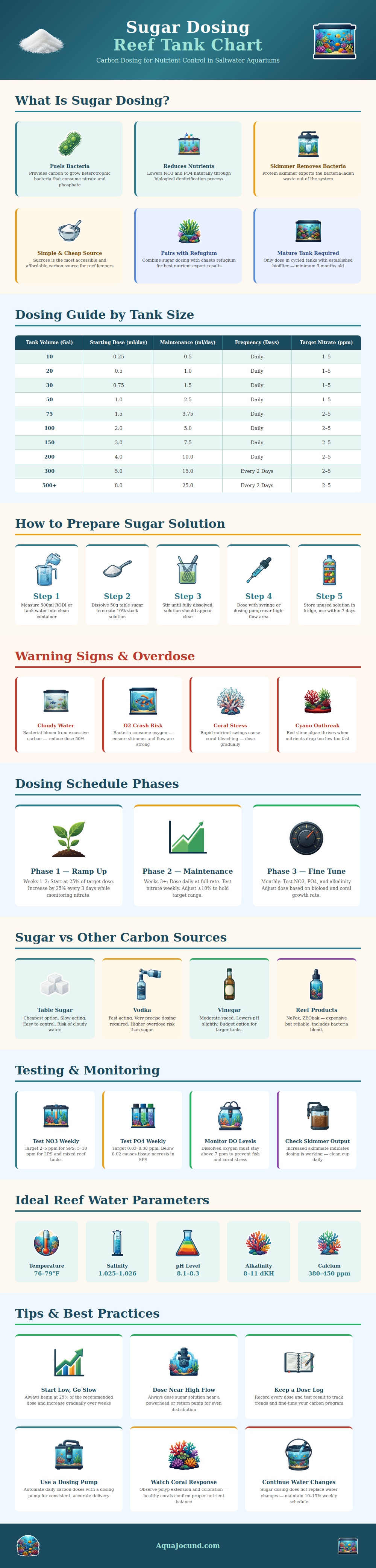
Your reef tank is humming along and everything’s great; except nitrate and phosphate is still high in the aquarium. You skim and perform water changes, but chemistry doesn’t stabilize. It’s frustrating because all of your work isn’t reducing nutrients in the water. Dosing with sugar to remove nutrients may seem strange for a marine aquarium, but it works well as nutrient export if you know how it works.
Add some fuel for bacteria instead of food for fish, and learn about this biological action in infographic. The basic premise is based off heterotrophic bacteria… The type of microbes that will eat your easy-to-digest sugars and removes phosphate and nitrate from water column while growing. A good protein skimmer remove all of those nutrient-rich bacteria before they die and return nutrients to the water. It becomes a process of eat/consume/export.
How to Use Sugar to Clean Your Reef Tank
The visual diagram illustrates how this can be effective using a refugium planted in macroalga that also serves as two-pronged weapon against excess nutrients. In order for it to operate effectively, you want a tank that’s been running long enough for its biofilter to be mature (minimum of 3 months); preferably longer. An immature biofilter isn’t up to the task for sudden taking on so many more bacteria.
Setting things up is easier different than most hobbyists imagine. All that’s necessary is prepare a 10% solution of sugar (table sugar) in reverse osmosis water and refrigerate solution for up to a week. See the chart below for a reference. Depending on size of your tank, you will start at a very low dose, a quarter or half a milliliter per day for a small 20g system, gradually increasing amount as required for bigger systems. Most importantly, don’t guess; go slow. On day one, you put in just a quarter of what you intend to add later. Let your established bacteria population adjusts.
Don’t crash your O2 levels! Where’s the catch? That’s right: monitoring. The first sign of an overdose is cloudy water, showing bacterial bloom. At this stage, you reduces the dose by 50% instantly. Also, since multiplying bacteria gobble up oxygen quickly, low dissolved oxygen become a concern. To combat it, you keep the powerheads and skimmer operating at full force to agitate the water and help gas exchange.
Regarding monitoring parameters, the guide recommends measuring nitrates at least once per week. Nitrate levels should be between one to five parts per million depending on the coral species. Small polyp stony corals prefers lower nutrient levels, while large polyp varieties can handle somewhat higher limits. Don’t let phosphate go below zero point zero two parts per million (dropping below this can trigger tissue necrosis in sensitive corals).
The cheapest carbon source for most people is table sugar, which acts slowly. Vinegar or vodka acts faster, but you must dose them carefully so you do not shock the system. Vinegar will also decrease pH with excess usage. Table sugar provides a good balance between cost and control. You must have a way to dose accurately around high flow zones so it spread evenly across the tank. This avoids localized hot spots that might damage nearby corals.
Monitor results over time by keeping a log of each dosage/dose result. This allows you to adjust the program as needed when you add more animal or your tank’s biological load changes. Dosing with carbon does not cancel out water changes. These continue for reasons such as trace element replacement and removal of dissolved organics that bacteria can’t consume. No matter which direction you go to export nutrients, you want to exchange about 10-15% of the tank volume each week.
Throughout this period, monitor your corals carefully. A good sign that the new balance is working are the presence of vivid colors and polyps. If your corals begin to bleach or retract, back off on the dose at once. Perfect should of been the enemy of good when it comes to reef keeping. Knowing how to dose sugar changes an inactive tank into one that becomes a living ecosystem with effective biological filtration.
The process takes time and regular testing, but ultimately it’s easy to see clean water and thriving livestock. Begin by doing a little, test what happens, and rely on the bacteria to do the rest of the job. A well-balanced tank will give your corals a good home.
