
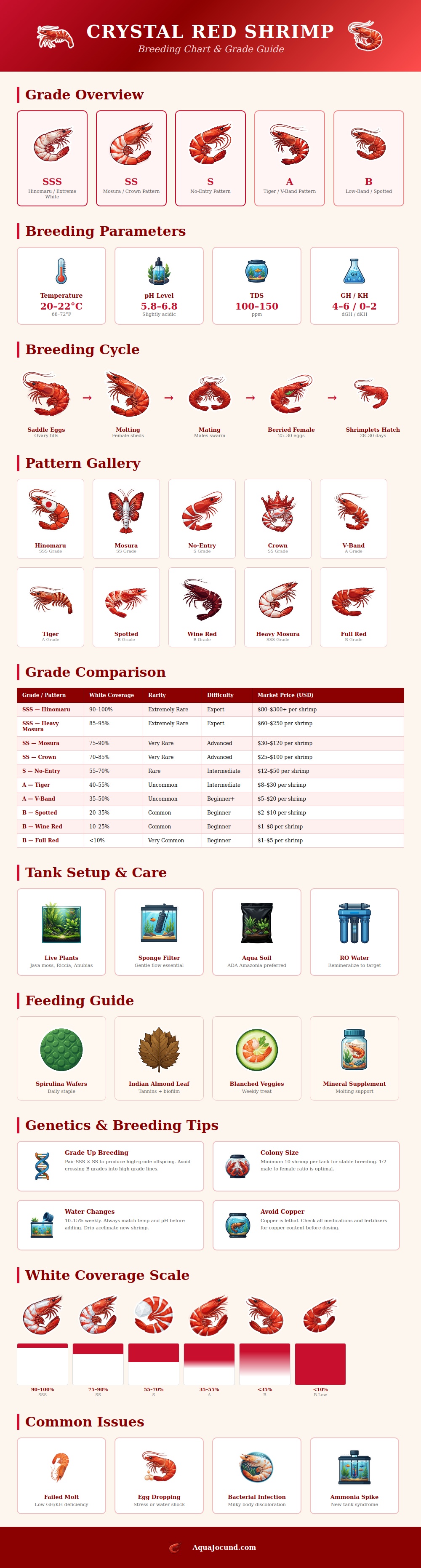
Visit any aquarium store, and there they are, all those lines of crystal red shrimp arranged according to cost: $2 here; $30 over there. Why? This is because more white is showing through that reddish shell. Seems random, right? Not so fast. It’s actualy a measure of genetic stability, which requires accuracy. That’s what the grade scale measures out. From top to bottom, it run from B-grade to the rarely seen SSS category. Sometimes, slight differences in banding patterns is what determine if your colony is a budget buy or part of a prized line.
The grades also will help you know what to expect. For instance, if you’re just starting out, most people begin with lower grades (A or B). The reason is that those are more forgiving shrimp. The lower grades feature less white and therefore they’re easier to breed. As you graduate to S, SS, etc., the shrimp gets increasingly defined in their red pattern and the white areas increases. That’s significant because higher-grade shrimp is less tolerant of fluctuations in your environment. They require tighter control. If you aspire for SSS Hinomarus, where they’re almost completely white… You can’t slap together a tank and expect it to happen. You’ll need to plan for stability.
How to Care for Crystal Red Shrimp
Water chemistry provides the basis for all of this. Crystal red shrimp evolved in soft acidic waters. To breed them successfully, you must mimic these conditions. If you keep your tank at temperatures of 68-72 degrees Fahrenheit, the metabolism stays within its comfort zone and there’s less risk of stress. A slightly acidic pH of approximately six supports good shell health. Hard tap water is most common error people make with keeping them. Higher alkalinity water makes it harder for shrimp to molt. Total dissolved solids and general hardness are also important ranges to focus on as shown in the chart. This emphasizes using reverse osmosis water remineralized to exact parameters. That’s what really sets apart casual keeping from serious breeding. Patience is required along with regular testing. But the reward is a robust colony of animals who reproduce predictably.
Once the conditions stabilize, breeding cycles go on schedule. Females develops a saddle on their underside to show they are ready for mating. Once paired successfully, they keep fertilized eggs for approximately four weeks. While waiting for the hatching day, it’s important to protect those eggs from strong water flow as well as aggressive tank mates. Powerful hang-on-back filters should be replaced by gentle sponge filters to make sure the tiny shrimplets is safe once they hatch.
Live plants not only give shrimps something to hide in but also serve as natural foods via biofilm development. Anubias and java moss are favorites because they grow densely without needing much light or fertilizers. This is helpful because fertilizers can contain copper, which is toxic to shrimp.
In addition to health, food also contributes significantly to color intensity. Staples include commercial wafers designed for shrimps. Variety helps prevent nutritional deficiency. Once per week, I provide blanched vegetables such as spinach or zucchini to give them necessary vitamins and fibers. Providing foods rich in minerals will help support molting, which is the most vulnerable stage in their life cycle.
One of the most rewarding experiences in the hobby is watching your shrimp molt successfully; it’s a clear sign that your animals are healthy and your system is balanced. More often than not, a failed molt is a direct result of a lack of calcium (or sometimes magnesium) in the water column. It’s not magic… It’s a science that makes sense and just requires time to make genetic improvement happen. The higher the grade of an individual, the more likely they are to pass on their specific color patterns to there young. A strong, color patterned SSS will generally outperform an SS. But a combination between an SS and an SSS will usually be better then the weaker SS. If you want a pure color/pattern then don’t throw any lesser grade shrimp into your breeding stock. Consistency matters. Treat your shrimp breeders no differently from how you treat the other water parameters. Selective pressure over generations improves what you want and reduces undesired variation.
Most common ailments aren’t caused by complex diseases, it’s because of neglecting fundamental care. Overfeeding & insufficient filtration lead to ammonia spikes that can decimate a colony rapidly. Cloudy body bacterial infections usually mean the water quality is poor rather than the animal being naturaly weak. Egg dropping is a symptom of stress. It does not kill the female permanently, though it will halt breeding for a while. If you know what to look for, you’ll spot these symptoms early enough to address them before things get worse. Most emergency scenarios are avoidable with routine care rules. Weekly small water changes help maintain low nitrates and top off necessary minerals. Drip acclimation for new shrimp means they slowly adjust to current conditions instead of being shocked by sudden changes in temperature or chemistry.
So at the end of the day, rearing crystal red shrimp isn’t about how much money you spend on equipment; it’s about attention to detail and being patient. It doesn’t have to be biggest tank. You don’t need the latest and greatest. What you need is consistency. Raising red shrimp is an evolutionary process; a refining process… That takes time to go from just any ol’ red shrimp to some real colorful high grade stuff. Every generation refines itself a little more in colors and patterns. Seeing your shrimp colony evolve and flourish gives you a sense of accomplishment that many other hobbies cannot offer. That gleaming red stripe across pristine white shell? That’s the fruits of your labor. Your hard work is evident with each healthy molt. It shows in each successful batch of shrimplets born healthy enough to keep the process going.
