
“What size do they get?” You grab one of those tiny little almost-transparent fries and ask yourself, “Is that all it’s going to be?” It’s difficult to imagine this delicate fish becoming a 10″ calico monster that needs a 100g tank or at least a decent sized garden pond.
Most newbie goldfish owners mistakes early stasis for permanent smallness. They can’t believe that a small fish might become anything else! But as the chart below shows, there’s a story here about a fish growing from nothing to big. Knowing where your fish are headed makes caring for them different, and helps determine what equipment you’ll need.
How Big Do Shubunkin Goldfish Get?
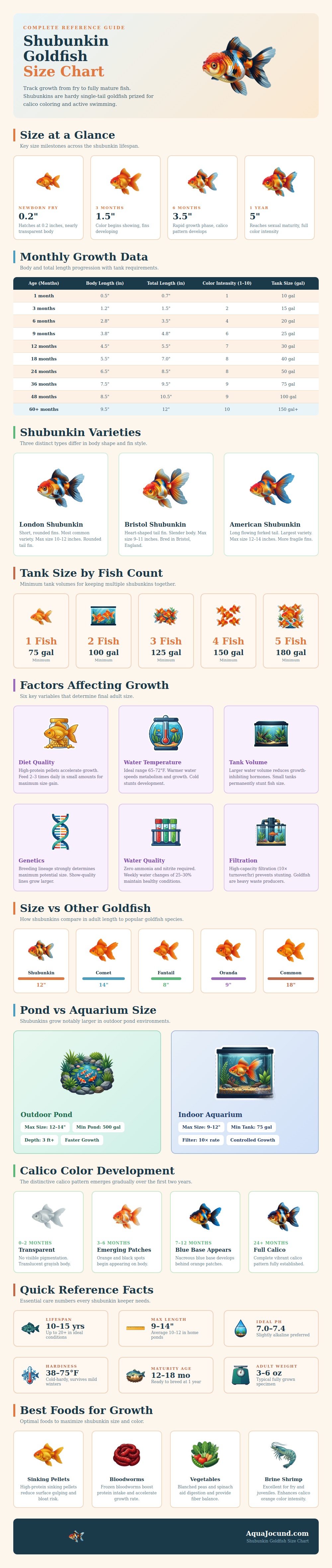
They’re quiet in the beginning. If you’ve got a new shubunkin, don’t expect fast growth (especially if you have some of those tropical fish that grow like weeds). They’ll take time to mature and even then, they may appear almost motionless, and certainly less so than others. But that is normal. Just be patient. Their colors realy start to come through around 6 months or so (see the graph) and by then, they’re really growing nicely, according to the graph. Until then, most of your wait is just for them to fill out, to catch up to their potential.
A lot of people buy them and then sell them (or get rid of them) prematurely, thinking something went wrong. All that does is cost you time and money. Let them grow on there schedule.
Potential size comes from water quality. Yes. This isn’t a suggestion. Goldfish generates large amounts of waste in relation to their body mass. That means bad filtration makes aquarium water quickly become toxic sludge. Get a filter capable of processing ten times the tank volume per hour with ease. Low levels of stress shuts down growth, which will stunt your fish forever. It does not kill them right away, but it steals their maximum size after years. If you want big fish, make sure they have plenty of room and dilute their toxins. Dilution means more volume and a lower toxin concentration, which makes the fish happy and helps them grow larger. The graphic details the required tank volumes for each group size.
To maximize size, diet is crucial. Floating flake can cause bloat and air gulping; therefore, sinking high protein pellets is better as they contain the building blocks of scales and muscles. To prompt growth spurts (which are especially important when young), offer frozen foods such as brine shrimp or bloodworms on occasion. Vegetables such as blanched peas will also aid in digestion and prevent other internal problems from stopping growth. This isn’t about feeding calories, it’s about supplying the materials for a structure overhaul. Two years of consistent nutrition is what separates a sturdy twelve-incher from a stunted eight-inch.
Size is one of them. Last time I wrote about how there are three major types of shubunkin: American, English or London, and Bristol. All have slightly different fin structures, such as the long-tailed American and the short-finned London. They also differs in body shape. Because of this, don’t be surprised to see some variation in size, even under the same conditions. Yes, genetics establishes a ceiling; however, environment dictates whether the fish hits it. So if yours isn’t as big as your neighbor’s American, don’t blame your care, theirs were born with a different blueprint.
The calico colors slowly reveal themselves just like they do as they physically grow. Color sets in as their bodies fill out. What started as pale or grayish in younglings will be solid shades of black, blue and orange by their second year. This color change is another time-lapse lesson in health. If colors are dull or begin to fade, immediately look at your diet and water parameters. A healthy fish have vivid colors, while a stressed fish will wash out. Use it like a tool to find problems; don’t ignore it.
To succeed with raising shubunkins you should of forgot that these guys are little bowl fish for life. In fact, under the right conditions, they can get pretty darn big. Plan your end game starting on day one. Feed strategically and invest in heavy duty filtration. Each step along the way will be worth it when you see the shimmer of a mature calico pattern in a spacious tank. All those little fry turns into something magnificent if you let them.
