
When most people get a betta fish, they do so based off its appearance. They look good in the bag. Those flowing fins and vibrant colors beckon to you. But what you don’t realize is that you’ve acquired an animal with specific physical need. Requirements are not universal and depend upon species’ shape. Long-finned showpieces move through water differently than short-tail fighters. And knowing this mean the difference between life and death. Treating all bettas alike irrespective of their tail type put you at risk for avoidable disease and stress.
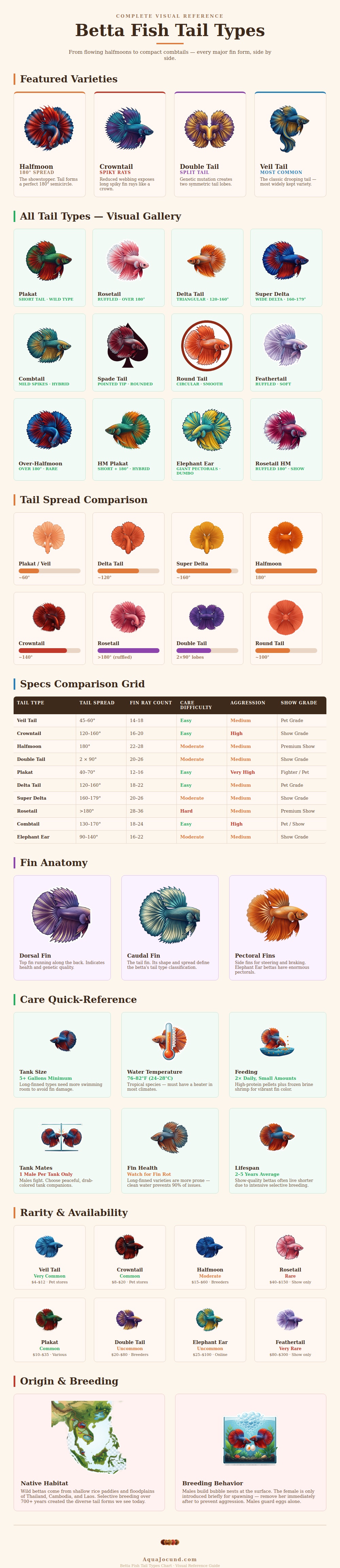
The graphic provided above visually shows these physical characteristics so you can understand how form follows function as your naked eye might not appreciate. The fin has surface area and spread. This is perhaps the simplest difference to point out. Consider the Halfmoon. When you display it, notice how its tail fans out into a nice half-moon shape. That provides a lot of surface area to drag through water. Compare that to a Veil Tail whose fins simply flop around behind it.
How to Care for Different Betta Fish Types
That affects its ability to navigate obstacle. You may be thinking it doesn’t matter unless it’s swimming. But consider each time it need to eat or just want to rest. The bigger the fins, the more resistance. Also, the bigger fins will be more prone to rips and tears as they bang into tank decoration with hard edges. It is a little thing but it is important for long term use.
And then you’ve got the textures such as the Rosetail and Crowntail. In these, the fins has less webbing between the fin rays. What does this do? It forms ruffles and spikes along the edges of the fins. And they are dramatic looking! But it also means those tissue aren’t as well protected from bacteria if your water quality falter. According to the chart, Rosetails is more difficult than regular Veil Tails to maintain. This is not by accident. Often the more complex the structure, the more complicated the maintenance. Don’t think you can get away with poor filtration if you keep a fish with delicate, exposed fin ray.
The size available does tell a story regarding breeding goals. Plakats has short (truncated) tails. These guys are the work horses of the hobby. They’re agile and strong. They don’t need lots of selective breeding to produce huge fins. They are usually less expensive since breeder isn’t working that hard to create those special genetics.
On the other hand, it’s common to order from a specialized breeder to get a high quality Elephant Ear or Halfmoon. Chances are you can’t go into a store and pick one up off the shelf. That is the result of all the work required to stabilize those genetic traits. You pay for beauty… and you pay for stability.
Physical needs require a change in care routines. Any betta requires a minimum of a five gallon tank. More swimming space benefit larger, finned varieties. That helps avoid fin damage and clamping. All sorts of bettas require temperature stability which is why you have a heater, to keep the water temperature steady at tropical levels of 76-82°F. Food stays the same as well. Offer high protein pellets in small quantities two times per day to promote bright colors. Feeding in small amounts prevents fouling the water. Nothing equals good water quality. Exotic Feathertails and simple Round Tails alike is prone to fast-fin decline in dirty water. Neglect is the first step toward fin rot. Toxins irritate sensitive tissues, and regular partial water changes eliminate them. Not rocket science. Just persistent effort.
Lastly, think about housing and temperament. Betta males are naturaly territorial. Male bettas should of never be housed together in small spaces. Some types is more aggressive than others. The rule does not change. Keep one male per tank. Carefully selected tank mates is possible. Peaceful species that do not nip at long fins are the key. A responsible keeper will select a suitable tank mate over a colored one.
From shallow rice paddies in Southeast Asia, Betta fish has come far. They’re among the most varied types of aquarium fish available today. That’s beautiful but it also requires awareness. To be a good betta owner, you can’t just own one. You must care for them in ways that match their physical needs. This means caring for different varieties differently based on the type of tail they have. A beautiful betta isn’t just what it appears in the bag. You could of helped a betta become its most beautifull self.
